An electron orbits around the nucleus (or, more sophiscatedly
has a wave function which contains the information about the electron
cloud). The electron has an angular momentum called orbital
angular momentum, the information about which is also contained in its
wave function. Like the earth, the electron has an additional intrinsic
angular momentum which we call spin angular momuntum. It is as
if the electron were spinning on its own axis (although that classical
idea has problems if taken too literally). The spin angular momentum
has nothing to do with the orbital angular momentum (or the electron
cloud).
Your statements regarding wavelengths of particles are
incorrect. A bowling ball going 100 mi/hr has a much shorter wavelength
than an electron going the same speed. Wavelength is not determined by
size of the particle.
I have no idea what you are trying to say about infinite
gravity etc., but it probably doesn't matter because it seems to be
based on your ideas of wavelength.
 QUESTION:
As a non-scientist doing
primary science teaching - I have a problem and I can't work out the
answer. Doing stuff using a toy car on a ramp, it seems that the
heavier the vehicle, the faster it is going at the bottom and
consequently the farther it goes at the end of the ramp. My gut
reaction is that the heavier vehicles have better axle construction, so
less friction - and it is this not their mass that causes the
difference. I have done maths and know about KE and PE and I cannot see
how the extra mass would in fact increase the velocity, although the
momentum would be greater - am I correct or am I missing something?
ANSWER:
Well, this is very
interesting. A recent question was very
similar except that experiment had just the opposite result, the
lighter car went faster! I can only reiterate that, in simplest
physics, with no friction all cars will reach the bottom at the same
time. This is also the result if there is friction but the friction is
proportional to the weight (as in the usual f=µN for
sliding friction where N is usually proportional to W).
So, your gut reaction is right—the result of the experiment must
indicate that the friction of the winner is smaller (relative to the
weight).
QUESTION:
A ball rebounds one-half the
height from which it was dropped. The ball is dropping from a height of
160 feet and keeps on bouncing. What is the total vertical distance the
ball will travel from the moment it is dropped to the moment it hits
the floor for the fifth time?
ANSWER:
This is really not physics,
it is math. Until it hits the first time it goes 160 ft; until the
second time, 2x(1/2)x160 ft; until the third time 2x(1/4)x160 ft; etc.
So the total distance would be
160+2x(1/2)x160+2x(1/4)x160+2x(1/8)x160+2x(1/16)x160=160x[1+2x(1/2+1/4+1/8+1/16)]=460
ft.
QUESTION:
I'm wondering about the
distances between subatomic particals and that relationship to their
size. If the subatomic particals of all atoms on the Earth, for
example, were to collapse to the point of actually touching each other,
what would be its diameter?
ANSWER:
First of all, subatomic
particles do not have well-defined sizes (they are sort of smeared out
over space) so "touching" each other does not really have a definite
meaning. However, if we suppose the protons and neutrons in a nucleus
are just touching, we can compress the whole earth so that its density
becomes that of nuclear matter (the mass of a typical nucleus divided
by its volume) and see how big it is. The density of nuclear
matter is about 1018 kg/m3 and the mass of
the earth is about 6x1024 kg. So the volume of the earth
compressed to nuclear matter density would be about 6x10⁶ m3.
This would correspond to a radius of about 113 m, pretty small!
Incidentally, this is what happens to a star when a neutron star forms
in stellar evolution.
QUESTION:
me and my friend have been
arguing about this for a week and he refuses to accept defeat unless i
get a "credible" source. So here goes: We were talking about mars has
approximately a third of the gravity that earth does, and he said that
is because the ATMOSPHERE is thinner there and it wouldnt be a third if
mars had an atmosphere similar to Earths. This turned into a debate
with him claiming that the atmosphere has everything to do with gravity
and your weight, how do I explain in a way that makes sense that
gravity is entirely about the mass of a planet and not atmosphere? He
says that even if i were right, if the earth all of a sudden had no
atmosphere whatsoever we would all weigh less because there would be
less total mass around our planet. Please help!
ANSWER:
You are correct that the
mass of the atmosphere is negligibly small compared to the mass of the
earth, however that is not the reason why gravity at the earth's
surface is independent of what the total mass of the atmosphere is. If
the atmosphere were as dense as lead and 5,000,000 miles thick the
gravitational force of something on the surface of the earth would be
the same as if there were no atmosphere at all. The reason is that for
a spherically symmetric mass distribution*, the
gravitational force is determined only by how mass there is inside of
where you are. One way to convince yourself that this is true is that
if you are at the center of the earth you would experience no weight
because there is just as much mass no matter which direction you look.
Here is one technicality: because the atmosphere is not dense we
normally ignore the buoyant force (although you certainly can't for a
blimp, for example). However, there is a tiny buoyant force which makes
our weight appear to be less (your weight is still the same,
there is just a different force up); hence, your friend is wrong on two
counts since if the atmosphere were less dense as it is on Mars, there
would be a smaller buoyant force so objects would appear to weigh more.
*This means that the density depends only on
how far you are from the center, not on where you are angle-wise; so
everything looks the same at the north pole as at the south pole, for
example.
QUESTION:
I would like to know what
impact did Millikan's oil drop experiment have on science during and
before 1920?
Why is the electron charge so important? What is used for?
ANSWER:
This is a strange question!
I believe that understanding the world around us in as much detail as
we can is required by the human spirit. If you did not know the
electron charge you could have no atomic physics. Experiments like that
done by J. J. Thompson were able to measure the ratio of the charge to
the mass, but to get either you had to measure one independently which
is what Millikan's experient did. So you could say that knowing the
charge gives you the mass and knowing the mass of something is
important in physics. The electron charge is used, like many other
fundamental constants, for understanding the universe; what could be
more important than that?
QUESTION:
Where does the word "moment"
in "moment arm" come from? How do the two terms relate to one another
in analyzing torque?
ANSWER:
An alternative word for
torque is moment, so moment arm is the distance from the axis around
which torques (moments) are calculated. The torque is generally written
as the moment arm times the component of the force perpendicular to the
moment arm. A completely equivalent writing of torque is force times
the component of the moment arm perpendicular to the force; I call the
component of the moment arm perpendicular to the force the effective
moment arm.
QUESTION:
I am an 8th grade teacher
trying to teach Physics. When I make up word problems for force, am I
always using acceleration due to gravity.
For example: I can say a 15 kg object is being accelerated 9.8m/s2,
what is its force?
But can I say a 20 kg object is moved 2m/s2 what is its
force?
Are not all force problems using gravity as acceleration?
ANSWER:
The basic law is Newton's
second law, F=ma which relates the net force F
experienced by a particle of mass m which has an acceleration a.
When a 15 kg object is freely falling the only force on it is its own
weight (assuming no air resistance), so if we measure its acceleration
to be 9.8 m/s2 the weight must be 15x9.8 kg m/s2=147
N (newtons)=33 lb. For the object of mass 20 kg which is measured to
have an acceleration of 2 m/s2, the net force on it must be
40 N which is about 9 lb; since its weight is 20x9.8=196 N, there must
be other forces on this object. An object may certainly have an
acceleration different from 9.8 m/s2. For example, a box
sliding across the floor might have an acceleration of magnitude 2 m/s2,
that is as each second ticks by the speed gets smaller by 2 m/s so if
it starts with a speed of 10 m/s it takes 5 s to stop. (We usually say
that the accerleration is, in such a case, negative, but the important
thing for 8th graders to understand, I think, is that acceleration
tells you how the speed changes, so you should think of an acceleration
of 9.8 m/s2 as 9.8 (m/s)/s so that if you drop something it
has a speed of 9.8 m/s one second later, 19.6 m/s two seconds laterr, etc.)
If you are in the US, it would probably be helpful for your students to
know that 1 N=0.225 lb since they probably think in terms of pounds; so
a newton is about a quarter of a pound.
QUESTION:
I'm interested in
understanding the interactions between subatomic particles. So I would
like to ask two questions. 1. Is there any thinking or explanation of
how the charges between the electron and proton are so evenly balanced,
despite the large difference in their respective masses? It seems like
there would logically be some underlying similarities that I don't see
discussed very much. 2. If these parcicles are really "smeared" like a
probability function, how can they exist for so long?
ANSWER:
Why would the relative
masses have any correlation with the relative electric charges? If
electrons and protons were not of identical charge, the universe would
be a very different place since atoms would not be electrically
neutral. Since the electric force is very strong, the lack of
neutrality of matter would cause there to be no objects as we know them
(the repulsive electric force would tend to keep objects from
coalescing. And, what does a particle being smeared have to do with its
existence?
QUESTION:
If two cars approach each
other from opposite directions, each traveling at a speed of 50 km/h,
each car one would perceive the other as approaching at a combined
speed of 50 + 50 = 100 km/h to a very high degree of accuracy.
But two spaceships approaching each other, each traveling at 90% the
speed of light relative to an outside observer, do not perceive each
other as approaching at 90% + 90% = 180% the speed of light; instead
they each perceive the other as approaching at slightly less than 99.5%
the speed of light. Why does this happen?
ANSWER:
Of course I cannot give you
a complete explanation since that would require that I do a complete
exposition of the theory of special relativity. Relativity is the
reason. Relativity is based on the postulate that all observers,
regardless or their motion or the motion of a source of light, will
measure exactly the same speed for light in a vacuum. So, if you
measure the speed of some particular beam of light to be c,
somebody moving with the speed of 95% the speed of light relative to
you will measure the speed of the beam to be c also. One of the
consequences of this postulate is that no object can move faster than
the speed of light relative to any other object. Hence, having two
objects have a relative speed of 180% violates this rule. The speed of
light is a universal speed limit. If you are truly interested, you
should learn the theory of special relativity; it requires only algebra
to understand it.
QUESTION:
I have a major question in
my mind and I have not found any website that helps me and so please
help me to answer my question: How is time affected by the amount of
mass? For example: if we put a cart on a slope which is 10.3 g, the
result will be 3 seconds... In addition, if we change the mass into 15
g, there will be an increase of time which will be 7 seconds...
( I have conducted an experiment exactly like the example above, and I
see that the more mass we put on the cart, the longer time we will get)
ANSWER:
Simple physics would say
that there should be no difference if there were no friction. Also, if
there were friction and it was proportional to the weight, the times
would be the same. However, if the friction were not proportional to
the weight, for example the lighter car had a frictional force 1/10 the
weight and the heavier car had a frictional force 2/10 the weight of
the car, the heavier car would have a smaller acceleration as you have
found. See earlier answer on this subject.
QUESTION:
My 8 year old son would like
to know if an object is moving faster than the speed of light, will it
cast a shadow.
ANSWER:
The groundrules of this site
clearly state that I no longer answer questions about going faster than
the speed of light. However, I want to encourage inquiring young minds,
so I will make an exception. No object may go faster than the speed of
light or even as fast as light. The reason is that the theory of
special relativity, which is extraordinarily well-verified
experimentally, shows that the energy required to accelerate an object
to the speed of light is infinite and, of course, there is not an
inifinte amount of energy in the universe.
QUESTION:
if you have a car in the air
and you fill the tires to 35 psi, when you put the car on the ground
the psi stays at 35 with the weight of the vehicle on the tires. why?
ANSWER:
I have previously answered
this question.
QUESTION:
How far would a golf ball
travel on the moon if hit at a 45 degree angle at 200 km/hour?
ANSWER:
I first checked and found
that the speed you indicate is far less than the escape velocity on the
moon. I then assume that the height attained and the distance traveled
will be small compared to the size of the moon so that I can assume
that the moon is flat, just as we do when we do such calculations on
earth. The acceleration due to gravity on the moon is about 1.6 m/s
(compared to 9.8 on the earth). Then I find (I presume you just want an
answer, not all the details) the ball will be in the air for about 49
s, travel a distance of about 1930 m, and achieve a height of about 483
m. Since these are very small compared to the radius of the moon, my
assumptions are fine.
QUESTION:
Does noise require energy to
happen?
ANSWER:
I presume you mean sound
noise. Sound is a wave and sound waves carry energy. Therefore, the
source of the noise must supply energy.
QUESTION:
Somewhat technical question,
so I don't know if it breaks the ground rules. I work in MRI and have
had some QM courses a long, long time ago. But this continues to puzzle
me. I don't mind at all looking it up in the QM books if only I knew
what to look under. Could you provide a reference or the correct
"topic" I could read up on? A charged spin-1/2 particle has a
gyromagnetic ratio.
For example, a proton has a QM spin-magnetic moment. When it is placed
in a constant and uniform magnetic field its magentic moment will be at
an angle (about 54.7 degrees) to the direction of the applied uniform
magentic field and it will precess around the direction of this
applied, external field.
The proton will radiate as it precesses in the magnetic field. This can
be detected by pickup coils. For example, this is how an MRI system
works. (But I am interested in a single particle case, not in an
ensemble of particles.)
Question: Where does the energy come from to drive the precession and
the associated radiating process as the particle precesses?
If from the magnetic field, then wouldn't this "drain", say, a
permanent magnet (system of magnets) generateing the magnetic field?
That doesn't seem right (but maybe).... Being in a uniform magentic
field, the gradient of B would be zero. So I guess there wouldn't be
any net translational force on the particle. I think this is because
there would not be any difference in energy between being at p1=(x, y,
z) and being at p2=(x+dx, y+dy, z+dz) so no net force to translate the
particle from p1 to p2. So does the particle just sit there radiating
as it precesses? That doesn't seem right. If it radiates it should be
loosing energy and going into a lower energy state. But there doesn't
seem to be a lower energy state to go into? Or, for every "bit" of
energy radiated it must be getting that amount of energy from someplace
else, but where/how? That is what is confussing to me.
If the magnetic field were not uniform I could see that the particle
would translate into a lower energy state and would convert some of the
potential energy into kinetic energy and radiation energy. But in a
constant uniform magnetic field?
ANSWER: {this
answer is not complete yet, I have to go to a concert!}
Your question is closer to
breaking groundrules for not being concise and well-focused than being
too technical. However, I will answer it because it is interesting. If
you work with MRI, I am afraid I must tell you that you do not really
understand what is going on. If a classical magnetic moment is placed
in a uniform magnetic field it will align with the field. That is what
it wants to do. If it is a quantum mechanical particle (that is it has
a spin angular momentum) it cannot align with the field because the
component of the total angular momentum (which is J=ħ√[3/4])
along the field direction may be only ±½ħ. That
is where your angle comes from, cos(54.7)=½/√[3/4]. It is not
really correct to say that the proton precesses; it is more correct to
say that it is equally probable to be at any azimuthal angle and so
many texts describe this situation as precession. Go ahead and think of
it as precession, but it certainly does not radiate energy. Note that
the moment is "up", that is 54.70 relative to the field
direction. Its other state, 54.70 relative to the opposite
direction ("down") is at a higher energy because it takes work to take
the "up" aligned moment and turn it to a "down" moment. Let us say that
it takes an energy E (which depends on the field strength) to
flip the moment from up to down. In an MRI what happens now is that we
shine in some electromagnetic radiation. If the radiation is of just
the right frequency, that is f=E/h, there will be a high
likelihood that the radiation will be absorbed resonantly (hence the
"R" in MRI, magnetic resonance imaging). This absorption is what is
detected in MRI. This is a very simplified overview, but it gives the
basic physics principles. The details of how the whole imaging process
is very much more complicated because of the problem of locating where
the absorption is taking place.
QUESTION:
I was wondering if it is
possible you could explain to me the basic facts of how zero point
energy works. If you could explain in most basic form please as I am
not very physics or maths orientated. I have heard it could be used as
a prepulsion method. However I cannot find anywhere an explanation i
can really understand.
ANSWER:
The only meaning zero-point
energy has to me is the lowest possible total energy of a quantum
mechanical system. Take, for example, a mass hanging on a spring;
classically the lowest total energy of this system is zero
corresponding to when the system is at rest. However, a simple harmonic
oscillator (which is what a mass on a spring is called) is a classic
problem in quantum mechanics because it is a system which can be solved
analytically. It turns out that it is impossible for the mass to be
exactly at rest, it must have some very small motion and the energy of
the system in its lowest energy state is called the zero-point energy.
The reason you are not aware of it in everyday life is that the motion
is so incredibly small for a macroscopic size mass on a spring that you
could never hope to observe it. On a microscopic scale, however, it is
observable. For example a diatomic molecule may be modeled as two
masses connected by a tiny spring and the lowest state is not with the
molecule at rest. Obviously, this is nothing which you could use for
propulsion.
QUESTION:
if an object is falling at a
fixed rate of 500 feet per minute, what g-force will that object
experience upon impact on the earth's surface. If possible include the
formula so other rates could be used, since I would also like to
calculate the g-force for the forward motion at different velocities.
FYI: this is an attempt at calculating the best combination of
conditions for an off-airport landing in un-inviting terrain by an
aircraft experiencing complete power loss.
QUESTION:
I fell down the stairs two
years ago and am still wondering what effect the impact might have had
on my brain. I fell head-first from the top to the bottom, and hit the
wall where it meets the small landing at the bottom - with my head. My
body kind of crumpled to my left. I fell 11 steps of normal height,
with my body turning head first, without touching the wall or railing.
The landing at the bottom is about 3 feet from the stairs to a plaster
wall. The impact was at the top of my head. Please let me know the
fall's velocity and force of impact of my head - and if you can, how my
brain would have moved inside my skull after the impact.
ANSWER:
Both of these questions are
unanswerable because the force is proportional to the acceleration,
that is the time rate of change of velocity. So knowing the velocity
when an object hits and the fact that it is at rest afterward gives you
the change in velocity but you cannot compute the rate of change of
velocity without a time. So, if an object changes its speed by 500
ft/min =2.54 m/s, its mass is 100 kg, and it stops in 0.5 s, the
average acceleration is 2.54/0.5=5.08 m/s2 and the average
force experienced is ma=100x5.08=508 N=114 lb. Since the weight
of 100 kg is about 220 lb, the force of the ground must be 114+220=334
lb. So the force you would feel is larger than your weight by
334/220=1.5, so you would feel a 1.5 g-force. This is an example, but
if either of these questioners really wants an answer, more data are
needed.
QUESTION:
While working out I was
lifting dumbbells and had the following question...what percent of the
work is gravity doing when I curl a 20kg dumbbell?
For a specific example, here are some numbers that may help…say I have
a 20kg dumbbell and I’m doing curls with one hand. It takes me 5
seconds to raise the dumbbell and 5 seconds to lower it. My arm is
about 35 cm from the elbow to the hand and my elbow remains stationary
during the curl. When I lower the dumbbell it is much easier, so
gravity must be doing some of the work, right?
So what percentage of the work is gravity doing while LOWERING the
dumbbell in relation to the amount of work it takes me to RAISE the
dumbbell? For example, if it takes me 10 Joules of work to curl the
dumbbell and it takes me 5 Joules lower the dumbbell, then is gravity
doing 50% of the work when I lower the dumbbell?
ANSWER:
Assume that the dumbbell is
at rest at the bottom, then the top, then the bottom. The work that
gravity does on the way up is 20x9.8x(-0.35)=-68.6 J; work is negative
because the weight (20x9.8 N) is a force down and the vertical distance
(0.35 m) is up. The total work done is zero and so the work you do must
be 68.6 J. On the way down it is just the opposite, you doing negative
work and the weight doing positive work. The total work that you do is
zero as is the work done by gravity. Does this mean you have gotten
nothing from the exercise? Of course not. It is just that asking what
the work done on the dumbbell is is the wrong question. You should ask
a more biological question like how much energy is required by your
body to do this exercise. If you lift it very quickly you will still do
the same amount of work on the dumbbell, but it will require less
energy expenditure from your body than lifting it slowly.
QUESTION:
What would happen to an
object if it suddenly became immune to gravit (silly thoiught that idea
is)?
Oddly it would depend what time of day it is. Assuming it's midnight
when this immunitry strikes (ie it is on the outside of the earth's
orbit) it would continue on a tangent to the orbit of the earth while
the earth continues around the sun. I have worked out that the Earth
veers away from that tangential line by over 4,000 km an hour. Is this
right? If so the gravity iummune object would leave the earth's surface
with a huge acceleration. (If it was midday when immunitry struck the
object would suddenly appear to weigh a vast amount more). I realise
that gravity is simple the result of objects following curved space, is
not really a 'force' and so cannot have a anti-force (other than
curving space the other way?!) and that all anti-gravuty devices are
simply using magnetic or electrostatic forces. But this question has
bugged me since reading a book calles The Seach for Zero Point.
ANSWER:
Here is the problem with
trying to answer your question: for an object to be "immune" to
gravity, it would have to have zero gravitational mass. But for
it to behave as you expect, moving in a straight line with the constant
speed it had at the instant of its immunity, it must obey Newton's
first law which applies only to objects which have inertial mass.
However, inertial and gravitational mass are the same thing (a
long-held experimental fact and a cornerstone of general relativity
theory). So, I am afraid that your question would fall into the same
category as questions like "suppose we could go faster than the speed
of light"; it is "suppose an object had inertial but not gravitational
mass", an unphysical situation.
QUESTION:
Is there a way of
determining how temperature affects diffusion. For example, say I have
a jar filled with a foul odor and want to lower the temperature to the
point that none of the odor diffuses through the molecular pores in the
jar. Is there an equation or method for determining what the required
temperature would need to be?
ANSWER:
This is a quite technical
question. In order to calculate diffusion rate you must know the
diffusion constant. The temperature dependence of the diffusion
constant is
given in Wikepedia and is an exponential function. You can then put
this result into the diffusion
equation and solve. As you can see, this is a complicated problem.
QUESTION:
I understand Bohr's idea
about quantum amounts of energy and that a photon is emitted (or
absorbed) when a electron changes energy states. And I have read
several times that this idea explained the spectral lines of a hydorgen
atom. But what I have not been able to find (and has caused me to
bother you with this question) is how this expains the exact wavelength
produced. Related, can you direct me to something that explains how the
speed and/or frequency of an electron that is emitting electromagnetic
wave relates to the wavelength of the light produced. Math equation on
this last one is fine... I am sure the info is "out there" and/or in
one of my texts, but I can't find it.
Hints or help would be appreciated.
ANSWER:
The key is to understand the
relationship between the energy (E) of a photon and its
frequency (f). The photon is the quantum of light emitted when a
transition occurs. This is the famous relationship Einstein discovered
in his theory of the photo electric effect, E=hf where h
is Planck's constant, h=6.62×10⁻³⁴ m2kg/s.
Hence, if an atom makes a transition from a state with energy E1
to a state with energy E2, the frequency
of the emitted radiation is f=(E1-E2)/h.
Then the wavelength (l) is just l=c/f where c is the speed of
light.
There is no well-defined energy
of the electron while it is emitting the photon, so your second
question has no answer. Anyhow, it is probably not a good idea to take
the idea of an electron crusing around in a well-defined orbit
too seriously.
QUESTION:
In the Movie "The Core" They
travel to the center of the Earth. Now if you were down there wouldnt
gravity not effect you as much, or what because almost half of the
earth is above you?
ANSWER:
The gravitational force is
only caused by mass not outside you. Therefore if you go down to half
the radius of the earth your weight will only be ⅛ of what it is at the
surface. If you get to the center your weight will be zero. You might
be interested in an answer to an earlier question.
QUESTION:
If you started with a
lightbulb. Surrounded the lightbulb with a perfect glass sphere, which
was coated on the inside, with a first-surface reflective mirror.
Removed the air from inside creating a vacuum within... and turned the
light on, then off...
In theory, would the light inside the sphere bounce around within the
sphere indefinitely?
ANSWER:
I have previously answered this
question.
PS there is no such thing as a perfect vacuum either.
QUESTION:
Okay, let's say that the
wind is blowing at a constant velocity of 30 km/hr from the south. If a
person were travelling at the same constant velocity, would that person
feel wind? Since the air around the person is moving exactly as fast as
the person is, would it be safe to say it would be the equivalent of
someone standing still when there is no wind outside?
ANSWER:
You are correct, you would
be at rest relative to the air and therefore would feel no wind. An
example of this is a hot air balloon or a helium filled balloon. One of
the problems with using such vehicles to move around is that they can't
be steered, they are totally at the mercy of the winds and go where
they are blown. An airplane can only steer because of the air moving
past its surfaces.
QUESTION:
If there were a civilization
on a planet orbiting Alpha Centauri 4.37 light years away, how big
would the diameter of their radio telescope have to be to clearly
receive a TV signal from Earth? I asked the people at SETI the same
question once and never got an answer.
ANSWER:
OK, I will take a stab at
this. But, I am not an engineer and do not really know for sure how
much information one must receive to be able to put together a tv
picture. I will assume that, since the wave nature of the radio waves
carries the information, we will need at least one million photons per
cycle of the wave. My thinking is more in line with AM radio waves
where there is one constant frequency of carrier waves and the
information is carried by the amplitude of the wave; I realize that
this is not really what tv is but it should give an order of magnitude
estimate. The typical power of a tv station is about 100 kW=105
J/s. The energy of a single photon is hf=6.6x10-34x108=6.6x10⁻²⁶
J/photon so for our power source we have N=105/6.6x10-26=1.5x1030
photons per second. The frequency of a tv station is about 100 MHz= 108
s-1. To get 106 photons per cycle we therefore
need 106x108=1014 photons per second.
4.7 ly=4.4x10¹⁶ m so the intensity (in photons/second/square
meter) at Alpha Centauri will be about 1.5x1030/[4p(4.4x1016)2]=6x10-5
photons/s/m2. We therefore need an area of 1014/6x10-5=1.7x1018
m2. That is about an 800,000 mile square. This hinges mainly
on my assumption of needing 106 photons per cycle of the
wave which might be wrong by several orders of magnitude.
QUESTION:
Can beef melt? This will
help me settle a long-standing debate with a coworker.
ANSWER:
There is no definitive
answer to this question because beef is not a homogenous substance like
iron or water or salt or oxygen or whatever. It is a mélange of
many different things. It has lots of water in it and we wouldn't argue
that water can melt; thaw a frozen steak and the ice in the steak melts
and becomes water. It has fat and we wouldn't argue that fat melts; put
it on a fire and watch the melted fat drip onto the coals. But it also
has lots of organic molecules which, when heated, change their
molecular identity, that is heat causes a chemical change rather than a
phase change (which is what melting or evaporating are). When you cook
something, that is what you do—cause the food to undergo a change into
something different from the uncooked food. So regardless of which side
of this argument you are on, you both win and lose!
QUESTION:
an arrow is shot up from the
ground at 30 m/s one second later, another arrow is shot up from the
ground at 40m/s what is their displacement from the ground when they
collide? (This was the most difficult question on a test that i had 2
days ago. The top 5 students of the class all got different answers. My
answer was around 170, i don't remember exactly, i just want to know
the answer.)
ANSWER:
I only need the kinematic
equations y=y0+v0t-½gt2
and v=v0-gt and I use g≈10 m/s2
for calculational ease. First, find out where the first arrow is and
how fast it is going after 1 s. y(1)=30x1-5x12=25 m
and v(1)=30-10x1=20 m/s; the purpose of this step is to find
the initial conditions for arrow #1 to use in the next step of the
problem. Now write the y equations, choosing t=0 when
the second arrow is shot, for each arrow. y2=40t-5t2
and y1=25+20t-5t2 (we don't
need the v equations since we are not asked for any speeds).
Now set y1=y2 and solve for t
and find t=1.25 s. Put this t into either y
equation and find y=42.2 m. You could go on and write the v
equations to find out the velocity of each when they collide. v1(1.25)=20-10x1.25=7.5
m/s and v2=40-10x1.25=27.5 m/s.
QUESTION:
Take a look at this website:
http://web.jjay.cuny.edu/~acarpi/NSC/3-atoms.htm
It's from CUNY so they
are not exactly cranks. Note in the 3d paragraph they say centrifugal
force keeps the electron from coming into contact with the nucleus. Is
the CUNY website wrong?
ANSWER:
This is atrociously poorly
written! Believe me, centrifugal force is not a real force. In even the
most elementary physics course we learn that a force perpendicular to
the velocity (as in an orbiting particle) causes the direction, not the
speed, to change. Hence there is no reason to ask the ridiculous
question of what "keeps the two particles from coming into contact with
each other" since the orbiting particle just orbits. Let me try to
clarify what centrifugal force is. As I have alluded to above, we
easily calculate a circular orbit for a particular force and velocity
using Newton's second law, F=ma, where F is the
electrostatic attraction to the nucleus, m is the electron
mass, and a is the acceleration where a=v2/r
for circular motion and r is the orbit radius. Now, suppose
that you are standing on the electron; how do you describe the
situation? Well, Newton's laws are not true in an accelerating system
which is the case here. And it is really obvious that they are not
valid because there is only one force and yet, if you are in the
electron's frame of reference, no acceleration. But suppose that you
insist on using Newton's laws to describe your motion; the only way you
can do that is to invent fictious forces to make things work out. In
the case we are discussing the electron is not accelerating and there
is one real force pointing toward the nucleus of some magnitude F
(this is referred to as the centripetal force, center
seeking if you know your Latin); but the sum of all forces must be
zero and so you must postulate the existence of a force which has
magnitude F and points away from the nucleus (centrifugal
force, center fleeing if you know your Latin). That is not
really there but it is often very much to our advantage to force
Newton's laws to be true in accelerating (so called noninertial frames
of reference) for computational reasons. Let me give you a couple of
other examples of fictious forces.
- Suppose you slam your foot on
the accelerator of your car. You feel a force pushing you back in your
seat, right? There is no such force; the only force on you is the seat
back pushing you forward and since you would like to use Newton's first
law your brain perceives there to be a force pushing you back.
- What force makes weather
patterns circulate? Because we are on a rotating earth there is a
fictious force called the coriolis force. Long-range artillery gunners
have to correct for this "force".
I can't imagine what course the
CUNY page was supposed to serve, but probably a physics for artists
kind of course where the students were assumed to be incapable of
understanding Newton's laws or what acceleration is. My own feeling is
that anybody can understand these if motivated.
QUESTION:
What is the correct equation
for momentum in Newtonian physics? I thought it was mass X
acceleration. (And I've never understood why it would be mass X
acceleration.) It seems to me it should be mass X velocity. When I
looked up momentum on Wikipedia, it gave the equation: mass X velocity.
(Which makes sense to me.) But I could swear when I was in college the
equation for momentum was mass X acceleration. On the other hand, I
didn't do so well in college physics, so maybe I'm remembering it wrong.
ANSWER:
You are right, it is
p=mv. The reason that ma sticks in your head is that
Newton's second law may be written F=ma.
There is another connection: since a is the time rate of change
of v, dv/dt (do you know calculus?), Newton's
second law may be written F=dp/dt, that is,
force is the time rate of change of momentum. This is how Newton
originally expressed it and is the way you must express it in special
relativity, that is F=ma is not true in special relativity. In
special relativity, though, momentum must be redefined to be p=mv/√(1-(v2/c2))
where c is the speed of light. Note that when v<<c,
p≈mv.
QUESTION:
I don't know very much about
how light works. And for some reason this idea just came to me. if
there was a video camera that took the video with an extremly high
frame-rate would some of the frames be blacked out, or would there be
some picture missing from it because there wasn't any light in it at
the time? So is it possible that light could travel in waves of
particles, much like this: ))))) So everything we see is actually like
a series of pictures with a rediculesly high frame-rate? ( . the dots
are pictures the video camera takes and, ) brackets waves of light
particles and the image that comes with it) could the camera take
pictures between the waves. like this: ).).).).)?
ANSWER:
Light may be thought of
either as a wave or as a stream of particles (called photons). However,
it would not be possible to take light which you would otherwise send
into a camera and make a shutter speed high enough to let through zero
photons; there are simply too high a density of photons in a visible
beam of light. However, if you had a very low intensity light ray, you
could arrange it so sometimes the shutter would let through only one
photon, sometimes none. So each frame would have zero or one little
dots on it. If you ran the movie you made at say two frames per second
you would see individual flashes as the photons hit the film; if you
ran it at real time the frames would be too close together for you to
perceive anything but the totality of all the photons, the image of the
original object.
QUESTION:
A friend of mine who is an
electrical engineer told me that a prof once told him electrons don't
actually orbit the nucleus of the atom. Is this true? My friend says
there is experimental evidence that sometimes the electron goes right
through the nucleus. We were drinking beer when he told me this, so is
this just BS or is there some truth to it? Lastly, assuming electrons
really do orbit the electron, I believe they move very fast. Do they
move fast enough to gain mass due to relativity? Also I assume the weak
nuclear force has to be pretty strong to keep the electrons from flying
away due to centrifugal force. On the other hand, even a weak battery
can make electrons flow in an electrical current. So how can the
electrons withstand centrifugal force as they orbit the nucleus and yet
move so easily in the flow of electricity?
ANSWER:
Part of your question has
been answered earlier.
It is a useful but inaccurate picture to imagine electrons in little
planetary orbits around the nucleus. When scales get as small as atomic
distances the identity of a particle becomes inaccurate and we should
think of particles as being represented by probablility distributions,
that is a mathematical distribution that allows you to predict the
probability of finding the "particle" in some particular small volume.
Therefore it is more accurate to visualize an electron as being a cloud
in the atom, the cloud being more dense where the particle is more
likely to be. This probability distribution extends right into the
nucleus and therefore there is a nonzero (but still very small)
probability of finding the electron inside the nucleus so, indeed, the
electrons do sometimes pass through the nucleus.
Electrons move very fast, but
relativity is only a minor correction. Anyway, I have argued that
you shouldn't think of mass increasing with speed.
The final question is completely
different from the others. A solid is bound together by the clouds of
adjacent atoms interacting and forming bonds. In some materials, which
we call conductors like copper, silver, etc., the outer
electrons become essentially free to move around in the material; in
fact these electrons behave pretty much like a gas inside the solid.
When a "weak" battery is connected across such a material, it is like a
fan in a gas and it causes the electrons to drift in the direction from
negative to positive.
QUESTION:
How do you go from the fully
relativistic form for Kinetic Energy, to the more well known ke=1/2mv2?
ANSWER:
This is a standard
derivation which can be found in nearly any textbook which covers
special relativity. The trick is to do a binomial expansion of the
square root:
KE=m0c2[(1-b2)-1/2-1]≈m0c2[1-(-½)b2+…-1]≈½m0v2
where b=v/c and c is the speed
of light. I have used (1+x)n≈1+nx+… for
small x.
I hope this was not a homework
problem since I don't like that and you would have cheated!
 QUESTION:
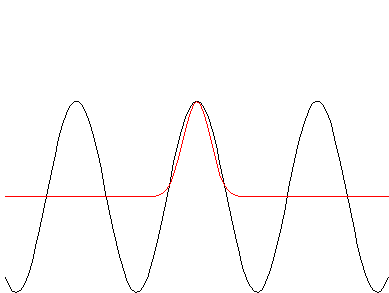
Is there any relationship
between a sine wave and the bell shaped curve used in statistics? They
look similar. Is there a reason for this or is it just a coincidence? I
suppose a mathematician could come up with a formula to describe the
relationship. However, would such a formula have any significance? (It
just occurred to me I'm asking the same question twice. If such a
formula lacks significance that implies any relationship between the
two curves is just coincidence.)
ANSWER:
You have been looking over
too restricted range if you think that a bell-shaped curve and a
sinesoidal function have similar shapes. To the left is a comparison
between the two. Once you get away from the central maximum of the
bell-shaped curve there is no relationship between the two. There is no
mathematical relationship between the two functions however you could
make a bell-shaped curve by adding an infinite number of sinesoidal
curves with appropriate weights; this is called a fourier transform
representation of a gaussian function (another name for a bell-shaped
curve).
QUESTION:
There is a lot of "missing
mass" in the Universe. Galaxies furthest away from us are receeding at
close to light speed (~c) -- and we are receeding from them
(relatively) at ~c. When objects move at close to c their mass
increases. Could galaxies receeding from each other (relatively) at ~c
be gaining extra mass that accounts for the "missing mass" in the
Universe?
ANSWER:
First, I always have told
students to not take too seriously the often stated claim that mass
increases with velocity; see the answer to an earlier question to
see my viewpoint on mass. I had a long discussion with a friend who is
an astronomer quite well versed in the theory of general relativity. He
argues that this could not possibly explain dark matter for a number of
rather esoteric and complex reasons which are beyond the scope of this
site. However, there is one simple example which should put the matter
to rest: in our own galaxy where no objects have speeds anywhere near
approaching the speed of light relative to earth, there is a severe
dark matter problem. The orbital velocities of stars around the center
of our galaxy cannot be understood in terms of observable mass in the
galaxy; the similar motions of other galaxies as well as our own are
the best evidence that we do not understand something about celestial
mechanics and the postulation of a mysterious dark matter is one
hypothesis to explain these problems.
QUESTION:
is there pure concussive
effect of an explosion in a vacuum
ANSWER:
I am not sure what you are
asking. However, concussive means the ability to shake or agitate and
in the case of an explosion would mean the propogation of a pressure
pulse and, of course, that cannot happen in a vacuum. When you see a
space movie and there is the explosion of a Klingon starship, you would
not really be able to hear it even though all space movie directors
seem to think you could.
QUESTION:
Would it be possible, with
respect to efficiency, to build a minature electrical generator to
attach to an axle of a car, transfer the electrical energy generated by
the rotating of the axle to a rechargeable battery? This would be done
in order to transfer the stored energy to your home when your car is
parked in your garage. If you had a system set up where you had a plug
that you could connect from your rechargeable batteries in the car to
the input of electricty to your house? This question has been on my
mind since I read about using wind and or hydroelectic power to cut
down on your energy bills.
ANSWER:
This is essentially how the
electrical system of your car already works, that is your alternator
recharges your battery so you can always start up your car (or listen
to the radio when the car is not running). If you put a generator on
your car you can't turn it for free, that is you must supply the energy
which you are storing in batteries and so your gas mileage will
plummet. Furthermore, if you are going to carry enough batteries to
make a serious dent in your household needs, the large weight of these
will also cut down your mileage. Since electricity is relatively cheap
and gasoline is relatively expensive, this idea is not a viable one.
You may be interested in an alternative which is one of the ways hybrid
cars work: if you connect your generator to your wheel only when
you want to brake, then the kinetic energy of your car will be
converted into electrical energy instead of into heat which is what
conventional brakes do. This energy from braking is used to charge up
the batteries used to run the car in its electric mode.
QUESTION:
i really need help with
prooving/finding something. I have no idea how to do it and everyone i
ask has the same problem, but i think it can even be done without
calculus. The question goes as follows: If i have a box on a surface
with coefficient of friction= mu (not given) and i pull the box with a
force T at theta degrees above horizontal, find as a function, at which
angle will i MAXimise the acceleration for any value of mu? (as a
function?). So naturally my first step was to realized what they wanted
and i got:
T(cos[theta]) - ({mu}[mg - Tsin{theta}]) = ma (where m= mass, a =
acceleration etc..) Now i have tryed rearanging it, finding
inequalities and many more things but i just cant find it!! I really
dont know how to do it and i would be so happy if you could show me!
ANSWER:
I don't know how to solve
this without calculus, but it could probably be done if you were
clever. Your equation is correct, Tcosq -mmg+mTsinq=ma. If
you solve for a and then differentiate a with respect
to q and set the result equal to zero you will find: tanq=m.
QUESTION:
I have learned that we all
will inhale (at least once in our lives) the very same atoms as our
ancestors from thousands of years ago. If this is true, does this mean
that our bodies atoms are bound to this Earth and remain here
permanently after we die. Does our atmosphere and (or) gravity restrict
our atoms (after death) to the Earth, or can our atoms find their way
off the Earth into space and possibly to other worlds? I ask these
questions for spiritual reasons and out of true scientific curiosity.
ANSWER:
Suppose that we assume that
the atmosphere gets completely mixed up by weather patterns after a
relatively short time, say a year; this essentially means that a
molecule here today is equally likely to be anywhere else in the world
in a year. Now, I calculated the volume of the atmosphere assuming it
to be 20 km thick; that would include most of the molecules. Now, I
assumed a typical human breath is about 1 liter; then I find that the
number of lungs full of air there are in the atmosphere is roughly
1.5x10²¹. Next I roughly estimate the number molecules in
one lung full of air to be about 3x10²². So, if I take one
breath and redistribute the air over the whole atmosphere, I will find
about 20 molecules of that air in any other breath. So, very roughly
speaking, each breath you take will have 20 molecules of the last
breath John Kennedy took before he died. But, we might more likely be
interested in the number of molecules over a lifetime; taking Leonardo
da Vinci, who lived to age 67 as an example, the number of breaths
breathed in his lifetime was about 7x10⁸ (I assumed about
20 breaths/minute), so every breath you take will contain about 1.4x10¹⁰
molecules (that is about 14 billion) that were breathed by da Vinci!
Keep in mind that my calculations are very rough but they should give a
good approximation of orders of magnitude.
Your second question is not
really related. Gravity does a good job of keeping most molecules in
the atmosphere confined to this world. However, there are virtually no
hydrogen molecules or helium atoms in the atmosphere because they have
escaped into space. Helium is recovered as a byproduct of natural gas,
having been confined underground where it cannot escape. The reason for
this is that temperature is a measure of the average kinetic energy of
the molecules and lighter molecules have much higher speeds than say
oxygen or nitrogen at the same temperature. The speeds are large enough
that the fastest have a velocity larger than the escape velocity and
fly off into space. For the same reason, the moon has no atmosphere
because the escape velocity is much lower and all the gas escapes.
QUESTION:
I've been wondering for a
while about the effects of fusion on
gravity. Fusion is a process by which lighter elements join to make
heavier elements, releasing large amounts of energy at the expense of
small amounts
of matter. However, concentration of large amounts of matter defines
gravity as a curvature of space.
If matter is lost due to fusion, does the gravity which that matter
represented go away too? Is it redistributed somehow?
ANSWER:
Let's imagine a universe
with no mass, just photons. Then I believe that spacetime would be
flat. So, when mass gets smaller spacetime gets less curved. Realize,
however, that the fractional change of mass in a star over its lifetime
never really approaches a large fraction. You should not think of
gravity as being something which is conserved (as implied by your
question "Is it redistributed somehow?"). If there is one mass there is
a gravitational field; if it is made to go away (conserving energy),
the gravity goes away too.
QUESTION:
I don't know if this is a
silly question or not, but I can't find it in your old answers (at
least, not in a form that I understand).
There is a lot of "dark matter" in the Universe; and mass increases as
matter moves nearer the speed of light; the galaxies are moving away
from each other at the speed of light.
Therefore, doesn't the mass of the galaxies increase enormously as they
are moving away from each other? Couldn't this account for the missing
mass of the "dark matter"?
ANSWER:
For starters, dark matter is
hypothetical and has never been directly observed. The universe is
expanding but the speed of the most distant objects is not the speed of
light, in fact not really close to the speed of light even though they
are moving rapidly, just not that rapidly.
"CORRECTED"
ANSWER:
I talked with an astronomer friend and found out that in fact
the most distant objects are moving with a speed quite close to the
speed of light (about 95%). Nevertheless, this cannot be the answer to
the dark matter puzzle for reasons explained in a
similar answer above.
QUESTION:
A metal spoon and a wood
spoon have been in boiling soup for a long while. If I take out both
spoons, the metal one will feel hotter. Does the metal spoon in fact
have a greater temperature or is it just a better conductor? I guess my
real question is how can this guy be holding a white hot space shuttle
tile in his bare hand that is 1260 degrees C? Can two objects have
equal temperature where one burns you yet the other does not? http://upload.wikimedia.org/wikipedia/en/thumb/5/5b/TPScube.jpg/300px-TPScube.jpg
ANSWER:
It is because the metal is a
better conductor. They both have the same temperature (assuming that
they were both submerged). This is why you never see fire walkers walk
on red-hot metal surfaces. The reason the man can hold the
hot shuttle tile is because it has been heated up locally so that
it is hot where it was heated up but not hot where he is touching it;
this is because the tile is a very poor conductor of heat. In the spoon
example maybe I misunderstood what you meant. If the two spoons are in
the soup with their handles sticking out, the metal handle is hotter
the metal is a better conductor.
QUESTION:
;
The reason for this email
it’s because I have a question about the ocean tides here on earth. I
understand that gravity bends time/space based on Albert Einstein’s
theory. My question is: Do the ocean tides follow the path of the space
bent due to the presence of the moon? I'm working on a presentation and
I wanted to talk about this subject and at the same time give a
graphical representation of this phenomenon. For some reason I keep
thinking that this phenomenon can be explain showing the fabric of
space being bent by the two bodies (Earth and Moon) resulting on the
ocean tides in other words, the earth will look oval due to the ocean
waters. The small deformation of space due to the moon's presence will
create an oval looking basket on earth's space forcing the waters to
fallow this shape depending on the moon's position. It’s this some what
correct?
ANSWER:
Suppose the oceans were full
of molasses; the tides would be much smaller, probably not perceptable
at all. And yet, the curvature of spacetime would be the same. It is
therefore fallacious to assume that the shape of the ocean reflects the
shape of spacetime. Curvature of spacetime is best visualized by
observing the bending of light by strong gravitational fields. Research
this and "gravitational lensing" for your presentation.
QUESTION:
Who was most responsible for
the Grand Unification Theory?
ANSWER:
There is no single GUT. Read
the Wikepedia
entry on GUTs.
QUESTION:
why does fire burn up? I
mean if you point a match down the falme still goes up, why doesn't
gravity draw the fire to the ground rather than the sky?
ANSWER:
I have previously answered
this question.
QUESTION:
My question relates to how
icebergs reflect the heat of the sun back out of the atmosphere. I know
that white reflects light, but does it also reflect heat? This is
mysterious to me.
What about a mirror? If the sun shines on a mirror, does the mirror
effectively redirect the light and the heat?
If, in a dark room, I blow hot air onto a white block of ice, will it
reflect away? Are the sun's light and heat one radiation or two?
ANSWER:
When we talk about heat we
are talking about energy transfer and that can be accomplished in
several ways thermodynamically. Heat energy from the sun is simply the
infrared portion of the electromagnetic spectrum which is comprised of
light with wavelengths somewhat larger than can be seen by the eye.
When this heat hits a reflective surface it is reflected much the same
a visible light. Blowing hot air, however, is a very different kind of
heat transfer; this is basically forced convection where you move a
volume of hot air to replace a nearby volume of cooler air. It is
essentially meaningless to talk about reflection of this kind of heat
transfer. There are other ways to transfer heat, the most important of
which is conduction; for example, sticking an iron rod into a fire and
waiting until your hand gets burnt.
QUESTION:
The situation is a ball
attached to a string like a swing. Apparently, no work is done on the
string, but surely the weight of the ball has a component that is in
the same direction of the motion of the ball, so some work is done on
the string.
ANSWER:
In the case of a simple
pendulum the ball is considered to be a point mass and the string to be
massless. If the string is massless you cannot do work on it because it
can acquire neither kinetic nor potential energy. If, however, the
string has mass, work will be done on it by the ball and by its own
weight. In fact, if the string has mass you don't even need a ball at
the end. This is called a physical pendulum, one consisting of things
other than point masses and massless pieces.
QUESTION:
The strong nuclear force is
said to have a very short range, owing to the short lifetime of its
carrier particle (at least as I was taught in high school many years
ago). This rang is said to determine the maximum size of an atomic
nucleus, hence this is why Uranium is the heaviest naturally occuring
element; any larger a nucleus and the electromagnetic force would start
to take over and the nucleus would fall apart.
My question is: the above make sense only if the strong force
originates from the centre of the nucleus, but it has always been
explained to me as though all nucleons (even the ones on the edge) can
experience the strong force (the classic demonstration involves magnets
coverred with velcro to show how the replusion is overcome if you get
close enough). So where does the strong force really come from and why
do the outer nucleons 'feel' it to a lesser degree?
ANSWER:
It is an oversimplification
to say that nucleus becomes unstable because of the Coulomb force
becoming dominant over the nuclear force. And, it is incorrect to
simply say that in a large nucleus the outer nucleons are "out of
range" of the nuclear force. The nuclear force is the force between
individual nucleons and so each nucleon interacts only with its nearest
neighbors due to the short range of the force. The nucleons on the
surface see only neighbors inside the nucleus and so they are bound to
the nucleus as a whole. Those on the inside see essentially no force
since each sees just as many neighbors in one direction as the opposite
direction and all forces approximately cancel out. In fact the simple
model that the nucleus is an impenetrable sphere (particles move freely
but cannot escape) does a remarkably good job describing nuclear
structure as long as you include the nuclear spin-orbit force which I
will not go into here.
QUESTION:
Does the acceleration due to
gravity change between day and night? During the day, the sun would
pull us toward it thus lowering the earth's pull. At night, it would
add to the the earth's pull, increasing gravity. Is this reasonable?
ANSWER:
The answer is yes, but the
effect is very small, probably not measurable. I calculate the
acceleration due to gravity at the earth's orbit due to the sun to be
about 6x10⁻³ m/s2. Assuming that g=9.8 m/s2,
the two values would be 9.806 and 9.794 at the equator, less than 0.1%.
This is small compared to variations in g due to the
nonsphericity of the earth, local mass variations, the rotational
motion of the earth and other effects.
QUESTION:
I am reading Roger penrose's
The Emperor's New Mind, and on page 301 he says that when two slits are
open the intensity at the brightest part of the screen is 4 times what
it was before, rather than twice, as common sense would predict. I took
that to mean that photons which are subject to positive interference
carry more energy than before they passed thru the slits.
ANSWER:
I have previously answered a
similar question.
QUESTION:
Regarding radiolysis, I have
read about it in textbooks, but I still have the following questions:
If the body is 80% water, doesn't radiolysis happen alot in diagnositc
radilogy? If yes, why is this not a big concern-or is it?
ANSWER:
Radiation can be used to
dissociate water. However, the probabilities are very small. A number
that I could find to give an example is that only about 20 molecules
dissociate for every 100 electron volts of radiation energy deposited.
The energy of a typical xray is like 1000 electron volts so if
completely absorbed could result in 200 destroyed atoms. And, of
course, most xrays are not absorbed. Even if a million of them were,
200,000,000 is a tiny number compared to the number of water molecules
in a thimble full of water.
QUESTION:
I'm sorry to bother you but
this is something that has been bothering me for a while and I'd really
appreciate your help. In Feynman's book on QED he cites that the
probability that an electron will couple with a photon squared is 1/137
(or aprox.
.085). He goes on to say that the proton has a 'magnetic moment' of
2.79. Now I assume that these two things are the same, the probability
of and electron/photon coupling and the 'magnetic moment', since
electromagnetic force is carried by photons. Therefore I would expect
the 'at rest charge' of one proton would be greater than that of one
electron in proportion to their coupling amplitudes; because in Feynman
diagrams it is said that the reason particles of like charge repel each
other is because they exchange a photon and the photon momentum knocks
them away from each other; like billard balls. However, when I watched
an online lecture from MIT on electricity and magnetism, the professor
stated that the force between two repulsive electrons and two repulsive
protons was aproximately the same. This is my point of confusion. Why
are they the same?
ANSWER:
You have several very
different things jumbled up here.
- First the 1/137 number is
called the fine structure constant and is the number which is used to
characterize the strength of the electromagnetic interaction. It is a
particular combination of physical constants like electron charge,
speed of light, Planck's constant, etc.; see the Wikepedia
entry for fine structure constant to get the exact definition.
- The magnetic moment of the
proton has nothing to do with the fine structure constant. Most
elementary particles look like tiny bar magnets and the magnetic moment
is simply an experimental measurement of the strength of that magnet.
It is dependent on the structure of that particle and reflects what the
density of electric currents is. A simple (overly simple) model would
be that a proton is a charged sphere which is rotating and the rotation
of the charge comprises a current which gives rise to a magnetic field.
- The third statement, I
believe, simply states that the electric charge on a proton is of
opposite sign but identical magnitude as the the charge on an electron
and has nothing to do with the magnetic moments or magnetic forces.
QUESTION:
I don't understand Newton's
Third Law. If it is true then surely, for example, it is impossible to
move your hand through a table since the reaction will always equal the
weight.
ANSWER:
Newton's third law (N3) says
that if one object exerts a force on another, the other exerts an equal
and opposite force on the one. Many students misunderstand this law as
you demonstrate in your example. Instead of talking about a hand, let
us assume there is a book on the table. Are there any forces on the
book? Yes, there is its own weight straight down (let's call that force
W) and maybe the table, which touches the book, also
exerts a force on the book (let's call that force T). Since
the book is not accelerating, the total force on it must be zero (that
is Newton's first law, N1) and so T must be a force straight up
which is of the same magnitude as W. These forces are equal and
opposite because of N3, right? WRONG, WRONG, WRONG! These
forces are equal and opposite because of N1 and they have absolutely
nothing to do with N3. They cannot be a N3 pair because both are on the
same body (book) and N3 addresses forces on different bodies. So, what
is the N3 (reaction) force which pairs with the force T? Since T
is the force the table exerts on the book, N3 tells us
that the book exerts a force down on the table which has
the same magnitude as T. And, what is the N3 (reaction) force
which pairs with the force W? Since W is the force the
earth exerts on the book, N3 tells us that the book
exerts a force up on the earth which has the same magnitude as W.
That's right, the book exerts a force on the whole earth. N3 can never
cause something not to move because the relevant forces are on
different objects.
QUESTION:
In a standard Newton's Rings
experiment, we place a convex lens of large radius over an optocally
plane glass plate. What will be the fringe pattern if the optically
plane glass plate is replaced is replaced by a concave lens, such that
its radius is larger than that of the convex lens?
ANSWER:
It will still be a bullseye
pattern but the fringes will be farther apart because the air gap
widens more slowly as you go out.
QUESTION:
Why does the refractive
index of a material change with wavelangth?
ANSWER:
Basically it is because the
permittivity (e)of a material depends on the frequency of the electric field
it experiences. And the speed of light is proportional to 1/√e. The reason the permittivity depends on
frequency is that the interaction of varying electric fields is mainly
the interaction with electrons bound to atoms. A simple model is to
imagine the electrons bound by tiny springs to atoms. This then becomes
the driven damped oscillator model and the response depends on how
close the frequency is to the natural frequency of the electron on the
spring (resonance).
QUESTION:
When a detector is placed at
one of the slits in the double slit experiment with light, is the wave
function collapsed by the observation of people or by the presence of
the detector? (i.e. if a detector was placed at one slit, but no one
actually looked at the results would you still get a interference
pattern?) Also I am not including the actual interference pattern in
the results, only the information given by the detector, the
information of course being which hole the particle went through,
ANSWER:
Any measuring device which
determines which slit the photon passes through will destroy the
pattern, it does not require a human to know.
QUESTION:
When the leaf has fallen a
certain distance its speed becomes constant, why?
ANSWER:
It has to do with air
friction. When an object passes through a fluid like air it experiences
a retarding force. This is how you can feel the wind, for example. This
force depends on the speed of the object; it is easy to convince
yourself of this by putting your hand out the window of a car at low
and high speeds—greater force at higher speeds. To a good
approximation, the force is proportional to the square of the speed so
something going 80 mi/hr will experience 16 times the force as
something going 20 mi/hr (which is why you should not drive too fast if
you want to conserve gasoline). A falling object is speeding up as it
falls from rest because of its weight which is a force down; but the
air resistance, which is a force up, gets bigger and bigger as it
speeds up until the force is equal to the weight of the object. Now the
object experiences zero net force so it stops accelerating. This speed
is called the terminal velocity. You can read much more detail in an earlier answer if you like.
QUESTION:
2 bicyclists on identical
bicycles roll down a hill (starting from a stop or identical starting
speeds). One bicyclist is heavier than the other; will this person
reach the bottom of the hill faster?
ANSWER:
It depends on the
assumptions you make. I will outline the essential considerations:
- If there is no friction then
they should both get to the bottom at the same time. This is because
the force down the hill on each is proportional to the weight which is
proportional to the mass so the accelerations are the same (I am
assuming you know Newton's second law).
- But there is friction in the
bearings of the bike, the rolling friction of the tires, friction of
the roadway, etc., but these are also approximately
proportional to the weight, so again there should be a tie.
- Air friction is determined by
geometry and speed, so it is not determined by weight. The greater the
speed the greater the force of air friction (approximately proportional
to the square of the speed), so eventually an object will have a force
from air friction precisely equal to but opposite the force from
gravity and it will stop accelerating; it has reached its "terminal
velocity". An object moving under the influence of gravity and air
friction experiences a greater. The terminal velocity for the heavier
person is larger, so if air friction matters (and it does because
pedaling into wind is much like going up a hill) the heavier person
will win. You can see more detail about air friction in an earlier answer.
Friction can be a complicated
thing, so it would be interesting for you to try things out
experimentally.
QUESTION:
Coulombs constant 9 x10^9
can be found as 1 / (4 pi x permittivity of free space ). It is also
found as c^2 x 10 ^-7, or 1 / permittivity x permeabilty x 10 ^-7), why
is this?
ANSWER:
If you measure the force
between two point charges separated by a distance r, this force
is found to be proportional to product of the charges and inversely
proportional to r2. If you measure the charge in
Coulombs and the distance in meters, then k=9x10⁹ Nm2/C2
as you state. This is simply an experimentally measured number, that is
the force between two charges each 1x10⁻³ C and separated by
1 m would be 9000 N, a number you could measure to get k.
Suppose that you have a number N and you want to define a new
number M=2N; that is all permittivity is, a redefinition
of k, e0=1/(4pk).
Your last question is most interesting. The permeability of free space
is m0=4px10-7 Ns2/C2
and, like k, it is just a proportionality constant which tells
you the magnetic force between two current carrying wires. Now, it
turns out that when you do the mathematics you find that the equations
of electricity and magnetism (called Maxwell's equations) predict waves
which have a speed of c=[e0m0]-1/2 and this speed
just happens to be the speed of light in a vacuum. And so if you now do
the simple algebra, you find that k=10-7/[e0m0]=c2x10-7.
QUESTION:
I have heard that if one
inhabited a two-dimensional macrocosm and a three-dimensional sphere
passed through this macrocosm, then one would see a point grow into a
circle, before collapsing into a point and disappearing again. Now I
apologise for asking you about such an unscientific conjecture, but
could it be that the appearance and subsequent disappearance of
particles and atoms and so forth which has been observed by physicists
to be occurring constantly; could it be that these transient particles
are, de facto, entities from a higher cosmos passing through this
three-dimensional cosmos?
ANSWER:
You are referring to virtual
particles as you indicated in a later message. How can a particle, with
energy mc2, simply appear from nothing? The answer is
that you can violate energy conservation as long as you also obey the
Heisenberg uncertainty principle, i.e. as long as the time
during which you violate energy conservation is short enough.
Quantitatively, The product ET (energy time time) must be on
the order of about Planck's constant which is a very small number (on
the order of 10=34 in SI units). So, you may spontaneously
create 1 Joule of energy as long as it does not exist longer than 10-34
seconds. This picture has done remarkably well in understanding virtual
particles. (Incidentally, you cannot have a virtual electron, for
example, because that would violate conservation of electric charge;
instead you must have a vitrual electron-positron pair.) Could they be
understood as evidence of higher dimensions? Scientists are loathe to
say anything is not possible, but more than simple conjecture would be
needed to convince anybody—predictions of nature are required for
acceptance of a hypothesis.
QUESTION:
If there was no wind present
what force would a raindrop hit a piece of wood, (siting on the gound)
at?
At what point would the force generated by a raindrop be enough to
cause damage to a piece of wood? What is the wood was covered in a
tar-like substance?
ANSWER:
A large raindrop has a
terminal velocity of about 20 mi/hr. Have you ever been hit by a large
raindrop? It does not really hurt so the force must be pretty
negligible. The force of a raindrop hitting wood will not damage it.
QUESTION:
I've been looking at various
videos on Youtube about homompolar motors. In some videos a battery is
used and in other there is not, but in both types of set-ups... What is
it that causes the spinning action. I can some what understand the
spinning when a battery is used. In a battery set-up there is a current
in the wire that makes a magnetic field around the wire, or wires, and
it is this magnetic field that conflicts with the current in the wire
causing it to be pushed away. But in the videos that don't use a
battery what is making the whole assembly spin? I is my understanding
that magnetic flux fields are stagnant. So when a charge is applied to
the "no battery" homopolar motor is there a current traveling along the
flux lines causing it to spin? I've attached some links to clarify my
question:
http://www.youtube.com/watch?v=2hHfkK4iGBQ
http://www.youtube.com/watch?v=hXbFfMBW97A&mode=related&search=
ANSWER:
In each of your examples
things get started with two wires. These are attached to a battery
which supplies the current and gets things spinnining. A good
explanation is given at
http://www.evilmadscientist.com/article.php/HomopolarMotor . After
the wires are taken away the motor continues spinning but because there
is very low friction; it is not being driven anymore. If you let it go
long enough it will eventually stop.
QUESTION:
;
I think no object can travel
any faster than whatever the force that pushes it travels. Like a
bullet from the muzzle of a gun. I assume its greatest speed in its
journey is at the muzzle of the gun.
If true, and baseball pitchers routinely pitch 100 mph baseballs, how
is it possible for the pitchers finger (s) to decelerate from 100mph in
a space of what can't be more than a fraction of an inch in a fraction
of a second. Seems like that would tough on any part of the body.
ANSWER:
Well, you should not think
of a force as being something which has a velocity; it is simply a push
or a pull. The velocity of something is maximized or minimized as
determined by the acceleration which is determined, via Newton's second
law, by the force. In your example of a bullet, the velocity is likely
greatest just as the bullet leaves the barrel because there has been a
large force acting on it and a small force acting against it (air
friction). As soon as it leaves the barrel, the only forces on it are
air friction (which slows it down in the direction it is moving) and
gravity (which accelerates it in a downward direction). The pitcher
example can be understood as follows:
- The instant that the ball
leaves the hand the hand must be moving with speed 100 mi/hr and, as
you note, must experience a force to stop it.
- But the hand does not stop in
a fraction of an inch, it probably travels a couple of feet or more.
- Understanding this you can
see one of the reasons for "follow through" in throwing balls, golf
swings, etc.
- A rough calculation of the
force is: let the time to stop be 0.2 s, the initial velocity be 100
mi/hr=45 m/s, the mass of the hand be 1/2 lb=0.23 kg, and the distance
traveled be 1 m=3.3 ft. Then the average acceleration is 45/.2=225 m/s2=503
mi/hr/s. Then the average force is 225x0.23=52 N=12 lb. The source of
the force on the hand is the wrist. Note that the distance does not
factor into calculating the acceleration, just the change of speed and
the time. The distance and time are not independent and making the
distance larger makes the time larger which makes the acceleration and
force smaller.
QUESTION:
Is there any type of matter
which cannot be melted, even when heated?
ANSWER:
It depends on factors like
the temperature and pressure. So there is no simple answer to your
question. Many compounds will not melt for some pressure ranges but
they will sublime, that is turn into a gas directly from the solid. An
example is carbon dioxide (dry ice) which does not melt at atmospheric
pressure, but it does sublime.
QUESTION:
How far would a person need
to fall before they accelerate to their "terminal velocity." 100 feet?
500 feet? Higher? I'm told that terminal velocity is about 125 mph for
a person free falling.....and that the acceleration formula is 33
feet/second/second. But I don't know how to reverse that math.
ANSWER:
What the terminal velocity
is depends on a number of things including the skydiver's weight, the
density of the air, and how he orients himself relative to his fall. If
he orients in a belly flop position he will have a lower terminal
velocity than if he falls feet first. Also, he technically never
reaches the terminal velocity but just approaches it asymptotically.
But you can estimate when he is within, say 95% of the terminal
velocity. The details of the physics are given in a previous answer; I will just give
you the results for your situation here. Choosing the mass to be 100 kg
(about 220 lb), the air density to be 1.3 kg/m3, cross
sectional area to be 1 m2 (more like the belly flop
position), and the drag coefficient 1.2, I find a terminal velocity of
about 35.4 m/s (about 79.4 mi/hr). The characteristic time is about 3.6
s; this is the time it takes the speed to go to about 76% of the
terminal velocity. If you wait twice the characteristic time, about 7.2
s, you will reach about 96% of the terminal velocity. The
characteristic distance is about 64 m; this is the distance it takes
the speed to go to about 63%. If you go three characteristic distances,
192 m (about 630 ft), you will reach about 95% of the terminal
velocity. If you are interested, the characteristic time is v/9.8
s and the characteristic length is 19.6/v2 m where v
is the terminal velocity in m/s. It is interesting to note that cats
that fall out of skyscrapers usually survive because their terminal
velocity is slow.
QUESTION:
;
How can motion be
generalized by simply looking at an objects velocity and acceleration.
More specifically, why do we only use the first two derivatives of
distance to explain the change of distance? Why don't we consider
higher order derivatives? Wouldn't an inclusion of these higher order
derivatives be necessary to fully account for motion? The question is
"Why can we generalize changes in distance by looking only at two
derivatives of distance?"
ANSWER:
Actually, you don't really
need anything but the position as a function of time to know everything
there is to know about the motion of a particle. Once you know that,
just differentiate it to get the velocity which is the rate of change
of position. If you care to know the rate of change of velocity
(acceleration), differentiate the position twice. If you wish to know
the rate of change of acceleration (which engineers often do and call
"jerk"), differentiate the position three times. If you want to know
how the jerk changes, differentiate four times. And so forth. But every
bit of this information is contained in the position as a function of
time. Physicists are normally only interested in velocity and
acceleration because, among other things, Newton's second law (N2) says
that a force causes an acceleration. It turns out that accleration is
not a useful quantity in the theory of special relativity since N2 in
the form F=ma is actually not correct in relativity.
QUESTION:
Do electrons maintain a
standard orbit about the nucleus?
ANSWER:
Actually, the idea of
electrons being in well-defined orbits in an atom is just a pictorial
way to qualitatively understand atomic structure. Originally Niels Bohr
solved the puzzle of how atoms are constructed but his ideas later
evolved into a much more complete theory of atomic structure. An atom
consists of "clouds" of electrons around the nucleus, that is the
electron does not maintain its identity as a point particle but becomes
"smeared" over the volume in a way which is determined by the
properties of the "orbital" it is in. This is quantum physics. However,
if you say that the shape of the cloud represents the orbit, then, yes,
electrons in one atom have the same distribution as in any other atom
of the same element.
QUESTION:
Hypothetical situation: I'm
walking in the park. Then, the earth explodes, casting the fragments of
earth to outer space. Not unlike the big bang. Now, I am smack dab in
the middle of one of those fragments. What is the cause of my death?
Will my tendency to remain unmoved turn me into a meat puddle? Or will
some other force counter act that so that I die from the loss of
atmosphere and loss of oxygen (I doubt this)? From freezing (I doubt
this too)? Your help is great appreciated as to what method in which I
would die, and about how long my existence will be from explosion to
death.
ANSWER:
The fragment you are on
suddenly experiences an enormous acceleration as a result of the
enormous force it experiences. It pushes outward on you to give you the
same acceleration, so it must push on you with an enormous force, far
more than your body is designed to survive. It is basically the same as
your hitting the ground with a very high speed (like after jumping from
a tall building)--the huge acceleration of your stopping requires a
force and that force kills you.
QUESTION:
If I heated my oven to
something like 500 deg F, and it was a perfect insulator, would the
temperature inside eventually decrease due to irreversible processes
such as friction between gas molecules and possible deformation from
molecular collisions?
ANSWER:
By definition a "perfect
insulator" will not let any energy out. We never talk about friction
between two atoms or molecules since it is a macroscopic phenomenon
resulting microscopically from interactions between molecules. In this
context if one molecule gains energy in a collision the other mus lose
exactly the same amount. I do not know what you mean by deformation,
but at normal temperatures the only excitation possible is rotational
excitation and this is already included in the microscopic description
of the hot gas. So, the temperature will not change.
QUESTION:
I recently read an article
about "nothing" in the center of the universe.
Since the "hole" is 5 to 10 Billion light years away, how long would it
take to get there using current technology (such as the fastest
man-made object: 250,000 km/h) and in a space craft traveling at 99% of
the speed of light? Also what would be the relativistic age difference
(earth vs spacecraft observer)?
ANSWER:
(I will take the 10 billion
light year distance; everything is half as large for 5 billion light
years.) The first velocity you quote, 250,000 km/hr is about
0.00023=0.023% the speed of light, so both observers would see the same
elapsed time which would be 10x109/2.3x10-4=4.3x1013
years, about 43,000 billion years. The case of a speed 99% the speed of
light, we would see it take about 10 billion years (just a hair longer)
but the observer in the space craft would see much less time elapse. He
would see the distance to the hole to be contracted to 10x(1-.992)1/2=1.4
billion light years; so the time it would take him, according to his
clocks, would be 1.4/.99=1.42 billion years.
QUESTION:
An acquaintance and I are
having a heated discussion relating to the 1960 jump from 103,000 ft
from a gondola by Joe Kittinger. According to several reports,
Kittinger reached speeds over 600 MPH after he jumped. Since I can't
prove that he did, I'm no physicist, he believes he must be correct.
How can I determine the speeds that were reached in this jump?
ANSWER:
In principle, this is a
simple free fall problem. In practice, we need to worry about air
resistance since that becomes important in real life at high speeds.
However, there is very little air above about 60,000 feet, so let's
assume that there is no air resistance and see how far he has to fall
to reach a speed of 600 mi/hr and if it is less than about 40,000 feet
he probably achieved that speed. The acceleration due to gravity is
about 21.8 mi/hr/s; that is a freely falling object will gain about
21.8 miles/hour as each second clicks by. One pertinent physics
equation is v=at where v is the speed (assuming
we start from rest), a is the acceleration, and t is
the time. So, putting 600 in for v and 21.8 in for a we
can solve for t: t=27.5 s; in other words, after about
a half a minute the object will be going 600 mi/hr. The second
pertinent equation is s=½at2 where s
is the distance traveled in time t. Solving for s I
find s=12,000 ft, that is he will have a speed of 600 mi/hr
when he is at about 90,000 ft, still far above where there is
signficant air. (Incidentally, in the second calculation I used a=32
ft/s/s so the units would come out right, viz. feet.) So, I
would say that yes, he must have gone at least 600 mi/hr. I did a
little research and saw 714 mi/hr quoted as the highest speed he
achieved. Once he starts encountering significant amounts of air he
will begin slowing down.
FOLLOWUP
QUESTION:
This is a follow-up, and didn't know if I should post it
online or not, since you've already answered it. But, the person with
whom I'm having this discussion still insists you're answer is wrong.
He fancies himself smarter than a nuclear-physicist, I guess, and, by
his calculations , the top speed that Kittinger could have reached is
350 mph. Here is his argument and his calculations, referring to your
response.
"That's
just a repeat of what the other professor said, and in both cases they
conveniently ignore drag. If you're going to ignore drag then ignore it
and the guy keeps falling at increasing speed. Why stop accelerating at
the point that corresponds to what the claims are? When you plug the
drag variables into NASA's algorithm Kittinger doesn't get to 614mph.
The professors don't bother to verify that the air is too thin to have
any effect.
Tell the college professor's to go to the Chemical Engineer's Handbook
and look up Fluid and Particle Dynamics. In there is a table that
describes the activity of bodies in free fall through a fluid. When
they're going slow, they are stable. As they increase in speed they
first start to tumble erratically, then they start spinning about their
axis of least inertia. The tumbling starts somewhere around Mach 0.4
and the spinning around Mach 0.6 That's the flat spin the story eludes
to, and the college professors ignore. If he fell at 614mph he's at
Mach 0.9 and is in a flat spin.
The big problem is all the contradictory statements that are attributed
to Kittinger. He the first supersonic skydiver. He gets to an estimated
614 mph or 714. He has no sense of speed, yet he knows he keeps
accelerating after the drag chute opens. That chute opens at 13 secs,
or 16 secs or at 96000 feet.
First of all drag doesn't work like a break. A body sitting still has
no drag. As it speeds up drag increases and keeps increasing until the
force propeling the object and the force of drag are equal. Then the
object stops accelerating and moves at constant speed as long as force
and drag stay the same. Drag is related to Velocity(speed) by the drag
equation. D = 0.5 x Cp x p x A x V^2 So as long as you keep the Cp,p,
& A the same, there is one value for drag for every value of speed
(V)
I'm not going into all the other crap, but the force pulling Kittinger
down and causing him to speed up is gravitiy working on his weight. At
roughly 300 lbs it takes 300 lbs of drag to stop him from accelerating.
He's the shape of a brick, roughly half as wide as long and 1/3 thick
as long. The Cp of a brick is 2.1. We use that to compute air flows
through our tunnel kilns at the brickyard. The density of the air is
about 0.00004 slugs/cuft. He is exposing about 15 sqft of area to the
"wind". So if we plug in all those numbers in the Drag equation and
solve for V(speed), he stops accelerating at 690 fps or 470mph. I'd say
the air is thick enough to make a difference.
But that doesn't take into account the drag on the small parachute he
deployed to keep himself from going into that flat spin. It's 6' in
diameter that's 28.26 sqft of area. The Cp for a round chute is 1.5. So
as long as the drag on the chute and the drag on Kittinger doesn't
total 300 lbs or more he is still accelerating. At 13 secs the total
drag is 254lbs and his speed is 283 mph. He'll accelerate for less than
a second more and get to about 290 mph. At 16 seconds the total drag is
384 lbs, so he'll decelerate from 347 mph with a pretty good jerk. I
have no idea where or why the 96000 ft comes from, so I'm going to
ignore it. He supposedly used a timer to deploy the chute.
The speed of sound is around 660mph and tumbling would start somewhere
around Mach 0.4 which is 0.4 x 660 = 264mph. That's damn close to the
13 sec mark.
We'll never know based on the info available, but I don't think he got
over 300-350mph."
Here are
the facts, as presented in an article at http://www.centennialofflight.gov/essay/Explorers_Record_Setters_and_Daredevils/Kittinger/EX31.htm
1. Kittinger jumped from 102,800 ft.
2. His weight is approximately 300 lbs.
3. He was falling in a backward orientation
4. After falling for 13 secs, a small chute, 6 ft. in diameter, opened.
5. He feel for 4 min. and 36 secs more bringing him to 17,500 ft.
ANSWER:
Your friend certainly makes
some quite good points, although he is maybe a bit overemotional and
maybe a little hostile to us college professors. It is true that we
often simplify problems to get to the core of a problem. So let me be a
little more careful and go over the calculation of your friend the way
I would do it since some of the numbers he quotes are undocumented and
some of them (in particular slugs/ft3) are completely
incomprehensible to a modern physicist! Your friend must be an
engineer. His equation is quite correct, that is the terminal velocity
is given by v=[(2mg)/(rACp)]1/2
. Now it is easy to see how disputes can arise because the answer, of
course, depends the choice of constants some of which are not easy to
estimate (for example, I would say approximating the man as a brick is
what some nutty college professor might do). The density of the air at
100,000 ft is about 1/100 the density at sea level and, since the
density at sea level is about 1.3 kg/m3, I will take r=1.3x10⁻²
kg/m3. I searched the web for tables of drag coefficients
and found that a
parachutist has Cd=1-1.4 (not 2.1 as your friend
assumed); I will use 1.2. The cross sectional area also requires a
rough estimate since it depends on whether he is falling, for example,
feet first or is falling "belly flop" orientation. I will assume the
latter so as to get as small a speed as possible and I will estimate
the area as about A=2 m x 0.5 m=1 m2 (your friend
uses 15 ft2, about 1.4 m2). Using m=136
kg (300 lb) and g =9.8 m/s2, we are ready to estimate v;
I get v=413 m/s= 924 mi/hr.
But, there is important
information which you did not tell me the first time through--the
opening of the small chute. So now the cross sectional area is about
2.5 m2 and the drag coefficient is about 1.42 (I model it as
an open hemisphere
into the wind). So now I get a reduced terminal velocity of v=240
m/s= 537 mi/hr.
Now I have the terminal
velocities, what happens in our specific example? The space is too
limited here to put in all the details, but I have assumed a constant
density for the first 4000 m (about 12,000) of fall. I went back to an
intermediate mechanics book to find the dynamic analysis of the falling
body with quadratic velocity dependent drag force and I could apply
(knowing the terminal velocities from above) the analysis to this
specific problem. In the first 13 seconds I find that he falls about
1000 m and ends up with a speed of 130 m/s (291 mi/hr). Then, after he
has fallen 3000 m more he will have a speed of 208 m/s (465 mi/hr). But
he is still accelerating but now the air gets denser so his
acceleration decreases even more; nevertheless, as he falls, since he
is still fairly far below terminal velocity (240 m/s) he will end up
going faster than 465 mi/hr.
So who is right here? Well, your
friend is right in that we will never know based on information we
have. I can easily imagine that I have made a factor of two error in
the density, the area, or the drag coefficient (and so could your
friend); increasing all by a factor of two would reduce the terminal
velocity by almost 2/3 which is the difference between 600 mi/hr and
200 mi/hr. The results are too sensitive to modest changes in the
parameters.
QUESTION:
At our work we have gone
stupid over GREEN Issues, we have been instructed to turn off the hand
dryer at the wall plug when our hands are dried, thus saving some of
the blow cycle.
Now when you dry your hands you turn it on at the plug, get the
remaining part of the last cycle and then have to turn the blower on by
the big silver button on the dryer.
Are we saving enery at all or is "turning on/starting the dryer" the
big user of power? Thus it would be better for it to finish its cycle
each time
ANSWER:
It is not true that turning
an electric appliance on and off uses more energy. (It is also not true
that turning a car off and back on at a long traffic light consumes
more gasoline than running the whole time.) Electric heaters like your
hand dryer are among the worst energy hogs so running them only as long
as necessary to dry your hands does make sense. However, if your
employer is really serious about energy conservation, he would
uninstall the electric dryers and replace them with paper towels or,
even better, one of those machines which has a long cloth roll which is
simply washed and then reused when it is all used up.
QUESTION:
Compressing gaseous nitrogen
makes liquid nitrogen which is very cold. But compressing things makes
them hotter. Any help alleviating my confusion will be greatly
appreciated.
ANSWER:
The compressed gas does get
hot, but that is not the end of the process. Here is a link
with an explanation.
QUESTION:
This question has to do with
television signals emitted from this planet. If there is a star that is
say exactly 40 light years from us, how weak would our "electromagnetic
reflection" be from the star or a planet (I'm assuming a reflection is
possible?) by the time we get it back, some 80 years after it left?
I realize that probably not all stars would reflect equally, so my
question is geared toward whether there might be anything at all that
could be measured and analyzed someday.
ANSWER:
Almost anything will relfect
electromagnetic radiation. The real problem here is the intensity. The
intensity of radio waves emitted from the earth will fall off
approximately like 1/r2 where r is the
distance. So, if you have a certain intensity 1,000 miles from earth,
the intensity 1,000,000 miles away will be (106/103)2=1,000,000
times weaker; and 1,000,000 miles is a very small number compared to
the distance to a star. And the reflected signal will lose just about
the same fraction coming back. My guess is that the intensity would be
so low that no information could be obtained from it.
QUESTION:
If an object is completely
submerged in water (let say sitting on the bottom of a lake) why does
buoyant force help you to lift the object out of the water. What I'm
confused about is why the pressure of the water pushing down on the
object doesn't hurt you as much as help you?
ANSWER:
Let's think of it as a box.
The bottom of the box experiences a force due to the pressure in the
water which pushes up. The top of the box experiences a force due to
the pressure in the water which pushes down. But the force on the
bottom is bigger in magnitude than the force on the top because the
pressure gets bigger as you go deeper. Therefore there is a net upward
force on the box which we call the buoyant force.
QUESTION:
What is the speed of gravity?
ANSWER:
This quetion has been previously answered.
QUESTION:
How would i calculate the
number of grains of sand on Earth ???
ANSWER:
There is, of course, no way
to calculate it. You could estimate it, however. I am not a geologist,
so I really don't know how much sand there is in the world but it must
be a lot. I will take a wild guess that there is enough sand to cover
the entire earth to a depth of 10 cm =10-1 m (there is
probably more than that). The surface area of the earth is about 5 x 10¹⁴
m2 (from A=4pR2)
so the total volume of sand is about 5 x 10¹³ m3.
Now, I will guess that a typical grain of sand would have a diameter of
maybe 0.1 mm=10-4 m so the volume of a typical grain of sand
would be about 10-12 m3. So the number of grains
of sand would be the ratio of the volumes (volume of sand/volume of one
unit of sand), about 5 x 1026, quite a lot! This is
comparable to about how many atoms there are in your pencil.
QUESTION:
during the double slit
experiment, i understand the bright patches are caused by the peak of
one wave interfering with the peak of another to form a doubly high
peak. but when the bottom of two waves also interfere with each other
to produce a doubly low wave, does this also produce the bright patch?
ANSWER:
Every point on one wave
interferes destructively with the corresponding coincident point on the
other wave.
QUESTION:
One of my classmates claimed
during our study group that if you glue two permanent magnets together,
north to north that eventually they will reverse poles… is this true?
ANSWER:
What happens depends on many
things like the materials from which each magnet is made, temperature,
how strong each magnet was, etc. One thing is for certain,
though: they will not both reverse their polarities. Either neither
will or one will or both will become demagnetized.
QUESTION:
Let's say I have a metal rod
about a half an inch thick and 300,000 kilometers long. Then say I give
one end of said rod a mighty whack with a hammer, propelling it forward
by one inch in a mere fraction of a second. My questions is, wouldn't
the impact of my hammer cause the other end of the rod to move forward
one inch just as rapidly as the end where I whacked it? And would this
violate Einstein's law that states that nothing can move faster than
"C"? Or would the far end of the rod have to wait one second after my
whacking my end before moving forward by one inch?
ANSWER:
Have you thought about the
implications of your question? I figure the mass of the rod would be
about 1010 kg. Suppose that you exert a constant force such
that after 0.1 s it is moving with a speed of about 0.5 m/s; it would
have moved about an inch in this time. The force is the change in
momentum divided by the elapsed time so, roughly speaking, the required
force is about 1012 N. Where are you going to get such a
force? Anyhow, to the meat of your question: no, the other end would
not start moving instantaneously. It could not begin moving until at
least one second later than your end started moving for the reason you
state: no information can travel faster than c. In reality, it
would be much longer than one second because your "mighty whack" will
compress the rod and this compression will move with the speed of sound
in the metal and this compression is what travels to the other end to
move it.
QUESTION:
If I were to stand on the
moon with my head facing directly forward into the line of orbit, would
I weigh more than if I were standing on the exact opposite side of the
sphere, in the rear so to speak? In other words, does the movement of a
planetary object either add or subtract from one's mass depending on
where they might be situated?
ANSWER:
Your weight is the force
which you experience due to the gravitational field you are in.
Assuming the moon to be a homogenous sphere, your weight is independent
of where you are on the surface and of the motion of the moon. Your
mass is the inertia you have in your rest frame and it is independent
of everything. Rest mass is an inherent property of an objece, weight
is determined solely by mass and field.
QUESTION:
Given that gravitation and
acceleration are locally indistinguishable, and that "gravity" is
causing the light to bend in gravitational lensing, can acceleration
also cause gravitational lensing in some aspects?
ANSWER:
Suppose that you are in an
accelerating elevator with a hole drilled in the side; if a beam of
light enters parallel to the floor, you will see it follow a parabolic
trajectory as it crosses the elevator. So the answer is, yes, light
bends when observed from an accelerating frame of reference.
QUESTION:
Given initially that a
Powerful large magnet and a heavy soft iron are attached magnetically
to each other , we obviously have to expend a lot of ENERGY to separate
it away from each other. But by law of conserv. of energy and E=MC^2
,should the soft iron(or magnet) initially attached to magnet (or iron)
weigh more? If not where is the energy we expended? if so it is unclear
where we should bring relativity to solve it.
(Same can be asked with gravitationally strong object.But it would
bring Gen.Rel into question, which would be uncomfortable for this
simple question)
ANSWER:
Yes, the magnets will be
more massive after you have separated them. But, the amount will be
unmeasurably small. Suppose that you do 100 J of work to separate them.
Then the mass increase will be Dm=100/(3x108)2
kg, about 10-15 kg!
QUESTION:
If an object weighing 500lbs
(let's say an elevator) falls from a height of 1,000ft (without any
resistance other than air) and hits the ground (concrete), how much
energy would it be equal to. And if you would, please translate into
sticks of dynamite.
ANSWER:
The energy when it hits the
ground is about 680,000 J which is equivalent to about 0.16 kg of TNT.
QUESTION:
Whats the lowest Temperature
ever attained here on earth according to latest details ?? .Some
unconfirmed source told me that it was less than a millionth degree
above 0 kelvin
ANSWER:
The lowest temperature I
have found reference to is 100 pK. That is one ten billionth of a
degree Kelvin.
QUESTION:
often aluminum outboard
props bend and warp, the manufactures answer is that over trimming the
engine so that it sucks air down into the props vortex, the air becomes
traped, supper heats and then warps or melts the prop. wouldnt that
trapped air have to reach 660 degrees to melt the prop? is that even
possible?
ANSWER:
The prop is not being
melted, just warped. At high temperatures metals become softer, more
easily deformed (that's why the village blacksmith had a hot fire).
QUESTION:
To our eye + brain, a
material has color when it absorbs all wavelengths of the visible
spectrum and reflects 1 wavelength. For example, a red brick has color
because it absorbed visible light and reflected light with the
wavelength associated with the red color. Why did all the other
wavelengths of light get absorbed and the red light not get absorbed?
Are all wavelengths absorbed and the red color wavelength is radiated?
Does this have anything to do with the HOMO-LUMO Gap (chemistry)?
ANSWER:
Of course, your explanation
is a little oversimplified. Nothing absorbs everything except one
wavelength. A red brick absorbs more of the light in the shorter
wavelength (blue) end of the spectrum than in the longer wavelength
(red) part of the spectrum. But your general idea is right. What gets
absorbed is determined entirely by the properties of the molecules in
the material, it is an atomic-level effect. All molecules have
absorption and radiation spectra and they vary from material to
material. I have no idea what the HOMO-LUMO gap is.
QUESTION:
Light, radio signals, and
audio are all types of waves which can be measured in Hertz. I know
that what we hear (audibly) are compressions of air created by the wave
(let's assume for this question we have an audio wave of 900Hz). Light
is also a wave, lets choose yellow which would be 515THz ( terahertz ).
Considering this, light can travel accross empty space (obviously) as a
wave. Here is where I find a problem that I want answered: If a 900HZ
wave were created from a source in space (not as sound, just a 900hz
wave) and was directed toward earth could we (on the earths surface)
detect the 900hz signal? If so how, wouldn't this cause sound
compression when it reached our atmosphere, making it audible? If not
then why, 900hz is a wave just like 515THz, is it possible to have a
900hz wave that you can't hear on the surface of the Earth with air? Or
If 900hz can not travel through space then why can a lightwave (or
whatever wave) travel through space at 515THz but a 900Hz wave cannot,
radio and lightwaves do not require the presence of air to travel
through space? Unless there is another possibility I have not thought
of above, all the options seem contrdictory to what I Understand about
physics, sounds waves, etc... I am by no means a scientist or even a
physics student, just a pondering thinker.
ANSWER:
The whole key is "what is
doing the waving". For sound, as you note, it is the air. For
electromagnetic waves (radio, light, xray, gamma ray, microwave, etc.)
it is electric and magnetic fields. You can hear compression waves in
the air but you cannot hear electric or magnetic fields. Your eye can
detect electromagnetic waves in a narrow frequency range and we have
instruments to detect other frequencies. Hence, if the 900 Hz wave came
across space then it must have been electromagnetic so you could not
hear it but you could detect it with an appropriate antenna and
electronic receiver. By the way, the wavelength of such a wave would be
about 333 km.
QUESTION:
Hi I'm a 52 year old high
school teacher and this is a problem I could not solve in the new
curriculum. Here it is, word for word:
A red ball is stationary on a
billiard table OABC. It is then struck by a white ball of equal mass
and equal radius with velocity u( -2i + 11j ) where i and j are unit
vectors along OA and OC respectively. After impact the red and white
balls have velocities parallel to vectors -3i + 4j, 2i + 4j
respectively. Prove that the coefficient of restitution between the two
balls is 1/2.
ANSWER:
First, allow me a little
rant! It is utterly ridiculous that this problem is part of a high
school curriculum. Coefficient of restitution (COR) is one of the least
important concepts in classical mechanics. Furthermore, it is nearly
always defined in terms of a one-dimensional collision which the
collision in your problem is not, so it looks like the problem writer
is trying to confuse the reader (which I consider to be poor
educational method). Furthermore, I find that I do not get 1/2 for the
coefficient of restitution when I work the problem. I will outline the
solution to the problem and give my results. You can reconstruct the
solution and see if I have made any errors. First, the COR e is related
to the energy loss Q in the collision by Q=½mv2(1-e2)
where m=m1m2/(m1+m2)
(reduced mass) and v is the incident velocity (if one of the
two particles is at rest as it is here). It makes no difference what
the actual masses are since they are equal, so I shall choose m1=m2=1
kg such that Q=31.25(1-e2) J. (I have used v2=125
m2/s2 as given in the problem.) Now, just
calculate Q to get e. The information given about the recoiling
velocities is their directions, not their magnitudes; to get the speeds
you must do momentum conservation. The red ball moves at an angle of
53.10 above the negative x axis and the white ball
moves at an angle of 63.40 above the positive x
axis. Conserving momentum in x and y directions I now
find the speeds of the red and white balls: vr=7.5
m/s and vw=5.59 m/s. Hence the energy after the
collision is 43.75 J and before the collision 62.5 J, so Q=18.75
J. Solving now for COR: 18.75=31.25(1-e2), e=0.63, not ½.
There is actually another way
you can do it: if you work in the center of mass system it essentially
looks like a one-dimensional collision since the two particles after
the collision move colinearly apart with speeds of 3.54 m/s each so
that the speed of separation is 7.08 m/s and the speed of approach
before the collision is 11.18 m/s. The COR is defined as the ratio of
the speed of separation over the speed of approach which works out to,
you guessed it, e=0.63! Now I have more confidence in my
solution.
QUESTION:
what, if any, would be the
major 'noticeable' differences in the universe if the speed of light
were drastically higher, say 10x, 100x or 1000x?
ANSWER:
For starters, you would not
be here to ask this question. The existence of life as we know is very
sensitive to the values of the most important physical constants, the
speed of light, c, being one of them. The easiest way to see
dramatic effects is from good old E=mc2. If c
were 10x bigger, the energy equivalent of mass would be 100 times
greater, so the energy being produced by the sun would be 100 times
what it is; talk about global warming! Assuming that protons and
electrons still existed you could still have hydrogen since atomic
physics is not very affected by relativity, but when you tried to make
a nucleus you would find that the masses of the nuclei were very much
less than the sum of its components due to the enormous binding
energies. In fact, I do not think you could have a neutron so you could
make no nuclei and therefore you would have no chemistry and the stars
would not be able to make energy using fusion.
QUESTION:
What is the basic physics
behind laser cooling.
ANSWER:
The basic physics is
essentially momentum conservation. If a ball is moving toward you and
you shoot it with a bb gun, the ball slows down (cools) a bit. Many
collisions with bbs will slow it down more. In laser cooling, the ball
is an atom and the bbs are photons from the laser. A nice simple
explanation can be seen here.
QUESTION:
Given COMPLETE information
about Hydrogen and Oxygen and Using physics laws "as it is now" to its
full extent (forgetting about the mathematical and Quantum mechanical
complexities) can we basically "predict" how a combination of type H2O
out of these gases behave? for example ,"Predict" that such a material
would be liquid under room temp. and has 1Kg/cc density, etc etc.?(we
can dispense with all other branches of science and make physics
"universal"
ANSWER:
When you say to forget about
"quantum mechanical complexities" you guarantee that the answer to your
question is no. However, "complete information" really means detailed
wave functions of hydrogen and oxygen atoms; given that information,
excellent predictions of the properties of H2O may be
calculated.
QUESTION:
I was wondering why
increasing the distance between the plates of a parallel plate
capacitor (when it's charged and not connected to a circuit) increased
the Voltage. I realize that since this decreases the capacitance and
the charge remains the same then by then equation Q=CV the voltage must
increase. But logically this doesn't make sense to me. Since the
equation for voltage is V=kq/r, this would imply to me that as you
increased the distance between plates you'd also be increasing the
distance between charges. Thus I would think voltage would decrease.
ANSWER:
The voltage you quote is for
a point charge, not parallel plates. For parallel plates the electric
field E is uniform and so the potential difference is V=Ed
where d is the spacing between the plates. The field is
determined by the charge Q on the plates and the area A
of the plates, E=Q/(e0A) so the field stays the
same when the plates are separated.
QUESTION:
Which weighs more. There are
two identical water bottles both are filled with the same amount of
liquid water. One is then frozen.
Both bottles arer taken on a hike. The dew point is such that the
frozen bottle starts to form condensation on the outside. Will the
frozen bottle endup weighing more due to the condensation that forms on
the frozen bottle ?
ANSWER:
Freezing the water will not
affect its weight so both bottles will weigh the same after one has
been frozen. So, the condensation will cause the cold water to be
heavier. [A technicality: because E=mc2, the frozen
bottle, because energy has been taken from it to cool and freeze the
water, will actually be lighter. However, the amount by which it will
be lighter will be unmeasurably small, so it may be ignored. A rough
estimate: suppose that 1,000 J of energy are removed in doing the
freezing; the mass equivalent is 103 J/(3 x 108
m/s)2 which is about 10-14 kg!]
QUESTION:
This is a question that's
bugged me for a long time. If you can shine a light into a hollow
perfectly smooth, reflective sphere with no means of the light escaping
that sphere - is any sort of energy built up within?
ANSWER:
There is no such thing as a
perfectly smooth, perfectly reflective surface. If there were, energy
would build up inside the sphere.
QUESTION:
I understand that the speed
of light is a constant, ie it is always the same in all circumstances.
I have also been taught that refraction is caused as light hits a
substance, through which it can pass, at an angle and is slowed. The
lower part of the wave hitting before the upper, relative to the
surface, and slowing causing an angle in the lights path..
So which is it, is light actually slowing when it travels through a
substance or not?
ANSWER:
The law is that the speed of
light in vacuum is the same for all observers. Light,
when passing through matter, moves slower.
QUESTION:
Real life question: Tire pressure on
and off the car: I am getting a new tire for my car. While it's on the
rack, they check the pressure and it's a perfect 32 psi. They put the
tire on my car, then lower the 3000 pound car back down on it, and say
see ya' later. I say,"Shouldn't you check the pressure while the weight
of the 3000 pound car is down on it?" "Nah", they say, it doesn't
change. That doesn't make sense to me. I actually asked this question to
my brother who is a ultra-high vacuum physicist at Sandia Labs, and he
didn't know. I also asked this question at the famous Cartalk.com forum
and got laughed out of it.
ANSWER:
Here is the basic physics, the ideal
gas law: PV=NRT where P is pressure, V
is volume, T is absolute temperature, N is the amount of
gas, and R is a constant of nature. Let's assume that T
stays the same when the car is lowered off the rack. Now, presumably the
volume of the gas in the tire decreases a little bit; therefore, the
pressure must increase a little bit to keep the product PV equal
to the constant NRT. However, the volume changes by a very small
amount compared to the total volume of the tire, so for all intents and
purposes (but not exactly) "it doesn't change".
QUESTION:
If you consider a rock
hanging from a two vertical massless ropes with a symetrical wieght
distribution, and the system is staionary, is there anyway possible
that the tension in the ropes will be greater than or less than half
the weight of the rock?
ANSWER:
It depends on where the
strings are attached to the rock. If one is directly above the center
of mass, it will carry all the weight and the other will have zero
tension. If they are equal horizontal distances from the center of
mass, each will carry half the weight. The thing is that the sum of all
the torques about the center of mass must be zero. So T1d1=T2d2
and T1+T2=W. where d is
the distance of each string horizontally from the center of mass.
QUESTION:
How does High voltage
transmission of electricity through long distances helps in reducing
the energy loss during transmission?
ANSWER:
The power P dissipated
in a resistor R is P=IV; if you increase the voltage
and keep the power the same, the current becomes small. But, in the
transmission line, if you use Ohm's law V=IR, P=I2R,
so low current means low power loss.
QUESTION:
By the phrase "High Tension
wires" what should we asssociate the meaning for "Tension"? Frequency
(Hz) ? Volts ? Current strength? (Amps)?
ANSWER:
The voltage is high. The
current is low. The frequency is 60 Hz.
QUESTION:
I have a question concerning
a dream I had when I was 12. Now I am 22 but I just thought of it
again. I'm not much for math, but this question has more to do with
physics and the rules of the universe. So, my dream was about Jimminy
Cricket of "Pinocchio" fame sitting on the Jolly Green Giant's shoulder
while floating in the middle of outer space. In the dream the Green
Giant was two light years tall while Jimminy was like an inch or two
high. The question I woke up with was how long did it take each
(Jimminy and the Giant)to see the Green Giants feet? Would it take both
the Giant and Jimminy two years to see the Giant's feet? Is mass in
anyway associated with the speed of time, with the greater the mass,
the faster the time? I think that the Giant would be able to see his
feet before Jimminy could. Sort of like how smaller moving objects,
like insects, blood and obviously atoms appear to be moving fast for
someone of human size, but does blood or an atom feel they are going
ridiculously fast? I know that this question must have been asked and
answered, but I don't know where to find the answer. And you guy's
appeared in a google seach titled 'ask a pysicist.'
ANSWER:
The way you "see" something
is to detect the light which came from it. Both the giant and the
cricket, at any given time, see light which left the giant's feet 2
years ago. It makes no difference what the masses of the detectors are.
QUESTION:
The question deals with the
center of gravity for a very specific object.
Given a cylinder 12 inches in diameter and 8 inches long which is made
of a homogeneous mass distribution; that has a 1.5 inch hole through
it's center in the radial plane and is subjected to a uniform field.
Viewed from the radial plane and aligned so as to see through the hole
where would the center of gravity be?
Viewed from the radial plane but orthogonal to the through hole where
would the center of gravity be?
I really don't need a specific numerical value but only to know if the
center of gravity moves or does it stay located at the same place and
is it the center of the volume?
ANSWER:
The center of gravity is
independent of any external field and independent of how you view it.
This object has the center of gravity on the axis of the cylinder and 4
inches from one end.
QUESTION:
Could antimatter ever be a
threat to space travellers especially for space travelers within a
solar system?
ANSWER:
Certainly not in the solar
system since if there were any significant amount of antimatter we
would certainly have observed its effects. There is also no evidence
that there is a significant amount of antimatter anywhere in the
universe. So, I would say, the answer to your question is no.
QUESTION:
I had a question about
gravity. I have read that Einstein said gravitation is caused by
geodesics and the tendency of mass to follow them. Is gravity a force?
ANSWER:
A force is something which
causes an object which feels it to accelerate; so gravity is certainly
a force in the classical sense. What is the origin of this force? That
is what general relativity answers by saying that space is warped by
mass, that is the gravitational force results from the geometry being
altered by the presence of mass.
QUESTION:
I am a librarian assisting a
library patron. The patron says at one time he had a book that gave him
a formula to compute the weight of an object. If you put an object,
such as a car, on a tire or ball or something that is pressurized, and
you know the PSI, you can measure the size of the point of contact with
the ground (the flat surface of the tire on the ground) and calculate
the weight of the object.
ANSWER:
Consider a piston of cross
sectional area A, vertical, which has a pressure P
under it and a weight W sitting on it and everything is in
equilbrium; for simplicity, neglect the weight of the piston itself or
imagine it to have been absorbed into W. We must not forget
that there is an atmospheric pressure Pa pushing
down on the cylinder. Then Newton's first law specifies that the sum of
all the forces must add to zero, and so PA-W-PaA=0
(pressure time area equals force) so W=(P-Pa)A. But
(P-Pa) is what is called the guage pressure, it is
the pressure which most pressure guages read, the amount over (or
under) atmospheric pressure. So 30 psi means, usually, 30+14.7 psi
since Pa=14.7 psi. This seems to me to be
equivalent to your question. Let's check it for reasonableness: suppose
a car has each of its four tires in contact with the ground by an area
of 6"x4" and the tire (guage) pressure is 30 psi. Then the weight of
that car would be 6x4x4x30=2880 lb which is about what cars weigh.
QUESTION:
Is it possible to accurately
measure the speed of a moving vehicle by just watching it?
ANSWER:
Well, I guess that depends
on what you mean by "accurately" and what you mean by "watching it". In
order to make an accurate measurement of speed you need to measure a
time accurately and a distance accurately. Hence, if you know the
distance between two landmarks and time the car from one to the other,
its average speed is the ratio of distance/time. If you use your
experience to judge the speed, I would call that estimating the speed
not measuring it.
QUESTION:
If the moon were to leave
earth orbit into space, what would be the effect(s) on earth .
ANSWER:
The most noticeable would
likely be that the tides would nearly stop. Obviously, there would be
no more solar (or lunar) eclipses. It is well established that many
biological systems depend on the timing of the phases of the moon to
time their functioning, but I am no expert on that. The moon also
affects the precession of the axis of the earth, but this is a pretty
small effect.
QUESTION:
what is the difference in
brightness of three lamps if they are connected in parallel/series
ANSWER:
I assume they are identical.
I will also assume that the light intensity is proportional to the
power dissipated by the bulb; this is not a very good approximation
because the resistance of tungsten wire is dependent on its temperature
which is in turn dependent on the current through it. Then brightness
depends on power which is proportional to V2 where V
is the voltage across the bulb. The bulbs in series will have only 1/3
the voltage across each as the bulbs in parallel, so they will be only
1/9 as bright.
QUESTION:
;
Is there a scientific proof
that the atom is neutral?
ANSWER:
Basically you are asking if
the magnitudes of the proton and electron charges are equal. Many very
sophisiticated experiments have been done and the best results to date
indicate that the charges are equal to an order of about 10-21
where the magnitude of the electron charge is 1. In other words, you
would have to go to at least the 21st decimal place to see
any difference.
QUESTION:
What keeps the protons and
electrons together to form an atom?Gravity?Let`s speak on a simple atom
of hydrogen.How can the proton+ which is 1840 the mass of the electron-
be electrically balanced?
ANSWER:
The Coulomb force holds the
atom together; this force is due to the electrical charges on the p and
the e and those are equal but opposite in sign (there are two kinds of
charge). Gravity is totally negligible in atoms and the relative masses
of the two has nothing to do with the problem. Actually, that is not
quite true: if a proton and an electron had equal masses they would
orbit around a point halfway between them but this has nothing to do
with gravity.
QUESTION:
The medieval model of the
solar system, which places the earth at the center and the other
planets (including the sun and moon, per the medieval definition of
"planet") in orbit about it, is incorrect; however, if one makes a
mathematical model of the solar system by, e.g., assigning a position
vector to each object, and then subtracting earth's position from each
object, one obtains what seems to be a consistent, working geocentric
model. In fact, it vaguely resembles the less popular medieval model
designed by Tycho Brahe.
Is there a reason that this
model is inaccurate? It seems that the heliocentric vs. geocentric
argument is really just a question of which reference frame should be
preferred, when in fact there is no preferred reference frame. Granted,
the geocentric model I have suggested is cumbersome and less useful for
practical purposes, but it seems that it is accurate. Most people
believe that the sun is at the center of the solar system and that
ignorant persons of the past believed that the earth was at the center.
It seems more appropriate to say that one can arbitrarily choose a
center, and that ignorant people of the present think that the choice
of center is important.
Am I wrong? I have been really
curious to discover whether or not I'm just missing some important
point.
ANSWER:
Suppose that you are in a
very large rotating drum (they have rides like this at an amusement
park sometimes). You perceive yourself as being pushed into the wall
and if the drum spins fast enough you will be crushed by this "force".
What is actually happening is that, because you move in a circle, you
are accelerating even though your speed stays the same because the
direction of your velocity is constantly changing. Because of Newton's
second law, a force is required to keep you moving in this circle and
the wall of the drum exerts a force on you to achieve this
acceleration. Now suppost there is a man at rest standing in the center
of the drum. He feels nothing at all. Now, you want to say, "Let's
choose me as being at rest and the other guy going in a circle around
me; that will be just as good a description of the situation." But,
alas, as you can see, there is a world of difference. If two objects
have constant velocity it makes no difference which you consider at
rest, but if one is accelerating and the other is not, they are not
equivalent. Finally, you know that the earth moves the way it does
because there is a force on it by the sun; the sun feels the same
force. But since the sun is so enormously more massive than the earth,
there is no way this force could cause the sun to move in an orbit
around the earth.
QUESTION:
Why gravitational constant
cannot be determined accurately just like c=299792458 m/s.As far as
possible this was the result-:
G=6.6732 X 10^-11 in units -m^3 kg^-1 s^-2.
ANSWER:
There are several answers.
First, since the meter is defined in terms of the distance light
travels in a given time interval, the speed in m/s is, essentially, a
definition and not a measurement. Still, in order to make this
definition, the speed of light had to be measured very accurately in
terms of the older definition of the meter. The speed of light (or
anything) is relatively easy to measure accurately: if you have very
accurate clocks and rulers you can measure a speed very easily. The
gravitational constant, on the other hand, requires that you measure
very accurately a mass (not too hard), a length (not too hard), and a
force. But the gravitational force between two laboratory-sized masses,
say a couple hundred kilograms, is very difficult because gravity is
nature's weakest force. A group at the
University of Washington has been performing innovative experiments
for many years trying to improve the accuracy of G.
QUESTION:
Has any 2 (atleast) of the 4
fundamental forces been successfully unified just like electricity was
joined to magnetism earlier?
ANSWER:
The weak interaction has
been unified with the electromagnetic interaction; one refers to the
electroweak force. The weak, electromagnetic, and strong forces have
been unified into what is referred to as the standard model of particle
physics. Gravity is the odd guy out.
QUESTION:
The law of physics are the
same on every point of the surface of the planet Earth or not?
ANSWER:
If it is truly a law of
physics, it is true everywhere in the universe.
QUESTION:
Please can you explain what
happens to the energy released by the shattering of a glass on a hard
surface? We are told that the energy on Earth has remained constant
since the formation of the planet so what is the fate of the energy
produced by this event?
ANSWER:
What makes you think energy
is released? Why does a piece of glass not just spontaneously break?
The fact is, you must put energy into the glass to make it break. If
you drop it, it has kinetic energy when it hits and then the surface
does work on it by exerting forces on it. So the question should be
what happened to the energy which got put into the glass to break it.
It takes work (energy) to break molecular bonds which were holding the
glass together before it broke; there goes some of the input energy. It
makes a big crash; there goes some more of the energy (sound). It will
heat up a little bit; there goes some more of the energy.
QUESTION:
What sort of interaction
between the atoms and photons makes them to be reflected (bouncing of
the mirror) and/or refracted (like through diamond) ?.If the answer
involves quantum mechanical implications does that pose any limitation
to the possible making of perfectly reflective mirrors?
ANSWER:
Photons interact with
electrons via the electromagnetic force. However, it is much more
fruitful to understand reflection and refraction by considering light
as waves. Then, whenever a wave encounters a medium of a different
index of refraction (that is the light travels at a different speed) it
has the possibilities of either reflecting or refracting. The amount of
each depends on numerous things, particularly angle of incidence, both
indiexes of refraction, and polarization. There already is a perfect
mirror which is total internal reflection which is used for fiber
optics for example. (Please note that I say "perfect" in a hypothetical
way since no surface is perfectly smooth and all media absorb light, so
no reflection is really 100%.
QUESTION:
Fusion of (ionized) hydrogen
molecules is done by increasing their temperature AND squeezing them
using powerful electromagnets.(right?). If so, is it possible to "FUSE"
them under normal room temperature just by indefinetly increasing the
electro-magnetic force?. If so possible, what about "FUSION" under
temperatures near 0 Kelvin ?
ANSWER:
The magnetic fields are not
to "squeeze" them but to confine them. The high temperatures are
required so that the positive ions have enough energy (that is enough
speed) to overcome the electric repulsion from other positive ions.
They need to get close enough to feel the nuclear force for fusion to
occur and slow ions cannot do this. Furthermore, magnetic forces are
perpendicular to the direction of motion so this force cannot squeeze;
also, the magnetic force is proportional to the speed of the particle,
so the slower the particle is moving (cold) the smaller any magnetic
force is.
QUESTION:
Are there any acceptable
alternatives to the current Big Bang model of the Universe?
What are they? What is the best evidence for the Big Bang model?
ANSWER:
I know of no reputable
astrophysicist who would not accept the big bang as the only viable
theory of the beginning of the universe. This is not to say that there
are not problems (like where did all the energy come from?). The best
evidence for the big bang are the
microwave background and the fact that the universe is observed to
be expanding out from a single point. A more interesting question to
most astrophysicists than the birth is the ultimate fate of the
universe; answering this question involves the currently fashionable
topics of dark matter and dark energy.
QUESTION:
SIr why does gravity so
different from other forces that it doesn't depend on the mass of the
object where the gravitational force acts?
ANSWER:
I guess you are asking why
all objects have the same gravitational acceleration; the reason is,
simply that the acceleration is inversely proportional to the mass but
the force is proportional to the mass and so mass cancels out. See an earlier answer for more
details.
QUESTION:
am a member of a group of
people with an interest in space & the universe. We have been
having a debate that is no closer to being solved than when it first
arose. This is topic being debated: If an alien race were to live on a
planet several light years away from Earth, we know that Earth would
look like a star in their night sky. We also know that the light they
saw would've left Earth many many years ago; perhaps even when the
dinosaurs lived. If they were to have a telescope SO powerful that it
could zoom in on the living animals on the surface of Earth, would they
be zooming in to see the animals of present-day Earth? Or, would they
be looking at the dinosaurs? I would VERY much appreciate if you could
help us in finally putting this debate to rest.
ANSWER:
To see something, your eye
(or telescope) must detect light which was emitted from that object (or
reflected from it). So, when you look at a friend who is 100 m away,
you are not seeing him as he is right now but how he was 100/3 x 108=3.3
x 10-7s ago. 1/3 of a millisecond is a quite measurable
time. Now suppose you are on a planet which is 100 light years from
earth. When you see the earth you are seeing as it was 100 years ago
because a light year is the distance light travels in a year. The moon
is 1.3 light seconds from the earth and the sun is 8.3 light minutes
from the earth. So, when you see the moon you are seeing it as it was
1.3 seconds ago. If the sun were to blow up right now, you would not
know it for 8.3 minutes.
QUESTION:
Is there a thought
experiment that shows (we can deduce from it) how mass increases at
relativistic speeds just as there's plenty of such to show how
coordinates transform?
ANSWER:
I am not aware of a simple
explanation such as those used for length contraction and time
dialation. In fact, there is no particular need to even say that mass
increases; what you must do is redefine momentum such that momentum is
conserved for an isolated system and one possible interpretation of
this redefinition is that mass increases. See my earlier discussion of
this topic.
QUESTION:
In the phenomenon of
polarisation, when a ray of light is passed through a crystal, the ray
splits into two, on the basis of the direction of vibration. How is it
possible when the light is a combination of electric and magnetic
vectors vibrating in mutually perpendicular direction?
ANSWER:
An unpolarized beam of light
has electric fields pointing in random directions; for each ray there
is also a magnetic field normal to the electric field. Light which is
polarized has all electric fields pointing in the same direction and
all magnetic fields are perpendicular to the electric fields. It is
convention to choose the direction of the electric field as the
direction of polarization but the magnetic field is still perpendicular
to that direction. The phenomenon you cite is called birefringence and
the split beams have different polarizations.
QUESTION:
why do the astronomers say
that viewing an event like a supernova is like looking back in time?
ANSWER:
Because they are far away
and when we witness the event, the light has been traveling for
thousands or millions or billions of years to get to us.
QUESTION:
is the energy carried by an
infrared photon greater or smaller than the energy carried by a visible
photon light?
ANSWER:
The energy is proportional
to the frequency. Infrared has a lower frequency than visible light, so
the infrared photon has a lower energy.
QUESTION:
why do bats and owls have
good night vision compare to humans?
ANSWER:
You have probably heard the
phrase "blind as a bat"; well, bats are not really blind but their
eyesight is not very good. The way they "see" using sound waves like
radar: they emit ultrasound which then bounces off things in their
environment and they are able to navigate by hearing the echos. They
might as well be blind. Owls, however, have very good night eyesight.
There are several things about their eyes which give them good night
vision:
- Their eyes are quite large,
- the iris can open very far to
let in more light,
- the eye is cylincrical rather
than spherical which allows the retina to be larger,
- the retina is packed with a
great many "rods", cells most sensitive to low-level light (cones, the
other type of vision cell, allow color vision), and
- the back of the retina is
reflective which means that light which does not interact with the rods
on its way in gets another chance.
Most animals have better night
vision than we do because of the reflective layer called the tapetum
lucidum which we do not have. That is the reason that the eyes of
many animals at night tend to shine when light is shined at them--it is
reflected back.
QUESTION:
Why does the fundamental
wavelength of a string increase as the tension on the string increases?
ANSWER:
You are putting the question
wrong since "fundamental wavelength of a string" really has no meaning.
The fundamental frequency of vibration of a string clamped at both ends
depends on the length of the string and the speed of waves in the
string. For the fundamental, the wavelength on the string is 1/2 of a
wave and the velocity is proportional to the square root of the
tension. The wavelength l on the string stays the same as tension
increases but velocity v increases. The frequency with which
the string vibrates is given by f=v/l, so the frequency increases when the tension
increases (which is, of course, the way you tune a stringed
instrument). If you are asking about the wavelength of the resulting
sound (which has frequency f) then it is given by ls=vs/f where
vs is the speed of sound in air and ls
is the wavelength of sound in air, so that wavelength is shorter when
the tension is increased because the frequency is larger.
QUESTION:
;
I understand the theory
behind evaporation - some molecules have average kinetic energy that is
great enough to enable them to escape the intermolecular forces that
hold them together as a liquid. I'm given to understand that the
kinetic energy is a Maxwell distribution? A bell curve? Also, when
evaporation occurs, the liquid becomes cooler, because it, as a whole,
has less energy. If this is so, why does evaporation go to completion?
So the majority (or large portion of molecules) dont have enough KE to
escape, and when the ones that DO have enough KE to escape, actually do
so, the temperature (and hence average KE) decreases for the liquid -
shouldnt this mean that LESS molecules have enough energy to escape,
and then evaporation will eventually stop?
ANSWER:
The Maxwell distribution is
not a bell curve since it cannot exist below zero. And, this
distribution of kinetic energies is for ideal gases. But neither of
those points are really germaine in answering your question; the
important point is that the distribution is something which has one
maximum the position of which depends on the temperature, approaches
zero as kinetic energy approaches infinity, and is zero at kinetic
energy equals zero. So, as you state, a small but nonnegligible number
have kinetic energies large enough to escape; of course the direction
of the velocity matters too (velocities into the fluid will not come
out even with enough energy). Now, when the high-energy particles
escape they leave a gap in the distribution and so, in order to
maintain the same distribution of energies some lower-energy particles
speed up but, in order to conserve energy this means the whole
distribution must shift to a lower temperature (that is some other
paricles slow down); that is the cooling. Rate of evaporation does
depend on the temperature, but this is not a huge effect for modest
temperature changes. In the real world the fluid is usually in contact
with its environment and tends to come to thermal equilibrium with it;
hence, when you set a glass of water on the table in a room at a given
temperature, water will evaporate at a pretty constant rate as the room
continually warms up the water. The most important factor affecting
evaporation rate is the surface area and that does not change. Finally
we get to the situation where only the last single-molecule layer is
left. Now the overriding factor is how does it bond (or not) to the
substrate. But even if this last layer of water stayed there, you would
likely judge the container as bone dry because the number of molecules,
while still very large, would be tiny compared to a macroscopic amount
of fluid (say a teaspoon of water).
QUESTION:
When two objects "a" and "b"
make an elastic linear collision, the after ci=ollision velocity of
object "b" is given by Vb'=(2Ma/(Ma+Mb))Va+((Mb-Ma)/(Ma+Mb))Vb And a
similar equation holds for object "a". As I understand it, these
equations are derived algebraically from conservation of kinetic energy
and conservation of linear momentum. Suppose the objects are billiard
balls and each is rotating about its center of mass with constant
angular velocity. If I assume no energy is lost due to friction when
the two surfaces are in contact (ok, maybe not realistic, but it
doesn’t seem too unreasonable for an approximation ??), would analogous
equations hold for angular velocities? ie, can I replace mass by moment
of inertia and replace velocity by angular velocity in the above
equation to get after collision angular velocity? I can’t see why not,
given that angular momentum and rotational kinetic are conserved, but I
have not seen such formulae anywhere.
ANSWER:
The equations you quote are
true only for one dimensional collisions, collisions where all the
velocities before and after are directed along a line. There is a much
more general solution if the balls scatter to different directions. You
are right, angular momentum must also be conserved if the balls come in
with spins as long as the table is frictionless; otherwise the table
would exert an external torque. Also, the angular momentum due to the
velocity of the balls could not be ignored; they have no such angular
momentum in a head on collision, but that would probably not be the
case usually. In addition, the pertinent inertial parameters would be
moment of inertia, not mass. If there were friction when the balls were
in contact, angular momentum would still be conserved but energy would
not, further complicating the problem. So the answer to your question
is a resounding no: there is no such simple equation for the real world
situation. The problem is sufficiently complicated that numerical
methods on a computer would likely be required to make accurate
prediction.
QUESTION:
The compressions and
rarefactions of sound waves generate adiabatic temperature fluctuations
in the medium (take air). Is there any limit to the temperature
fluctuation? or., is it possible to create sound waves with such an
intensity that TEMPERATURE inside COMPRESSION reaches SEVERAL THOUSANDS
(if not possibly millions) of degrees (and temperature of rarefaction
reaches NEAR ABSOLUTE ZERO)? (it is useful to completely sterilise the
air)..
ANSWER:
Let's look at the pressure
fluctuations in a sound wave. At the threshhold of pain, the loudest
sound you can hear without feeling pain, the pressure variations amount
to about 30 N/m2; compare this to the pressure of the air,
about 100,000 N/m2. I believe that the resulting local
temperature fluctuations would be negligible.
QUESTION:
How would I draw a diagram
that shows refraction of light that causes "water-like" mirages on the
pavement.
ANSWER:
I plagarized this from
Tipler's excellent book Physics For Scientists and Engineers,
Freeman/Worth Publishers.
QUESTION:
Why does a diamond glitter
so much?
ANSWER:
In a nutshell, it is because
diamond has a very high index of refraction, 2.42. For reference, the
indices of refraction of glass and water are about 1.5 and 1.3
respectively. What this means is that light travels much more slowly in
diamond than in air and the result of this is that it is very much bent
when it goes from air to diamond or vice versa. It also has the
effect that much of the light which enters the diamond does not go
through but is reflected back (due to something called total internal
reflection, also the way that fiber optics works). This effect can be
accentuated by cutting the diamond cleverly and that is the purpose of
the facets. Therefore, the "glittering" is because most of the light
which strikes it bounces back toward you.
QUESTION:
I am learning about magnetos
in school, and we were taught that they have a tendancy to arc at high
altitudes. Why is this? Does the Permittivity of air change with
temperature and pressure?
ANSWER:
The only thing I found about
this topic is very interesting. It says that the arcing is temperature
dependent, not altitude dependent. Thus, when a pilot takes off the
temperature of the coil is relatively low but, as time goes on, the
temperature of the magneto gets higher and, of course, this will be
happening at higher altitudes so the pilot reports that the magneto
problems occur at higher altitudes but the culprit is really
temperature. You can read a more complete explanation here.
QUESTION:
If the effects of general
relativity are taken into account then does mass of an object A near
another large massive object B depend on A's distance away from B?.
QUESTION:
Consider this situation
where a heavy ball of'rest mass' of value 'm0' be thrown upwards at
velocity 'v' such that it reaches the height 'h' before falling back;
according to the law of conservation of mass-energy, the sum of kinetic
energy,potential energy and the energy of 'rest mass' (m0c^2) are
conserved at ground as well as at height h. But the gamma factor isn't
same. Let m1 be the relativistic mass due to velocity at ground and m2
be the 'rest-mass' at height h. Apparently m2=m1 since the mass-energy
is conserved. but m1=m0*gamma(v) at ground,hence m2 = m0*gamma(v) at
'h'. clearly the gravity was little less at 'h' than it was at the
ground. Does that mean that the "rest-mass" will be more under less
gravity?
ANSWER:
These two questions both essentially ask the same thing--what
is rest mass in general relativity. Having done a little research, I
find that this is not an easy question to answer because several
different definitions are used. A discussion of this question would be
too lengthy for this site, but there is a good discussion at
Answers.com.
QUESTION:
A polythene rod can gain a
negative charge when rubbed with a cloth. a) Explain, with reference to
electrons, what has happened? b) Why is difficult to detect any charge
on the cloth?
ANSWER:
This is called the triboelectric effect. In fact, for charge to be
transferred from one to the other, only contact is required, not
rubbing. Different materials are placed in the "triboelectric series",
those near the top tend to give up electrons (become positively
charged) and those near the bottom tend to gain electrons (become
negatively charged). Polyethylene is near the bottom and wool or silk
near the top, so the polyethylene gains electrons on contact. The
magnitude of the effect depends on many different things and is
generally not very predictable. You can read a detailed explanation in Wikepedia.
I am not certain why the charge on the cloth is not so easy to detect,
likely that it is easier for something to gain electrons from the air
(lose positive charge) than to lose them (lose negative charge). Or
maybe it is because the cloth has so much more surface area over which
to spread the charge. Or maybe the sharp points (fibers, rough areas, etc.)
in the fabric encourage corona discharge.
QUESTION:

How can you tell if a point
is 180 degrees out of phase?
ANSWER:
I presume that you mean phase relative to some other wave. First,
define a periodic wave: it is one which, after some elapsed time T (period)
repeats exactly what the wave did since the time t=0 until time
t=2T, and so on. One could also define it in terms
of space: it is one which, at any particular time, repeats its shape
when you travel along a distance l (wavelength). Let us call the the time of the
beginning of the wave t=0 and the time of the end of that one
period t=T. Then 0 corresponds to 0 degrees and T
corresponds to 360 degrees. Thus, the exact middle of the wave
corresponds to 180 degrees. Now, if another wave of the exact same
shape is such that its beginning is at t=T/2, it is said to be
180 degrees out of phase with the other wave. An example of two waves
180 degrees out of phase (red and black) is shown at the right. Notice
that if you were to add these two waves up you would get zero; that is
another way you can tell if two waves are 180 degrees out of phase. You
really should think of waves, not points, as having relative phase.
QUESTION:
what would be the weight of
a astronaut standing on the moon whose earth weight is 180lb
ANSWER:
The acceleration due to gravity on the surface of the moon is about 1.6
m/s2 and on the earth it is about 9.8 m/s2, so
the weight of something on the moon is (1.6/9.8)We
where We is the weight on the earth.
QUESTION:
When an airplane engine
spins, it creates an image of the propeller standing still or barely
rotating. You can also see this with car tires, fans, or any other
spinning things. What causes it to look as if the propeller is barely
rotating when it is at high rpm's?? Also, why does the image change
directions???
ANSWER:
I do not believe that you will see this effect in sunlight, just
artificial light which has an otherwise imperceptible flicker. Also,
you often see this effect in movies or on television (you know, the
wagon wheels on a western which look like they are going backwards).
The explanation is in an earlier
question I answered.
QUESTION:
How can photons exert
pressure (Nichols Radiometer) if they have zero mass?
ANSWER:
In special relativity we find that anything, like a photon, with zero
mass travels with the speed of light and that it posesses both kinetic
energy and linear momentum. Since a photon has momentum it can transfer
momentum to something and thereby exert a force.
QUESTION:
G is the graviational
constant, but I don't know what it's worth. I don't know what the mass
of an electron is either, or a proton for that matter. But what,
according to the best numbers we have, would be the strength of the
gravitational field of a electron, proton, or heck, even a neutrino be?
ANSWER:
You can easily look these constants up. G=6.7 x 10⁻¹¹ N
m2/kg2, me=9.1 x 10⁻³¹
kg, mp=1.7 x 10⁻²⁷ kg, Fg=Gmpme/r2
where r is the distance between the two. I take r=0.5 x 10⁻¹⁰
m, approximately the size of an atom. The force turns out to be about 4
x 10-47 N. To put this in perspective, the electrical force
between the two is about 9 x 10⁻⁸ N, so gravity is totally
negligible on the atomic scale. The neutrino mass is far less than that
of an electron, so gravity plays essentially no role in its
interactions either.
QUESTION:
As I was driving down the
street looking at houses on my right, I noticed my cars shadow on the
houses (approching the streetlamp on my left). My shadow caught up and
passed me. Like a lever and I was the fulcrum. Using this anology, if
light approched an object closer that its shadow was cast, wouldn't the
shadow be moving faster?
ANSWER:
Yes.
FOLLOWUP
QUESTION:
You answered "yes" to my
posted question about a light approching an object that cast a shadow
further than the distance of the lights approach. Faster than light
speed! I thought light was the theoretical limit?
ANSWER:
I guess I don't understand your question. There is no difference
between your moving or the source of light moving. For example, if you
move at 50 mi/hr, the source is at rest, and the shadow moves at 150
mi/hour then the shadow moves at a speed of 100 mi/hr relative to you.
If you are at rest and the source moves with a speed 50 mi/hr then the
shadow moves with a speed of 100 mi/hr relative to you. This assumes
that the geometry has not changed (distances between you and the source
and the shadow. The "speed limit" is that nothing can move faster than
the speed of light, not, as you seem to suggest, faster than the source
of the light. However, it is subtler than this. In fact, the shadow may
move faster than the speed of light because the shadow is not
"something". You more often see the example of taking, for example, a
laser beam and shining it on the moon; now rotate this laser very fast
so that the spot on the moon moves faster than the speed of light
(which is pretty easy to do). But, that spot, again, is not
"something". The acid test is that if you imagine the shadow moving
(more quickly than the speed of light) from point A to point B, you
must not be able to use this moving shadow to transmit information from
A to B.
QUESTION:
This question deals with
free-float. An object is falling toward earth. A tunnel has been
previously excavated completely through the earth at exactly the
location of the object's landing, through the core and out to the other
side of the planet. The object continues its fall through the tunnel
without touching the sides of the tunnel. I know the earth's rotation
is an issue, but imagine that the object makes it through untouched.
Where would the object stop its fall? Newtonian gravity was described
as an attraction to the center of the planet. But that is no longer our
understanding of gravity. Would the object, travelling at its terminal
velocity exit the earth on the opposite side, travel up into the air,
then fall back to earth? Or would the object travel just to the surface
on the opposite side, then fall back into the hole, thus continually
boomeranging through the earth? Or maybe something else?
ANSWER:
I recently answered
this question.
QUESTION:
Have you seen ' YouTube -
Walter Lewin Makes a Battery out of Cans and Water ' I have never seen
anything like it !! My friend asked me to give it my best shot.. we are
both in our 50's, and not students.. My response is below. Do you know
how this works?
ANSWER:
This is called Kelvin's thunderstorm or Kelvin's waterdrop
electrostatic generator. There is a pretty good explanation here.
QUESTION:
Which is the difference
between matter and waves? Which is property that says that matter is
matter and waves are waves?
ANSWER:
Everything is both particle and wave. If you look for a particle, you
will find one. If you look for a wave, you will find one. The classic
example is light. If you take light of a particular color (wavelength)
and do an interference experiment (for example the Young double slit
experiment) you will only be able to understand the experiment if you
say "light is a wave". If you take the very same light and shine it on
a metal and measure the properties of the ejected electrons
(photoelectric effect) you will only be able to understand the
experiment if you say "light is particles".
QUESTION:
If Resistance of super
conductors is ZERO then how would we calculate amperes if a current is
flowing through it formula:- Amps=Volts / Resistance.?
ANSWER:
Ohm's law is not universal, it only applies approximately to some
materials under some conditions. There is no reason to suppose a
superconductor is ohmic (obeys Ohm's law) but it does: V=IR, so
if R=0, then V=0 no matter what I is. So a current may
flow with no potential difference. Another way to say it is that a
superconductor is everywhere at the same potential regardless of any
current flowing through it.
QUESTION:
If two hydrogen atoms are
sitting alone next to each other, and they then combine to form a
hydrogen molecule, what happens to the energy produced by this
reaction? What form is it in?
ANSWER:
This is just a chemical reaction, and, as in most exothermic reactions,
the energy appears as heat. On a more microscopic scale, the energy is
in the kinetic energy of the H2 molecules.
FOLLOWUP
QUESTION:
My question now is what kind
of motion does the hydrogen molecule acquire? When the (identical)
hydrogen atoms snap together to form the molecule they are moving
straight at each other; I can't picture in which direction the molecule
would move away, or is it the case perhaps that the molecule wouldn't
actually move away, rather the bond between the atoms would stretch and
contract in an endless oscillation (endless anyway until we introduce
something else into the system such as other molecules for this one to
bump into)?
ANSWER:
If the two were moving in opposite directions with equal
speeds, then they would have to be at rest afterwards (that is their
center of mass must be at rest). So the energy would have to be in
internal energy of the molecule, either rotating or vibrating. In this
case, the excited molecule would either break back apart or would decay
to the ground state via radiation. These "inelastic" mechanisims for
conserving the total energy could happen also in cases where the two
did not happen to have zero linear momentum before the collision. So,
if you want to understand it completely, it is more complicated than
just an increase in temperature.
QUESTION:
In a nuclear reactor, a
neutron hits a uranium atom, causing an explosion, then a chain
reaction. Where does the first neutron come from?
ANSWER:
A fissile material, like uranium or plutonium, will usually have a
small probability for spontaneous fission, that is fissions just happen
randomly in the material. Therefore you don't really need a source,
your fuel will provide needed neutrons to get the chain reaction
started. However, although I am not a nuclear engineer, I suspect most
reactions have a separate neutron source. The best known source
historically is to take an alpha particle emitter and coat it with a
light nucleus like berylium and there will be a reaction with neutrons
as one of the reaction products; one is the PuBe source, using
plutonium and berylium. you can learn form by looking for neutron
source in Wikepedia.
QUESTION:
What are the properties of
the cambdien rods that absorb neutrons in a reacto to control the rate
of reaction?
ANSWER:
I believe you mean cadmium. There are hundreds of stable nuclei and you
can shoot a slow neutron at any nucleus and there will be a probability
that the neutron will be absorbed. This probability is quantified by a
quantity called the neutron absorption cross section s, the larger the
probability the larger the cross section. Some cadmium isotopes have
unusually large values of s.
QUESTION:
what happened after Galilio
threw the two balls?
ANSWER:
It is my understanding that the experiment probably never took place,
that is it is an apocryphal story.
See this link. If it did take place as legend has it, the two balls
of different weights would have hit the ground approximately
simultaneously.
QUESTION:
How was the speed of light
calculated?
ANSWER:
I believe that the first part of an earlier
answer will answer your question. Essentially Maxwell's equations
predict waves which travel at the right speed.
QUESTION:
One thing that has always
been a question: When Rutherford fired "positive particles" at gold
foil, how was he able to separate atoms in order to "shoot" these
particles out? Similarly, when we talk about speeding protons around a
supercollider (like the Large Hadron Collider), again, how are these
protons isolated so they can be accelerated?
ANSWER:
Rutherford used alpha particles which came from radioactive decay from
heavy nuclei, that is these positive particles exist charged in nature.
However, one can rather easily make alpha particles from helium gas by
simply removing the electrons from the nuclei. Similarly the protons
for a proton accelerator can be made by ionizing hydrogen. There are
many types of ion sources but the simplest to think about is simply a
spark which is nothing more than a plasma of electrons and positive
ions in the gas allowing current to flow (mainly the electrons) across
a large voltage difference.
QUESTION:
Hi, if you change the mass
of a ball rolling down an inclined plane and the angle of the slope is
constant the final velocity of the ball will always be the same no
matter what its mass is! I know this is because acceleration due to
gravity on earth is constant but is there a better explenation. Is it
because you break the weight of the ball into two vector components:
Force parallel which accelerates the ball down the slope and also Force
perpendicular which supplies the normal force to the ball. When the
weight of the ball increases the two vector components also increase
and Force parallel increases to a magnitude which accelerates the ball
at the same rate if its weight were less. F=MA then if M increases F
parallel will also increase and A remains constant?
ANSWER:
You are making this harder than it need be. Essentially the reason
that the acceleration of gravity is constant is that weight is
proportional to mass and acceleration is proportional to mass and so
acceleration is independent of mass. See an earlier answer.
QUESTION:
When sleeping on an air
mattress does a person's body heat become lower than if they were
sleeping on a standard mattress? Is there any heat transfer?
ANSWER:
I think your question is answered by an earlier
answer. If you sleep on the cold ground, for example, heat will be
transferred more quickly from you to the ground by convection if you
are on an air mattress than if you were on a mattress which is a poor
conductor and consists of many "tiny air mattresses" as explained in
the earlier answer.
QUESTION:
How is it that gravitational
compression can dominate electrostatic repulsion between protons in our
sun to result in temperatures sufficient to support fusion? I am
anticipating ionisation of hydrogen and separation of electrons and
protons - the former to outer regions and the latter to core.
ANSWER:
I do not see why you would assume that the electrons and protons would
rise and sink respectively. In fact, when the temperature becomes large
enough to ionize the hydrogen, you have a plasma; if this plasma did
separate into positive and negative parts, then you would run into
problems with the Coulomb repulsion. In the unseparated plasma,
however, electrons around protons shield protons electrostatically from
other protons (and vice versa).
FOLLOWUP
QUESTION:
Why is it not reasonable to
expect separation of electrons and protons under the gravitational
force within the sun given the vast difference in masses of these two
entities?
ANSWER:
The dynamic effects of gravity are independent of mass; for example,
drop a bowling ball (proton) and a marble (electron) and both move
exactly the same.
QUESTION:
A 50-kg box is pulled by a
force at an angle of 30 to the horizontal. If the box accelerates at a
rate of 3 m/s2 , and coefficient of sliding friction is 0.4, what is
the magnitude of force pulling the box?
Problems I am having:
Imagining the box where is the rope attached? At the top right corner
or the bottom right corner?
I have not found a simple way to figure out which is cos and which is
sin. Please help!
I am studying for the MCAT.
ANSWER:
This is a problem where you are supposed to view the box as a point
mass, that is, you do not worry about torques, etc; it is a
simple Newton's second law, F=ma, problem. It makes no
difference where the rope is attached. The force has a component
horizontal which provides the acceleration, and a component vertical
which "helps the table hold up the box". So the equations to be solved
are:
50*3=-f+F*cos30
0=-50*9.8+N+F*sin30
where f is the frictional force which is f=0.4*N
and N is the normal force. So you have three equations with
three unknowns, F, N, and f.
QUESTION:
Aside from the big bang and
black holes, are there other reasons to consider the unification of
gravity and the other forces (i.e. quantum mechanics) a fundamental
requisite for a complete theory of all that is?
ANSWER:
This is really a philosophy question rather than a physics question. It
is the philosophical bent of most scientists to seek to understand
nature using as few laws as possible. For example, if you found the
laws governing the flight of a baseball and the flight of a basketball,
you would be displeased to have separate laws for each; you would seek
an overriding law to describe the flight of anything.
QUESTION:
What is the medium through
which electromagnetic waves propagate? It's easy to see physical waves
go through water. And I can understand sound waves traveling through
air. But what is the stuff that carries electromagnetic waves?
ANSWER:
This is one of the classic questions in the history of physics and its
answer resulted in one of the great revolutions in physics, the theory
of special relativity. The simple fact is that, since it is electric
and magnetic fields which are "waving" and these fields may exist in
perfectly empty space, that electromagnetic waves may propogate through
perfectly empty space. They are the one wave which requires no medium
through which to travel.
QUESTION:
Is there a temperature at
which fire will not burn? Lets say that it is 10 degree F below 0. I
think you can create a burning fire at this temperature. But what if it
is 200 or even 2000 degrees below 0. Is fire still possible? Or is
there a point at which humans cannot create enough speed in the
molecules to create flames? Just a curious question. We were sitting
around and couldn't come up with a viable solution that we could all
agree on nor could we discover the answer online. We all agree that a
human probably couldn't survive at 2000 below 0 but you know.... Thanks
for any advice you might have..
ANSWER:
First of all, the lowest temperature is -459 F which is absolute zero.
It is tricky to just say the temperature at which you can have
something burn since it obviously depends on what you are burning. For
example, helium will not burn at any temperature and paper burns at 451
F (remember that book/movie Fahrenheit 451?). So a sheet of
paper below 451 F will not burn. But if you get it burning by elevating
the temperature at one corner, as it burns, since energy is being
released, the adjacent paper will heat up and burn until it is all
burned out; this is regardless of the temperature of the environment
around it as long as there is oxygen available to support the burning.
Oxygen liquifies at -130 F, so would not be available for burning
unless the paper were immersed in it.
QUESTION:
Chad Johnson,Wide receiver
of the Cincinnati Bengals football team recently raced a colt in a 100
meter race.Johnson covered the 100 meters in 11.720 seconds.How many
miles per hour was Johnson racing at?
ANSWER:
His average speed was 100/11.72=8.53 m/s. This can easily be converted
to mi/hr: 19.1 mi/hr. If you are interested in the details of the
conversion, write back.
QUESTION:
does light have weight?
ANSWER:
It depends on what you mean by weight. If you mean the classical
definition of the force which the earth exerts on something by virtue
of its mass, then light does not have weight because it has no mass.
However, if you mean is light affected by a gravitational field, then
you could say that it has weight because it bends in a gravitational
field as if it had gravitational mass; this phenomenon is explained by
the general theory of relativity where a gravitational field is viewed
as a warping of spacetime in the vicinity of a mass. An earlier answer may be of
interest to you.
QUESTION:
What is the definition of
dust and what is it's constituents?
ANSWER:
According to Wikepedia,
dust is defined to be anything with a diameter less than 500 x 10-6
m. This is half a millimeter, so it seems rather large to me. At any
rate, dust can be composed of anything which exists as a solid at the
conditions of the environment.
QUESTION:
Our sky appears blue because
of the sun's light is scattrated by air molecules, and our sun appears
yellow/red at sunset for the same reason. My question is will the sun
appear white if you were viewing it from the surface of the moon?
ANSWER:
On the moon the sky is black and the sun is white.
QUESTION:
I'd like to ask how can I
convert Coulombs to Newtons, Newton to Kilograms and kilograms to
meters/second. For example how can I find the acceleration that can be
caused by the pressure of say, one ton?
ANSWER:
You might as well ask me how to convert elephants to tigers. All your
requested conversions are impossible to do because the units measure
different quantities. A Coulomb is a measure of electric charge, a
Newton is a measure of force, a kilogram is a measure of mass, and
meters/second is a measure of speed (and a ton is a measure of a force,
not pressure, in English units). The only possible answer I can give
you is that in common (not scientific) parlance in countries using the
metric system of units a kilogram is often used as a measure of weight;
this is technically incorrect because weights should be specified as
Newtons but in this context 1 kilogram is the weight of an object on
the earth's surface which is actually 9.8 Newtons. Hence, one could say
that 1 kilogram equals 9.8 Newtons when referring to the weight of an
object.
FOLLOWUP
QUESTION:
Yes converting was the wrong term.
What about deriving these units? For instance, by the coulombs law two
positive point charges of 1 coulomb gives an in-between repulsive force
of 8.988×10^9 Newtons. How they got to that number?
ANSWER:
One additional thing: it is the force between the two charges
separated by 1 m. Many laws of physics cannot be derived, they
must be determined experimentally. Th way you come up with what that
force is (after having appropriate operational definitions of what a
Coulomb and a meter are) is to actually measure the force. Of course,
you would not use 1 C charges because that is a huge amount of charge
(as is evident from the huge force). Rather you would take, for
example, two 1 mC charges separated by 1 cm in which case the
force would be 0.8988 N because F=kq1q2/r2
where k is 8.988 x 10⁹ N m2/C2.
QUESTION:
I have what I think are two
fairly simple and related questions about transfer of heat when a
person is sitting on cold metal bleachers. First, do people lose heat
faster through 1) the contact with the bleachers, or 2) the exposure to
the cold air (assuming no additional layers on either their lower or
upper half)? Second, when a person is in contact with a cold surface,
are pockets of air (like an air mattress) a better insulator than a
more solid insulation material (like a blanket or dense foam cushion)?
I am guessing that contact with cold metal draws more heat than cold
air, and that air is better than solid, but I don't have the science to
back it up.
ANSWER:
Heat is generally moved faster by conduction than by convection, so
your derrier will get cold faster sitting on the bleachers than
standing up; of course, since your body is a source of heat, it is
possible that you can actually warm the seat up which then reduces the
heat loss to the seat. The air is a better insulator than something
solid for the same reason. You are right on both counts.
MORE:
One thing I should have added is that an insulator made up of many
little "bags" of air is better than an equal volume of air (for example
something like styrofoam). A convection current in a big container of
air can be set up such that air flows quickly across the temperature
gradient whereas that cannot happen in the many little volumes. That is
why, of course, it is better to fill your walls with fiberglass
insulation rather than just let it be filled with air.
QUESTION:
I was thinking about
hydrogen and the fact that it is less dense than air, and water and the
fact that it is denser than air... Could the gpe gained by hydrogen,
and the gpe converted into kinetic energy by water be used?
By that i mean, water is allowed to fall, some sort of dynamo is turned
by the falling water (as in power stations) generating electricity.
This electricity is used to electrolyse water, producing hydrogen (and
oxygen). Hydrogen is allowed to rise, then when it reaches the top
again, it is burnt, producing water again. Surely there is an excess
energy here or am i missing something blindingly obvious? Surely the
larger the distance travelled down by the water and up by the hyrodgen,
the greater the excess energy.
ANSWER:
Here is the problem with your plan: If you drop 1 kg of water from a
height of 100 m it acquires about 1000 J of kinetic energy. This is the
most energy you could get out of the turbine generating electric power
if it were perfectly efficient (which is of course impossible). Now,
the energy required to do electrolysis on that water is about 1.3 x 10⁷
J. So you would have only enough energy available to do electrolysis on
about 1/10,000 of the water which fell.
QUESTION:
My question is about the
momentum light is know to carry . I was wondering , if an object falls
into the sun , won't it get slowed down by light pressure so that it
will posses less kinetic energy as it would without light pressure.
Doesn't that mean the sun-object system is losing energy since the
photons carry energy and that energy was used to slow down (remove
energy) from the object and as they slow the object down the photon
cease to exist (removing energy again).
ANSWER:
If the photon transfers its momentum by being absorbed (perfectly
inelastic collision) then the photon disappears but its energy does
not. The object would get that energy in the form of heat or maybe
atomic excitations or ionizations. Energy of the system would not be
lost when the photon disappeared but just transformed to some other
kine of energy. You are right that the object will have a smaller
acceleration toward the sun than it would without light pressure, but I
suspect the difference would be trivial.
QUESTION:
Could you please answer this
question to me? it has had me wondering for about 3 months now:
What happens to energy carried by an electromagnetic wave when it
interferes with another?
If energy carried by a EM wave is like E^2, (E field intensity
squared), and in phased interference of two waves, they add linearly,
energy would be 4 times greater instead of two!
Another way to pose the same problem, but with resulting energy null:
Consider that I send a wave from point A, and in its way it sums with
another one in point B, which travels in the same direction and way, so
they share their path from that point forwards. Imagine that they add
with 180º phase difference: they will "destroy" (cancel) each
other, so from B onwards, there would be no EM field at all, right?
then... where did the energy of wave A, and the energy of B go??
Or maybe waves do not carry energy at all? Energy conservation must
hold.
ANSWER:
You should not think of there being energy at a particular point in
space due to the presence of electromagnetic waves. Rather, there is a
flow of energy through each point in space. Although there is always
zero energy at a point of destructive interference, energy is
flowing through that point. I do not believe there is any to do
your proposed experiment--they simply cannot be aligned to share their
paths exactly.
QUESTION:
I was told that with
artificial gravity (based on rotating an object), that you would have
to have something very large in diameter in order to provide the
uniform gravity required by our bodies to avoid interfering with blood
flow. Is there a set number for this and how was it determined?
ANSWER:
I am not aware of any rule. To set such a rule would require knowing
about physiology and how much of a variation we could tolerate. You can
make an estimate by making a reasonable guess. Suppose that we can
tolerate a 1% change over the height of a man, say 2 m. Then if R
is the radius of the floor, then the radius at his head is R-2
and so, v2/R=g and v2/(R-2)=1.01g.
If you solve these two equations you will find R=202 m, large
as you say. If our bodies could stand a larger variation, R
could be smaller.
QUESTION:
Imagine two billiard balls
coming at each other in a direct head-on collision. The billiard ball
coming from the left is going 10 m/s, while the one from the right is
going 5 m/s. They have the same mass and little deformation occurs in
the collision. I say that the ball going 10 m/s stops dead (for all
practical purposes) and gives its momentum to the other ball, causing
it to reverse its direction of motion and move away at a speed of 5
m/s. My friend says this is counterintuitive - that the ball with the
greater momentum should "win" (in his words). What's the correct
answer?
ANSWER:
Usually a billiard ball problem assumes a perfectly elastic collision,
so that is what I will do. The problem cannot be solved without
specifying energy loss in the collision, and elastic means no loss. So,
conserving both energy and momentum it is an easy problem. I find that
after the collision both balls have reversed their directions; the one
which came in with speed 10 m/s exits with speed 5 m/s and the one
which came in with speed 5 m/s exits with speed 10 m/s. A quick outline
of the solution:
- the mass does not matter, so
take it as 2 kg.
- The momentum before the
collision is pb=2x10 + 2x(-5)=10 kg m/s
- The energy before is Eb=½x2x(10)2+½x2x(-5)2=125
J
- The energy after is the same
as the energy before, Ea=½x2x(v10)2+½x2x(v5)2=(v10)2+(v5)2=125
- The momentum after is the
same as the momentum before, pa=2v10+2v5=10
- Here v10
and v5 are the velocities after the collision of the
balls with initial speeds of 10 and 5 m/s respectively. Now solve these
two equations for the two unknown velocities and you will get -5 and 10
m/s respectively. (You will also find a second solution, because the
energy equation is quadratic, of 10 and -5 m/s which corresponds
physically to a "miss".)
QUESTION:
Why does not the lightening
go in a straight line?
ANSWER:
Lightning propagates by a series of small steps called leaders. Each
leader shoots forward about 150 feet, then a new leader, often in a
different direction, is formed carrying the electric current, etc.
For the leader to be able to carry the current, the air must be ionized
and the field relatively far from the cloud does not have an intense
enough field to do this. However, the field at the tip of a leader is
strong enough to do this. There is a pretty good discussion of the
mechanisms of lightning at this
link.
QUESTION:
I know that Einstein's
account of gravitation involves the LOCAL interaction of masses. But
Newton's universal constant of gravitation, G, is global. Do we throw
out G as a consequence of the general theory of relativity?
ANSWER:
I am not sure I understand your question. Newton's universal law of
gravitation is an empirical law, simply a mathematical description of
experimental data. On the other hand, general relativity is a theory
which explains why Newton's law is correct, because of the warping of
spacetime in the vicinity of gravitational mass. Hence, you do not have
to throw anything out.
QUESTION:
Is CONDUCTION of temperature
--- none other than inter-molecular (or inter-atomic) transfer of heat
energy through RADIATION? Or is there any other factor involved which
makes CONDUCTION different from such radiation transfer.
ANSWER:
No, conduction is something different from radiation. If you heat up
one end of an object, the molecules will contain a higher vibrational
energy than their lower temperature neighbors and will transfer, via
the forces between molecules, energy to them. Think of two masses
connected by a spring and one of them is set vibrating; before long,
the other will be vibrating too. A simpler way to say the same thing is
that the energy is transferred by collisions.
QUESTION:
Would you answer a question
for me? Since a quark of a given flavor and its antiquark tend to
annihilate each other when they come together, how is it that
a phi meson (made up of a strange quark and its antiquark), a psi meson
(made up of a charm quark and its antiquark), and a upsilon meson (made
up of a bottom quark and its antiquark)
can exist in a metastable state and not immediately annihilate each
other?
ANSWER:
There is no reason why a particle and its antiparticle cannot exist in
a bound state. The best known example, perhaps, is positronium where an
electron and a positron appear in a ground state.
QUESTION:
Do gravitational waves
really take away the energy from system of rotating bodies?
how long will it take for earth to crash into the sun then?
ANSWER:
First let us establish that gravitational waves have never been
directly observed. However, there is indirect evidence where the energy
of a particular binary star system is decreasing at the rate which
would be expected if gravitational waves were being generated as
predicted by general relativity. The rate of energy loss depends on the
masses of the objects and, I am quite sure, the sun will run out of
fuel and die long before there is any noticable change in our orbit due
to gravitational radiation.
QUESTION:
I have a question about the
twins paradox that's been bugging me for a while. In it, the twin in
the spaceship is said to be under acceleration and therefore he ages
more slowly than his twin on Earth. But if no frame of reference is
privileged, couldn't one just as reasonably say that the spaceship
remains motionless while the Earth undergoes acceleration away from and
then back towards it? In that case, shouldn't the earthbound twin be
younger when they reunite? The same question would also apply to mass
change due to acceleration: why isn't it just as reasonable that the
Earth (and every other object in the universe) should gain in mass
instead of the spaceship?
ANSWER:
There is never any question as to who is actually doing the
acceleration. When the traveling twin slows down he feels being smashed
against the front of his ship. The earth-bound twin feels no such
force. Also, the ship needs to burn its engines to accelerate, the
earth does no such thing. However, I very much dislike the explanation
that all the aging takes place during acceleration periods. See an
earlier discussion of this. Regarding mass, there is
no mass change associated with acceleration. However, a moving particle
has increased mass and both twins would agree, as long as they are
moving, that the other has larger mass.
QUESTION:
If gravity is understood in
Relativity Theory as a distortions of spacetime, how is the use of
gravitons as the particle of gravitational exchange reconciled with the
relativistic model? Also, can we profitably model the electroweak and
strong forces as distortions of spacetime?
ANSWER:
For your second question see the following question. For your first
question, see my earlier
answer.
QUESTION:
I'm a senior in high school.
Over the past few years I have obtained a growing interest in
theoretical physics. Anyway, recently I have been thinking over general
relativity, Einstein's law of gravitation, and the Grand Unified
Theory. One question has been bothering me. If the force of gravity can
be defined as the curvature of spacetime, why can't electricity and
magnetism, or any other force for that matter be considered a curvature
in spacetime. I'm sure the answer is alot to explain in an email, so if
you would rather direct me to paper's or books, or simply telling me
that this approach has been tried before, I would be grateful.
ANSWER:
The answer is fairly simple, I believe. In the theory of general
relativity, mass "warps" the spacetime around it so that it is curved.
However, electric charge does not warp spacetime. Electric charge is
the source of electromagnetic fields and mass is the source of
gravitational fields. Also perhaps of interest to you is that there is
a good quantum theory of electromagnetism but there is no satisfactory
theory of quantum gravity.
QUESTION:
I have a question about
supercooling. Last year, a fisherman I know was changing his lobster
traps, and he checked the sandbags used to weigh down the traps. When
he took it out, the bag was well below freezing, and immediatly began
crystallizing the water in the air. I wonder if salt water can be
supercooled, and would the ocean floor be candidate for the
supercooling phenomenon?
ANSWER:
Two sequential questions, one about supercooling and one about
superheating; that's supercool! When the water is very deep, the
pressure is very high. If the pressure is high, that will keep the
water from becoming ice because it is necessary that ice have a lower
density than water, that is it must expand. So, if the pressure is high
enough, water will be below the freezing point but not freeze. Now,
bringing this water up to the surface where the pressure is lower will
allow it to solidify.
QUESTION:
I have been researching
zero kinetic energy and microwave fields so that I may find the answer
to a question between my brother and I. From all the research I have
gathered, I have not come up with proof that microwaves (from an actual
microwave oven, of any variety) can cause energy pulses to increase and
heat liquid well after the microwaves have ceased. Case in point - If
liquid is heated for a specified amount of time using microwaves, and
is then removed from the microwaves, can the kinetic energy cause the
liquid to continue to rise in temp for any duration of time? Even after
the microwaves are no longer affecting the liquid?
ANSWER:
Gee, I have no idea what you are talking about! I do not know what you
mean by zero kinetic energy. However, what you may be asking about is a
fairly well known phenomenon where a liquid will become superheated in
a microwave oven. Superheated is when a liquid has a temperature above
the boiling point but does not boil. This can be dangerous since it is
easy to cause the superheated liquid to boil violently (just disturb it
mechanically by putting a spoon in it, for example). Maybe this is what
you are referring to when you refer to a continued rise in temperature;
the temperature does not go up, it is just that the liquid boils. I
suspect the temperature would actually go down to the boiling point
when the boiling begins. For more information, go here.
QUESTION:
There are two observers
standing on a stationary platform. A spark of light is emitted from a
light source that is equal distance between them. From the frame of
reference of the two observers, they will see the spark at the same
time.
If the platform on which the two observers is moving and the light
source remains in the same spot as it was before. From the frame of
reference of the two observers, which would receive the light first?
Why is this the same/different from the first scenario?
ANSWER:
If there are two observers at rest with
respect to each other and their is a flash of light halfway between
them, they see it at the same time (regardless of how the source itself
is moving, as long as it is halfway between when it flashes). So the
answer to your question is that they will see the light simultaneously.
However, and here is the catch, if you are standing on the ground and
they are moving by you will not see them observe the light
simultaneously but the guy at the back will see the flash first and
then the second. Hence, you and the guys moving by do not agree on
whether or not these events are simultaneous. This kind of thought
experiment is one of the first hints leading to the theory of special
relativity which finds that time is not a universal thing but depends
on the motion of the frame you are in.
QUESTION:
Say there was a 1.0g bee and
it started out traveling north at 5.0m/s ( with respect to the ground)
and then as it was going along it collided head on with the windscreen
of a 10000kg truck that was traveling south at 20m/s ( with respect to
the ground) . The bee bounces off the window at 40.0m/s - north (with
respect to the ground) after an imapact lasting 0.08s.
Obviously the bee started out moving north and ended up moving south.
this means it must have come to rest with respect to the ground, during
the collision. Doesn't that mean the truck which it came into contact
also stopped for an instant? Is that possible, a bee stopping a truck?
ANSWER:
Let us calculate the average
force which the truck exerted on the bee during the collision time: F==ma=mDv/Dt where v is the velocity; this is just
Newton's second law. So, F=(10-3 kg)(40 m/s-(-5
m/s))/(0.08 s)=0.56 N north. Therefore the truck experiences (by
Newton's third law) the same force south. So the average acceleration
the truck experiences during the collision is a=F/M=(0.56 N)/(105
kg)=5.6 x 10⁻⁴ m/s2; that means that after 0.08 s
the truck's speed will be decreased by 4.5 x 10⁻⁵ m/s. So, I
think we would agree that the truck's speed will never be zero. I think
your confusion comes from the reasonable but untrue assumption that the
bee and truck are at rest with respect to each other during the whole
time the collision is happening; they will only be at rest relative to
each other at one instant and that will not be the instant when the bee
is at rest but rather when the bee is moving with the same (northward)
velocity as the truck has.
QUESTION:
If I were to take an
extended trip at close to the speed of light, and my friend were
watching me, he'd observe me staying young as he grew old, due to time
dilation. I would see him staying young as I grew old. So here we have
two conflicting realities. How can both of these things be true?
ANSWER:
This is the well-lnown twin paradox although
it is not a paradox at all since it is fairly easy to show that the
earth-bound twin grows older. I have answered this question before; click here.
QUESTION:
Fill a large pot with water.
Mark the water level. Remove a fourth of the water and freeze it. Place
the ice chunk back into the pot. Because of the lower density of ice, a
portion of the ice chunk is above the water level. Even so, is not the
water level back to the original marked water level? In addition, does
not the water level remain the same as the ice melts?
The Arctic is a floating iceberg, while Antarctica is a landmass.
Presently, areas of the Arctic are losing mass, while Antactica is
gaining. Global warming enthusiasts warn that the melting of ice in the
Arctic will cause the oceans to rise by various amounts. If the above
is true, the cubic miles of ice at the Arctic are already reflected in
present ocean levels.
ANSWER:
You are correct that if all floating ice
melts it will have no effect on the ocean level. However, it is my
understanding that there is plenty of ice on land to cause a problem
should it melt (glaciers in Greenland, Canada, Antarctica, Siberia,
etc.). I was unaware that mass of Antarctica was increasing; what is
your source for this?
QUESTION:
Suppose a beam of light is
travelign perfectly back and forth between two mirrors, hitting the
same point on each mirror each time. Suppose these mirrors were to come
closer to each still maintaining the perfect back and forth beam.
Finally suppose these mirrors were to phase together. What would happen
tot he beam of light? during thsi process and after the process?
ANSWER:
There are real world
problems with your question. First, there is no mirror sufficiently
reflective so that your experiment can be done (see an earlier answer). If there
was a photon between two idealized mirrors, bouncing back and forth,
when the spacing started being comparable to the wavelength of the
light you would find that only at some spacings could you put in a
photon at all. These are integral multiples of half the wavelength of
the light.
QUESTION:
Two protons are moving side
by side (parallel). Is there a magnetic interaction or just an
electrical interaction?
ANSWER:
Sorry to be so long getting back to you, but
I had to go back and review some relativity. There is a magnetic
interaction. Imagine you are in the rest frame of one of the protons.
Then it sees only an electric field from the other (which is also at
rest); choose a coordinate system such that the field it sees is E=zE
where z is the unit vector in the z
direction. So the force it feels is in the +z direction and of
magnitude eE. Now, view this from a frame moving with speed v
in the +x direction. Because of the way that the
electric and magnetic fields transform (I don't think you want me to go
into details) there is now both an electric and magnetic field at the
proton we are watching: E'=gEz
and B'=(gv/c2)Ey where
g=(1-v2/c2)-1/2,
c is the speed of light, and y is
the unit vector in the y direction. Now, in this frame the
proton we are watching has a velocity v=-xv
where x is the unit vector in the x
direction. The force now is F'=eE'+e(v x
B')=eE. (I will leave it to you to verify that
last step!) So, the force is exactly the same, but it is composed of
both magnetic and electric parts if the protons are moving in our frame.
QUESTION:
When light is "slowed down"
because it enters a different medium what exactly is happening? How is
lights velocity rduced throught water or glass? Why does this
refraction happen?
ANSWER:
The answer is a little lengthy, so bear with
me. There are two important constants in electromagnetism (EM) which
essentially specify how strong the electric and magnetic forces are in
a vacuum; these are e0 (electric constant, called the
permitivity of free space) and m0 (magnetic constant, called the
permeability of free space). It turns out that when you do the
mathematics you find that the EM equations (called Maxwell's equations)
predict waves which have a speed of [e0m0]-1/2 and this speed
just happens to be the speed of light in a vacuum. However, things are
different in a material: because the material is composed of many
charges and the charges are moving, the whole medium is affected if
exposed to electric or magnetic fields. For example, an electric field
will polarize the molecules and this polarization will result in a
weaker electric field than if the material were not there. Hence the
strength of the forces are different so we need to measure new values
of permitivity (e) and permeability (m) both of which are
larger than the free space values. So now Maxwell's equations predict a
new (smaller) velocity [em]-1/2. In a nutshell, the speed
changes because of the interactions of the electric and magnetic fields
of the light with the electric charges and currents inside the material.
QUESTION:
I am revising some
poorly-written curriculum materials for my Integrated Technology class,
and have stumbled upon this paragraph:
"Energy can not be seen since, unlike matter, it has no mass. However,
it can be measured, sensed, or otherwise detected. For example, we
cannot actually see the energy of a light bulb traveling through air,
but we can see its illumination reflected from this laboratory manual
or the walls of this room."
While there is some correct information here, the statement that energy
can't be seen strikes me as wrong. It seems to me the issues are: 1) We
can only see energy in the visible portion of the spectrum and 2) it
must be directed toward our eye for us to see it. The fact that light
is not matter doesn't, in fact, matter. In fact, I would say that we
can't see matter without (visible light) energy.
Is my assessment correct (the explanation, as written, is wrong or at
least misleading), or can you illuminate me on this subject?
ANSWER:
It is most unsettling to a
physicist to read garbage like this! Energy is, simply stated, the
ability to do work. It comes in all forms, not just electromagnetic
(light). A moving car has energy due to its motion (kinetic). A falling
skydiver has energy by virtue of his altitude (potential). A cup of hot
soup has energy by virtue of its temperature (heat). A bottle of
gasoline has chemical energy stored which can, as you know, be
exploited. To speak about "seeing" energy is ludicrous; can you see a
moving car, a falling skydiver, a cup of soup, a beam of light? It is
also inaccurate to say that energy does not have mass; as we know from
the theory of relativity, mass is energy--you know, E=mc2!
QUESTION:
Is quantum physics and
quantum mechanics the same? If so, what is their similarities? If not,
what's the difference? What are they classified under?
ANSWER:
Quantum physics usually means the early
insights and advances in the study of the quantum theory. It would
include Planck's explanation of black body radiation, Einstein's
explanation of the photoelectric effect, the Bohr model of the atom,
Rutherford scattering, DeBroglie's hypothesis, etc. Quantum mechanics
is much more complete and less phenomenological and involves
considerably more mathematics. There is, however, no formal definition
of what each term covers and they may be interchanged more or less as
you like.
QUESTION:
A sky-diver is falling
toward earth. A tunnel has been previously excavated completly through
the earth at exactly the location of the skydiver's landing. He
continues his dive through the tunnel without touching the sides of the
tunnel. I believe that Newton would have had him stop at the earth's
core. Where would Einstein have him stop?
ANSWER:
First, since this is clearly an idealized
problem, let us neglect air friction (which is, of course, not
negligible because the skydiver has a terminal speed before he hits the
ground). Until he enters the tunnel he is accelerating with a constant
acceleration down. When he enters the tunnel, he experiences less and
less force as he goes deeper because there is less and less of the
earth pulling on him (all of the earth outside him exerts no force)
until finally at the center he has zero force on him but he has his
highest velocity of the whole trip since he has been speeding up the
whole time. Now as he moves away from the center he slows down. When he
reemerges at the other end of the tunnel he has exactly the same speed
as he had when he entered it. He continues until he reaches the
altitude from which he originally jumped at which point he turns around
and begins the process all over again. Newton an Einstein would both
agree on this. If air friction were included, he would not go as far
and if he happened to stop at the center of the earth, he would stay
there forever. If the air friction were included the general solution
to the problem would be that he would oscillate back and forth going
less far each time until he finally stopped in the center. There is an
interesting aspect of this problem: when the skydiver is inside the
tunnel, he moves exactly like he were a mass on an ideal spring.
QUESTION:
I was driving in my car
today and thought of my physics class I took a few years ago, and tried
to test my mental capability of remembering some simple concepts.
I was wondering if the acceleration of my car is constant relative to a
second car, is the acceleration also constant when comparing to a third
car ? Then I was wondering if the velocity of my car can reverse
direction when its acceleration is constant. And finally, is it true
that my car with a constant speed can not accelerate?
ANSWER:
If you mean that the second
and third cars are moving with constant velocities, then, yes your
acceleration as measured by any other car is the same. This is the
keystone of Galilean relativity and Newtonian physics since it means
that Newton's second law, F=ma, is "invariant", that is all
observers will agree on what the force is on an object. Yes, velocity
can reverse when acceleration is constant. The classic example, of
course is a projectile; if you throw a ball straight up its
acceleration, when it leaves your hand, is a constant 9.8 m/s2
down at all times and it clearly reverses its direction at the top of
the trajectory. Acceleration is defined at the rate of change of velocity.
Velocity is a vector whereas speed is a scalar, the magnitude of the
velocity. Hence it is quite possible for you to accelerate if you move
with constant speed; for example, if you are moving on a
circular racetrack with a speed of 60 mi/hr you are constantly
accelerating because the direction of your velocity is changing.
QUESTION:
Is it possible to use
hollowed out asteroid, and spin it to produce artificial gravity? While
I read from one of the answers that a spacecraft can only be a certain
size/mass, now I am wondering whether the same size, mass limit also
has effects for hollowed out asteroid, or since it has an extremely
thick shell, the size/mass limit is a lot greater?
ANSWER:
Anything which has the right angular
velocity can simulate gravity if you are inside it. For it to be a good
approximation, the size must be large compared to you so that your head
does not have a significantly different acceleration from your feet.
QUESTION:
How fast would somthing have
to travel to creat a sonic boom, so strong it could break glass? ( I
seen it in a movie and it seems like it should have been moving alot
faster)
ANSWER:
For there to be a sonic boom the source must
move faster than the speed of sound. Once there, a further increase in
speed has little effect on the strength of the boom. This is more
determined by the size and geometry of the source (a bigger airplane
has a stronger boom than a smaller one) and by its distance from the
observer.
QUESTION:
I have a calculator that
converts "lb to kg" and vice-versa. If F=ma and in the SI system my
force in newtons would be my mass in kilograms times my accleration
(m/s/s). In english units my force would in lbs would be my mass in
slugs??? times my accleration in ft/s/s. How can the calcualtor use kg
(a mass) to convert it to a (force) lbs? I also use a scale that has a
button that that allows you to switch between kg and lbs when "weighing
or massing" things.
I "weigh" about 220 lbs therefore should my mass be (220/32) 6.9 slugs
which would be the same as (in SI units) 99.7 kg's-but my weight in SI
units is 2156 newtons. How is they are using force and mass
interchangeably? (I have been out of school a while and used slugs but
was also taught there are lbs-mass and lbs-force.)
ANSWER:
Pounds and kilograms are conventionally used
both as a force or a mass which is really too bad. Physicists do not do
that. However, one often talks about 5 kg of onions, for example and
converts that to pounds. To be really precise, some people refer to the
pound-mass and pound-force; a pound mass is the mass of an object which
weighs one pound-force. When a kilogram is converted into pounds it
means pound-mass. It is
all very confusing and should not be worried about too much. The
problem arises mostly because the SI system has mass, length, and time
as the fundamental quantities and the English system has force, length,
and time. A slug is that mass which experiences an acceleration of 1
ft/s2 if a force of 1 pound-force is applied; almost nobody
uses the slug except maybe some engineers.
QUESTION:
What is it about the oblong
holes in a wiffle ball that makes it curve so easily? There's a lot of
information about curveballs in baseball but not so much about the
physics of a wiffleball. I was just wondering if wiffeballs, which are
hollow and have holes, curve for a different reason than baseballs,
which are solid and have seams.
ANSWER:
Anything which moves through the air has its
path determined by two things, gravity and air friction. To make an
airplane lift off, you must have a higher pressure under the wing than
you do on top of the wing. An airplane does this by the shape of the
wing. A curveball operates by the same principle except its asymetry of
pressure is the result of spin which causes the pressure on one side to
be different from the other. With a whiffle ball the holes cause the
effects of spin to be much larger (both because the holes disturb the
air more than the seams do and because the weight is smaller so gravity
has a smaller influence on the motion). I suspect the reasons for
oblong holes is that you can get different effects by spinning it about
different axes.
QUESTION:
Assume a batter who is 5'8"
tall and weighs 120 pounds is coming
up to the plate with a wooden bat, 26-28 ounces.
Against an 80mph fastball thrown from the major league distance of
60'6",
and assuming the ball makes contact with an acceptable point of the bat
(somewhere near the sweet spot), how fast does the batter have to swing
the
bat in order to hit the ball:
100 feet, 200 feet, 300 feet, and 400 feet.
ANSWER:
This is a typical example of expecting
elementary physics to be able to give a simple formula for everything.
The fact is that elementary physics gives us the tools to start
attacking real-world problems like this, but we cannot simply apply
simple physics to real world situations like this. The batter does far
more than just give the bat speed and these details count. The distance
is also determined by the direction with which the ball leaves. The
important thing you want to focus on is the speed with which the ball
leaves the bat and that is greatly influenced by how elastic the
collision is (wooden vs. aluminum bats, for example). If you
had some measure of elasticity, you could easily calculate the speed of
the ball after the collision using the masses of the ball and bat
before the collision by simply applying momentum conservation. However,
this is a very poor model for what actually happens because the bat is
not simply flying along by itself. This whole question would be better
addressed experimentally than mathematically.
QUESTION:
how much energy is needed to
enter the earths atmosphere rather than being caught in an orbit? for
example if a person with a hyperthetical suit that could withstand
entry through the atmosphere jumped towards earth off a space station
would they ever return to earth or forever be in orbit around the
earth?
ANSWER:
Your question is not
correctly framed. It is not energy to enter the orbit (whatever that
means) which you should think of. Rather, it is just a matter of
knowing how the person "jumped toward the earth". What determines what
the orbit of anything will be is simply its velocity (magnitude and
direction) at some particular point. So, if you just edged off the
space station you would orbit along with it since both satellites (you
and the space station) had identical velocities. If you push off really
hard straight toward the earth, however, you would exit with a
different orbit and if this orbit at some point intersects appreciable
atmosphere, you would reenter. What determines whether or not this
happens is basically how hard you push off.
QUESTION:
If you have a light source
going from piont A to piont B, and the didtance is 50 million light
years, (or whatever) and the source completely die's, you now have a
light beam traveling to point B, (earth) and at the same time an
asteroid breaks the beam by traveling by it, you now have a light beam
that has been broken, does the beam still go, but now in two parts?
Once the beam leaves point A, do you now have a light beam all on its
own?
ANSWER:
Let us suppose that the source has been on
for 1000 years when it goes out. You now have a beam of light 1000
light years traveling through space with the speed of light. If
something crosses exactly in the center of the beam and absorbs the
light from the beam for one year, then you have first a beam 500 light
years long, then a gap of one light year, then a beam 499 light years
long.
QUESTION:
Hi, i recently thought of
an invention regarding the producition of electricity. I know that
electricity is produced by various methods but ultimately all it takes
to produce electricity is to spin a turbine. I was wondering if a
turbine had north magnets on it and another turbine was facing the
first and it south magnets wouldnt the magents attract and if one
turbine was spinning wouldn't the other? This would yield twice the
electricity even though it only requires on of the turbines to be
powered. Would this work or is it unfeasible?
ANSWER:
Ah, the never ending quest
for something for nothing! Why not just weld the two turbines together
and attach each to a generator? It would be the same thing as your
using magnets to "attach them together". The fact is that you cannot
get more energy (electrical) than you put in (from hydro, or burning
coal, nuclear fission, or whatever). And imperfect efficiency dictates
that you get far less out than you put in. Now, suppose that you get
one megawatt from the generator attached to one turbine; if you attach
a second generator and demand one magawatt from that also you will have
to put in twice as much energy.
QUESTION:
If a black hole is a
singularity, how can black holes be different sizes?
ANSWER:
They cannot be of different geometrical
sizes (because a singularity is a point), but black
holes have mass and they can have different masses.
QUESTION:
You build a long train on a
very big circular track and set it running at 100mph. On the roof of
that train you build another track, and set a second train running at
100mph, so the second train is doing 200mph relative to the ground.
Assuming infinitely strong building material, and no atmospheric drag,
infinite friction between wheels and track, and that centripetal force
doesn't throw the trains of the track etc etc. Keep on building up and
up infinitely. What happens to the speed of trains at the very top of
the infinite stack when they are all doing 100mph faster than the train
underneath them? and how many trains in the stack to get to the maximum
possible speed?
ANSWER:
Let's not think about this
circular train since accelerations cause problems in special relativity
and I think we can answer what your question is without circular tracks
and, in fact, without having them on top of each other. Imagine trains
on parallel trecks: train A is at rest, train B moves with speed 100
mi/hr relative to A, C moves with speed 100 mi/hr relative to B and so
forth. There is no limit how many trains you can add in this way but no
train may move with a speed greater (or equal to) the speed of light
relative to any other. Thus, if you had 1050 trains, the
last train would not have a speed of 100x1050 mi/hr relative
to the first but would have a speed of just under the speed of light.
QUESTION:
ok this may be the holy
grail of science and is mostly unkown but.. The Large Hadron Collider
in CERN is as u probably know due to be turned on in november. Now i
just have 2 questions one being a concern of mine. Firstly if they do
find the higgs mechanism to be true or if they do find an equation for
everything then what will its uses be other than tick a box of
accomplishments. Like could this mean we could potentialy build new
life, exploit matter and time...? and secondly I assume that wen they
turn this on they will gradually add energy rather than full blast and
potentially rip apart the universe? because I would hope if they see
its too much energy as they turn it up they would stop and not get
carried away by ultimate glory. But im sure 2000 scientists together
have figured that out.
ANSWER:
The goal is purely intellectual, that is
knowledge for its own sake which, in my opinion, is one of the defining
characterstics of humankind. But, most knowledge eventually will lead
to applications someday; who would have guessed 200 years ago that
electricity would have ever been more than a curiosity? that someday
horses would be purely for recreation? Regarding your second question,
it is likely that the energy will be gradually ramped up as they start
using the collider because that is the best way to troubleshoot a new
accelerator. It is absolutely not because anybody thinks this could "rip apart the universe" the energy is called
high energy because the particles go very fast (just less than the
speed of light) so, given their size, they have very high energy. But
in an absolute sense, the amount of energy any particle has is really
tiny, not nearly enough, for example, to warm your cup of coffee.
QUESTION:
I THINK I understand that,
in the "twins paradox" experiment, that the space traveler ages more
slowly only during the period of acceleration; once she reaches the
experimental speed (whether its 60%c or 80%c), then - as long as she's
travelling in a straight line at a constant speed, she ages the same as
her twin on earth. Is this correct?
ANSWER:
Most elementary modern physics textbooks
explain the twin paradox as all the aging taking place during the
noninertial (accelerating) phase of the trip. I consider this to be
totally incorrect and a complete copout! One need introduce no general
relativity to understand the twin paradox, the period of acceleration
can be made infinetesmally short. I have previously outlined how to
think about the twin paradox and you should
read that; note that there is a
big difference between how fast clocks run and how fast they appear
to run to other observers.
QUESTION:
I recently read that all
matter within a black hole gets compressed to a singularity where
matter no longer exists. How can you have mass without matter?
ANSWER:
I think that what is meant here is that the
mass is not in the form which we normally associate with matter, e.g.
solid, liquid, gas... But mass has a much more specific definition.
There are two kinds of mass but they turn out to be the same (which is
explained in the theory of general relativity). One is gravitational
mass: it creates and feels gravitational fields and a black hole
certainly fulfils this criterion. The other is inertial mass: it causes
an objece to resist acceleration if a force is applied to it, also
certainly a property of black holes.
QUESTION:
Hello, I just wanted to know
if there are any gases that exist that are very good electrical
conductors, but do not respond to magnetism. Plasmas conduct
electricity, are there any types of plasma that do not respond to even
strong magnetic fields?
ANSWER:
Any moving electric charge
experiences a magnetic force when in a magnetic field and any unionized
gas is, in itself, a poor conductor. Therefore, the answer to your
question is no.
QUESTION:
the air contains
approximately 0.03% of carbon dioxide and this amount is almost
constant.why is this so?
ANSWER:
Why is it almost constant or why is it
0.03%? Much of the reason that CO2 is fairly low is that
plants absorb it from the atmosphere and give off oxygen. Therefore,
the northern hemisphere has a slightly higher amount than the southern
hemisphere because the amount of landmass is greater in the north.
Also, the level fluctuates seasonally because of the winter dormancy of
many green plants. Recently, as you probably know, the levels have been
steadily increasing because of people and their cars, factories, power
plants, etc.
QUESTION:
I read about Cerenkov
radiation and the "blue glow" that it causes. Is this glow always blue?
If not, does it depend on what the medium is (water, oil, etc.) or what
the particle traveling faster than light is?
ANSWER:
The intensity of the radiation is
proportional to the frequency. Therefore, the higher the frequency
(shorter the wavelength) the more intense the radiation (the spectrum
is continuous, not of a single wavelength). Therefore, it turns out
that most of the "light" is in the ultraviolet spectrum. You would
therefore think that Cerenkov radiation should look purple, but the eye
is more sensitive to blue so that is what we perceive. For the same
reason (sensitivity of the eye) the sky is blue and not purple.
QUESTION:
How can i plot the function
Sin[n pi/2]/(n pi/2)
ANSWER:
This is just basically the
function sin(x)/x. All you need to do is take your
calculator and, for several values of x, calculate sin(x),
divide it by x, and plot. You can make your correspondence to n
by n=2x/p. The only problem point is at x=0; here you
have to find the limit as x approaches zero. It may be shown
that sin(x)/x=1 for x=0. The curve looks like the
figure to the right.
QUESTION:
Could microwaves, 95GHz 3mm
wavelength, be focussed on a tiny point using lens or mirrors ?
ANSWER:
Yes, any electromagnetic wave is susceptible
to focusing using reflection or refraction provided that you design
your mirrors and lenses to work with the wavelength you are working
with. You cannot use the same lenses and mirrors that you would use for
visible light.
QUESTION:
Let m0 be the rest mass of a
photon. Since it moves with the velocity of light, its energy is, E= m0
c2----------(1) This means that m0 = E/ c2 ---------(2)
By Einstein’s Theory of relativity, m0 = 0
Hence, from (2) E/ c2 =0, Or, c=1/0 How is this possible?
ANSWER:
Your basic premise, the expression for
energy, is wrong. The energy is given by E=(p2c2+m02c4)1/2
where p is the momentum. Since the rest mass of a photon is
zero, E=pc which tells you the relationship between energy and
momentum for a massless particle. The energy of the photon is also
given by E=hf where h is Planck's constant and f
is the frequency of the corresponding electromagnetic wave.
QUESTION:
I'm an editor for Scuba
Diving magazine, and I wanted
to check something that one of our writers included in an article about
how
to save air when scuba diving. One of his tips is "Swim Slowly," and
here is
his explanation of why you should do so ...
"Water is dense and, unlike air, not compressible. To swim through it,
you
have to force aside your body¹s volume and (assuming you¹re
neutrally
buoyant) your weight in water every time you move forward the length of
your
body. (Imagine if you had to shove aside a 200-pound sack of sand to
walk
six feet.) Obviously, the faster you swim, the more body-weights of
water
you have to move aside in a minute, and the more energy and air you
consume
to do it.
The energy cost of speed is even more than you might think because
it¹s an
exponential function proportional to the square of the speed. So
swimming
twice as fast requires four times as much energy and air. But the
reverse is
true, too: Swim half as fast as you do now, and you¹ll use only
one-fourth
as much air."
ANSWER:
As we all know, it certainly
requires more effort to swim through water than to "swim" through air.
However, this has little to do with the compressibility of the fluids
and it is also not accurate to say that you are pushing the water out
of the way. The reason is almost entirely due to frictional type forces
and these turn out to be determined by the viscosity of the fluid (it
would be harder yet to swim through honey, but its density is close to
that of water). It also depends on velocity and geometry. The author is
correct that the force which the water exerts on you depends on the
velocity; for some velocities, fluids, and geometrical situations, this
dependence is approximately proportional to the speed squared as the
author states. Now, to swim through water with a constant speed
requires energy; the amount of energy is the force you must exert
(equal and opposite to the force the fluid exerts on you) times the
distance you swim. Assuming that the amount of air you consume is
proportional to the work you do, then yes it does require less air to
swim some distance slowly.
QUESTION:
which is hotter and which is
colder in water- black or white construction paper, and why?
ANSWER:
You have not given enough information for
your question to be answered. If you have a completely isolated system
in thermal equilibrium, everything will be the same temperature. If you
have two objects, one black and one white, in a very large amount of
water (so that its temperature is constant) being illuminated by light,
the black will absorb more of the light and the energy of this light
shows up as an increased temperature. The white will also absorb light
but not as much so it will not get as much hotter (like something black
in the sun gets hotter than something white). The water will be more
efficient at carrying off this heat and so the temperature difference
will not be as large as in air.
QUESTION:
I'm curious about the
wavelength and frequency of light and if either relates to its speed,
and if so, how? If I were to setup a laser motion detector (such as
ones often used in small mini-marts to ring an electronic bell when a
customer enters or leaves) and it were to operate using infared (800nm
to 1m wavelength) versus if I used ultraviolet (<248nm?) and I was
able to find something that moved incredibly fast in an attempt to move
through the beam of light without triggering the bell which would I
have a better chance with?
ANSWER:
There is a very simple relationship among
speed (v), frequency (f), and wavelength (l)
of a wave: v=fl.
Furthermore, the speed of
electromagnetic radiation, be it visible light, infrared, ultraviolet,
is a universal constant (actually, it is speed of waves in a vacuum
which is constant for all waves but air is virtually indistinguishable
from a vacuum as far as light goes). So all light should perform the
same as far as timing is concerned. However, there will be some
dependence on the wavelength depending on what you are detecting; a
person would absorb or reflect visible light far better than radio
waves, for example.
QUESTION:
if their is a truck full of
birds and the birds are sitting at the bottom of a trailer ,does it
weigh the same as if all the birds are flying?
ANSWER:
There is more than one answer to this
question. Let us assume that the birds are hovering or moving with
constant velocities. In that case, each bird stays in flight because
the air exerts a force up on him equal to the bird's weight; but
Newton's third law requires that the bird therefore exerts an equal
downward force on the air. Therefore the net weight of the whole truck
is unchanged. All forces internal to a system cancel out in the
calculation of the net force on that system because of Newton's third
law. Another possibility would be if the birds have an acceleration
with a vertical component; the simplest example is that all the birds
are in freefall inside (probably not what you had in mind by "flying")
in which case the birds would not contribute to the weight (neglecting
any air friction or buoyancy). A similar question was
answered earlier which might interest you.
QUESTION:
my 10 yr old son aked me the
following question over the weekend and I have no idea if the answer
can ever be known - but here goes:-
If the universe started with a big bang and has been expanding ever
since - then in the second before the big bang - where did all the
matter come from?
ANSWER:
I believe that it is not understood where
the energy of the universe came from.
QUESTION:
I'm a martial artist
debating an old concept in martial arts that I find to be dubious in
terms of the physics. Suppose I punch a heavy bag that is initially at
rest. Prior to hitting the bag I have generated some momentum. At
impact, my arm and body will be decelerated by the reaction force from
the bag. The theory is that if I keep my rear foot flat on the ground
and have a solid body connection from that foot to the punching hand,
the ground now "supports" my punch and it will therefore have more
effect on the target. This is often called "hitting with the ground".
My suspicion is that this explanation is not quite correct. Among the
confusion is that I'm not a passive object, I can continue to apply
some force during impact by continuing to drive off the back foot, but
I suspect this results in more of an added "push" due to the extended
time interval of contact, and what I really want is the biggest
impulse. I need the help of a real physicist. Does "grounding" the
reaction force of a punch through my body to the ground give the punch
more power, or does it just matter how much momentum I can generate
prior to impact?
ANSWER:
In introductory physics courses we usually
talk about momentum in terms of collisions of point masses. Here, since
the various parts of your body move with different speeds, this is not
quite true. But, let's think in terms of a perfect point mass M
being your whole body moving toward the target with some effective
speed V so that you have a momentum MV. Now, for
simplicity, assume a perfectly inelastic collision and assume the
target has the same mass as you do (which seems reasonable since
martial arts are for fighting other folks). Then momentum conservation
has MV=2MV' where V' is the speed of the two of you
immediately after the collision. Hence, V'=V/2. The force which
your opponent (and you) feels is the time rate of change of his
momentum, that is approximately MV/(2T) where T is the
time the collision lasted, so one way to increase the force is to
minimize the duration of the punch. So, now let's get to your question.
If you keep a foot in contact with the floor what you are doing is
increasing your effective mass (the whole earth now becomes part of the
system). This increases the momentum which will, in turn, increase the
force applied (if T stays the same). This is a very simplistic
overview but gives you the flavor of what is going on.
QUESTION:
Taking the light as a
guiding agent (its invariant speed) in several thought experiments,the
lorentz transformation of coordinates can possibly be completely
derived,and time dilation,
lenght contraction,non synchronisation of simultaneous events,and such
things can be understood therefrom.But mass increase seems to be
detached from this continuity of explanations.
The explanation of "Mass" gets carried away by referring to Sir J.J
thompsons electron experiments.
Hence the question arises-
Is it possible to deduce the effect of mass increase
("Mass increases by gamma factor as velocity increases"{where
gamma=(1-(v/c)2)-0.5}by purely referring to lorentz transformations?without referring to
explanations and definitions from electromagnetism.
The relativistic addition of velocities seems to provide some clue.
Also an explanation as to how the time part of four momentum can be
treated as energy is needed.
ANSWER:
All the quantities which you can derive from
the Lorentz transformation are what we call kinematic quantities. Mass,
force, and more importantly linear momentum and energy are what we call
dynamic properties. So, just like in an introductory physics course
where, after we learn how to describe motion (kinematics), we next want
to understand how motion can be changed; in classical physics this
leads us to Newton's laws. What happens in relativistic physics is that
we quickly find that Newton's second law, in the form F=ma
is no longer a true law of physics; that is, if two observers both
measure the acceleration of a mass m they will get different
answers for a, so that would mean that force is no
longer a useful concept in that context. So what we do is look for the
relativistic equivalent of Newton's laws. To do this, write Newton's
second law as F=dp/dt where p=mu
is the linear momentum and u is the velocity of the
particle, so for an isolated system we expect to find dp/dt=0,
that is the momentum is conserved. If mu is the
definition of momentum, where m is what classical physicists
call the inertial mass, we find that momentum conservation is no longer
a true thing for isolated systems. So, what we do is to redefine what
we mean by momentum such that momentum is conserved and the new
definition becomes the old definition for small speeds. If we define
momentum as p=gmu we find that momentum is
conserved in an isolated system and p≈mu
for small u. So, you see, the gamma factor comes from
redefinition of momentum, not redefinition of mass. Almost all
introductory physics texts say that it is mass which increases, and
this is certainly a possible interperatation of the new definition of
momentum. I prefer to say that m is the inertial mass of an
object at rest and that p=gmu. Your
question about energy being the fourth component of four momentum is
too involved for this site.
QUESTION:
Is ball lightning real or
hype ?
If real, how is it formed ?
ANSWER:
It is real. How it is formed
is, I had thought, not very well understood. However, I did find a news
story from 2002 which says the mystery is solved.
QUESTION:
I'm a fifth grade teacher. A
text for my students about butterflies says that the morpho butterfly,
which has a blue appearance, actually isn't blue. Rather, when light is
reflected off the edges of its scales, the wings appear blue. I have
heard this line of reasoning with children before, from a park ranger,
explaining to my students that a bluejay isn't blue either; rather,
it's the light reflecting off the wings that makes it appear blue. My
understanding of color is that this very reflection of light IS color,
and that you may as well say that nothing really has any color, but
rather, objects have properties that allow us to perceive color once
light hits them. Who's naive here, me, or the book and the park ranger?
ANSWER:
Anything has color by virtue of the
wavelength of light which comes from it. Our eyes can detect the color
of the light and it is that which defines something's color. Perhaps we
should be careful in our definition of the color of something: it is
the color which we see when the object is illuminated with white light
(which, as I am sure you know, is a mixture of all visible colors). I
do this so we do not have to confuse the discussion with, for example,
a white object which is illuminated by green light and therefore is
green; let's just say it's white. So, what determines what wavelength
(color) of light comes from something which is illuminated with white
light? The most common mechanism is that the object absorbs light of
some wavelengths but not so much others. So, if my wall has a paint
which absorbs much of the light which is not red but doesn't absorb red
very well, then my wall is red. But there is another very important way
which nature has found (many butterflies, birds like peacocks and
hummingbirds with iridescent appearances, etc.), and it is
called interference. Have you ever noticed the pretty colors on a thin
film of oil floating on water (like a parking lot after a rainfall), or
on a soap bubble? What is happening here is that light reflects from
both the front and back of the film and goes back to you. If those two
waves happen to emerge in phase (that is the peaks and valleys of the
light occur at the same time and same place) they add up to be very
bright in that color but other colors will not add constructively and
can even completely vanish if the peaks of one coincide with the
valleys of the other. Although biologically it is more complicated than
this (the interference comes from something called a diffraction
grating formed by the "scales"), the general reason is still similar to
thin film interference. If you want more detail, google
interference butterflies or check out this
link.
QUESTION:
If an asymmetrical object,
say a spaceship shaped like a "7" in its dorsal perspective had an
engine assembly like a booster of some type attached to that left-hand
arm at its furthest point or very close to it, how much force in
relation to the forward force would be needed to compensate for the
drifting that would occur due to that forward momentum being produced
by the engine being so far out?
I ask because I am an Artist who enjoys (you guessed it, SciFi and
Space travel)...I have designed an ship that is very asymmetrical, with
the main drive being positioned practically on the farside of the rest
of the ship being held away at a distance. So I was thinking of using a
thruster assembly for a compensator, but I feel it would be better if
there was some actual thought on this one.
ANSWER:
When a force is exerted on an object two
things can happen: (1) there will be an acceleration of the center of
mass of the object in the direction of the force. And (2) there will be
an angular acceleration about the center of mass of the object and in
the direction of the torque (that is the object will begin spinning
about its center of mass). What you would want in a spaceship is to get
the first but not the second. Yes, you could put another little
"thruster" a large distance from the center of mass to have an equal
and opposite torque, but that would be impractical since I presume you
want the main engine to be very powerful so, unless you could put a
small engine very far out, it would not have adequate torque. What you
should do if you insist on this configuration is to point the main
engine so that the direction of the force it exerts passes through the
center of mass and would therefore exert no torque; this would
probably be not terribly off what you might call "straight ahead" since
the main engine is likely to have a very large mass and the center of
mass would therefore be relatively close to it.
QUESTION:
I'm a med student working in
the neonatal ICU. The attending and I were debating over this physics
problem....
So when the babies can't eat on their own (not strong enough to suck)
we put a tube in their stomachs and put the nutrition in for them.
Usually the 30mL of food per feed is put into an open syringe (ie. no
plug) which is connected to the thin tube going into the stomach. HE
says that the speed at which the food goes in is dependand on the
height of the syringe more than anything else. I said that this isnt'
true (though I just discovered on Wikipedia that it would be if it were
a syphon type system) and I think its more dependant on the length of
the tube, the diameter and the viscosity of the fluid. However, I cant
prove this mathematically. Could you help answer this question?
ANSWER:
Your friend is partly right if you are
dealing with an ideal fluid like most introductory physics texts deal
with. But you are the winner for real fluids. Imagine sending water
through your apparatus; then, with everything about the experiment
being identical, repeat it with honey. Surely your colleague would not
argue that the times would be the same. Indeed, you would still have a
good arguing point even with an ideal fluid: surely the fluid will leak
out a large hole faster than the small hole.
QUESTION:
What seems like a very
simple concept to me is something a friend of mine can't understand.
Could you explain this in a way he might be able to comprehend?
Car A is travelling along a road at 20m/s. Car B is 20m behind car A
and doing 22m/s.
Car C is travelling at 1000m/s. Car D is 20m behind car C doing
1002m/s.
Will the time taken for A to catch B equal the time taken for C to
catch D?
I believe the answer to this question is yes.
ANSWER:
The important concept to understand here is
called relative velocity. If you drive down the street at a speed of 40
mi/hr and another car comes toward you with a speed of 40 mi/hr, then
you see it approach you with a speed of 80 mi/hr. Thus, if two cars
start out at opposite ends of a football field each going 40 mi/hr,
they will crash at the same time as if one had stayed put and the other
approached going 80 mi/hr. They will not crash at the same place, and
maybe this is what is confusing your friend. If the cars are traveling
in the same direction, as in your examples, you subtract the speeds to
get the relative speed. The directions of all the speeds can be taken
care of by using vectors, but it is probably better to just use your
common sense if you are trying to get a feeling for it. For example, if
you are going 40 and the car in front of you is going 42, he is moving
away from you with speed 2; if he is going 38, he is moving toward you
with speed 2 and you will collide if you don't slow down. So what
matters is the relative velocity. In the specific examples you state,
if the two pairs of cars start simultaneously an equal distance apart,
say 10 miles, the two chasers catch up at the same time. They will not,
however, have gone the same distances before catching up as in my
example above.
QUESTION:
I am a biologist who
regularly uses chemiluminescence to expose x-ray film. During my
distant days as a chemistry student, I was oriented to the theories
that energy and light are transmitted as waves or packets. From one
perspective, sound is merely a lower energy/lower frequency than light.
Can you help me answer the two following questions:
1.Can one consider radioative emmisions (i.e. from 32-P) as merely
waves with very very high frequency?
2. X-ray film depends on a chemical reaction for it to be exposed. This
reaction requires energy from a source. Visable light, UV light, IR
light, and radioisotopes all produce enough energy to expose the film.
Can I cause the film to be exposed with high frequency audible sound of
long duration?
ANSWER:
First, sound is not just lower frequency
wave light waves because light is electromagnetic radiation which
travels in a vacuum; sound is a disturbance in the air or other
material media and cannot travel in a vacuum. There normally are three
kinds of radiaocative emissions and one of them, gamma-radiation, is
merely very energetic electromagnetic radiation. I am not very expert
at x-ray film but I believe that it occurs via the photoelectric
effect, that is one quantum of the x-ray is completely absorbed and
causes the chemistry to occur. So presumably x-ray film is sensitive to
a narrow band of frequencies of electromagnetic radiation and less
energetic photons would not expose the film. Sound waves are not
quantized and so cannot cause the chemistry to happen no matter how
loud it is or how long you "shout at it". (Actually, sound is sometimes
quantized inside crystal and the quanta are called phonons.) So if some
important chemical interaction requires a threshhold amount of energy
to cause it to happen, no radiation with less energy per photon will be
detected and sound will not be detected either.
QUESTION:
Well this may seem dumb, but
no one can answer it, no one can say why this is so? X2+Y2=
the square root of Z2
Why is this so?
I had the hypotheses that it was related to the base number system, but
the conclusion was false.
X3+Y3= the three square roots of Z3 or
rather Z*Z*Z
But it did not work.
Proposition One, the hypotenuse cannot be greater than the opposite and
adjacent sides added together, neither can it be shorter than the
longest line, this logical, needing no proof,
Yet the space between is in question in Proposition One, X3+Y3=
Z3 this does not transgress Proposition One,
Nor does this
X^N+Y^N= Z^N
Z = the hypotheses, N equals the power of the base system number.
Proposition Two, Therefore we can infer Proposition One with the
equation above, which is X^N+Y^N= Z^N, to conclude this equation does
not transgress Proposition One. Therefore why is space defined with the
2=N?
To simplify, two products of themselves what is the root of them?
Why Is this so? Proposition three, space could have been defined in
another universe, as N=1.25, or N = 3.1, why in this universe N=2?
Given the equation X^N+Y^N= Z^N.
Are my Proposition correct, I think so, but why is it the power of 2 in
a base system, and not for say the power of 3 in a base system. Why is
this universal equation X2+Y2= Z2 to
space?
any help would be nice?
ANSWER:
Well, this is not really a well-focused
single question, but I will try to answer it. This is really a
mathematics, not physics, question. The Pythagorean theorem is true for
Euclidean geometry, that geometry in which we seem to live, the
geometry which we learn in high school. There are hundreds of
proofs which you can use to refresh yourself. It has nothing to do
with the number system we use to count with. An example of someplace
where the theorem is not true is on the surface of a sphere. Imagine
two lines starting at the north pole which are 900 apart and
they run down to the equator and the equator then completes the
triangle; Then all three sides are equal. Although you seem to think
that it is not true that X3+Y3=Z3,
that equation can be true; given X and Y you may find Z to satisfy the
equation. For example, if X=1 and Y=2 then Z=(9)1/3. What is
particularly interesting about the Pythagorean theorem is that there
are special cases where X, Y, and Z are all integers greater than zero,
e.g. (3,4,5) and infinitely many others.
One of the most famous of mathematics' unproved conjectures was known
as Fermat's
last theorem (1637) which states that there are no solutions where
X, Y, and Z are positive integers greater than zero to the equation XN+YN=ZN
with N>2. It was only recently (1995) that the proof was achieved by
Andrew Wiles.
QUESTION:
i dont know how reliable a
source this is, but i recently watched the movie "what the bleep do we
know" and it talked about electrons and how they jump in and out,
between places. it then mentioned that the nucleus of an atom does a
similar thing, popping in and out. i'm not sure if i misunderstood. is
the nucleus constant?
ANSWER:
I really don't know what you are asking. It
probably refers to vacuum polarization where the presence of an
electromagnetic field causes virtual electron-positron pairs to appear
and disappear spontaneously. There is nothing wrong with this as long
as it happens quickly enough that the uncertainty principle is not
violated; that is, it is ok to violate energy conservation as long as
you only do so for a very short time. Similarly, any
particle/antiparticle pair could appear and disappear. Since both
nuclei and electrons are electrically charged, this can happen near
either of them. It does not mean that the electron or nucleus are
popping in and out of existence, just the "clothing" in the vacuum
around it.
QUESTION:
How likely is it that the
laws of nature will change, making life in the universe impossible, say
within 1000 years, 1 million years, and 1 billion years?
ANSWER:
Since there is no evidence
that the laws of physics change at all, there is no chance based
on what we know. It is of interest to astrophysicists to look for
evidence that the fundamental constants of nature might change, but
there is no firm evidence of its happening. In any case, it certainly
will not happen within less than a million years.
QUESTION:
at what pressure and
temperature will carbon melt instead of sublimate?
ANSWER:
See the attached phase diagram.
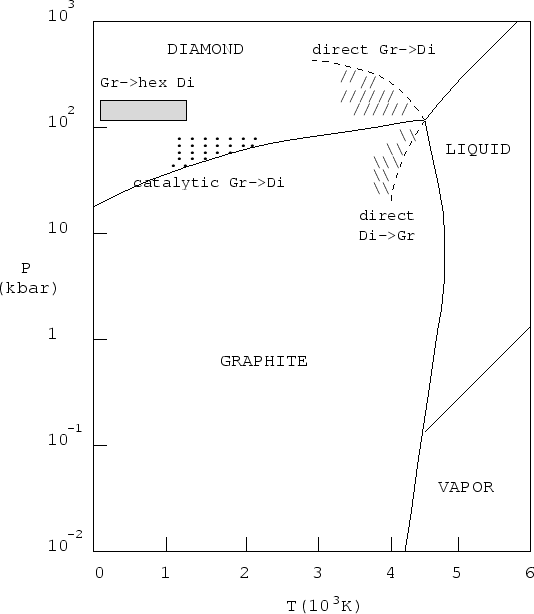
QUESTION:
I was wondering, is it
possible for electrons and protons to annialate each other? Even though
an electron is an elementary particle and a proton a baryon?
ANSWER:
No, it is not possible. If it were the
universe would become empty of mass.
QUESTION:
Do Newton's Three laws
relate to each other?
ANSWER:
I don't really understand
what you are asking. The three of them together form the basis of the
dynamics and statics of classical mechanics, and they are therefore
related in that they all address the same types of problems. On the
other hand if you are asking if one can be expressed in terms of
another, that is if they are in some way redundant, the answer is no.
Although many people write off the first law as simply a special case
of the second law, that is not correct and each of the three conveys
unique ideas.
QUESTION:
I'm currently in an argument
with a few friends, some of which are in engineering whether gravity
and the idea's surrounding it are covered as the Theory of Gravity or
the Law of Gravity.
I've been lead to believe that it is the Theory of Gravity and as such
it is concidered a law merely because it has been around for so long.
However, it is still JUST A THEORY.
Now if I'm wrong I'll recant and apologise to them.
So, is it the Theory of Gravity or the Law of Gravity. And do you have
any links or references that I could use to either prove or disprove it
either way?
ANSWER:
I would say that it depends
on how you define a law and a theory. Here are my definitions: a law is
a mathematical statement describing how something is
whereas a theory is an explanation of why something is.
Now, I assume that you are referring to Newton's universal law of
gravitation, namely F=-Gm1m2/r2.
This is an empirical law that tells you the force which two objects
exert on each other because of the gravitationsl attraction; it says
nothing about what the origin of this force is, that is why do two
objects which have mass attract each other. I would therefore say that
this is not a theory of gravity, it is a law of physics. On the other
hand, the theory of general relativity explains why two masses attract
each other (because the presence of mass "warps" the space around it}
and therefore is the operative theory of gravity. I should point out
that either a law or a theory might be applicable only in special
circumstances; for example, Newton's three laws of motion are
applicable in everyday life but when you try to extend them to very
large speeds or very small distances, they become inapplicable.
QUESTION:
;
while seeing from the ground
the towards the sky, the long distant flight emits smoke and the trail
of smoke behind looks like a cloud, like a rocket is going. Why is it
so.
ANSWER:
The condensation trail left behind jet
aircrafts are called contrails. Contrails form when hot humid air from
jet exhaust mixes with environmental air of low vapor pressure and low
temperature. Because of the high altitudes, contrails are composed of
ice crystals and become cirrus clouds.The mixing is a result of
turbulence generated by the engine exhaust. Cloud formation by a mixing
process is similar to the cloud you see when you exhale and "see your
breath".
QUESTION:
If I shoot a modern arrow
straight up into the air with a bow that exerts 75 lbs of thrust does
the arrow travel to the top of it's flight in the same amount of time
that it takes to fall back to earth?
ANSWER:
A freshman physics class would say yes but
that is if you neglect air friction. On the way up the arrow has two
forces on it: its weight down and the air friction also down. On the
way down it also has two forces on it: its weight down and the air
friction up. The problem is complicated somewhat by the fact that the
air friction force depends on velocity, so it is not possible, without
stipulations on the initial speed and the details of the air friction
to determine which will be quicker, up or down, but since the forces on
them are definitely different if there is any air friction at all, the
times will definitely differ.
.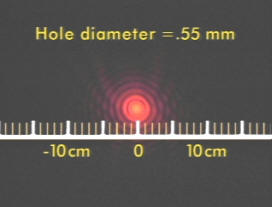
QUESTION:
What is the efect of the
shape and the thickness of the slit in a single slit diffraction?
ANSWER:
By "thickness" I presume that you mean the
width of the slit. This is part of the standard single slit analysis
and it is found, as the slitt gets narrower the pattern expands. The
shape also determines the nature of the pattern. The simplest (extreme)
example would be the pattern from a hole. An example is shown at the
right.
QUESTION:
My question relates to the
double slit experiment. It is my understanding that when photons are
"shot" one at a time through a double slit, the screen records
individual dots - the pattern of which (over time) will be "striped"
(i.e. consistent with a diffraction/interference pattern). Hopefully
what I just said is correct? Anyway, my question is: what happens if
only one single photon is shot (i.e. there is no stream of
photons)...is there an inteference pattern on the screen with this one
photon, or does the photon appear as a dot in the spot on the screen
where one would expect it to be based solely on the particle theory? In
a general sense, my question is whether the interference patterns
arises from previous photons interfering with later ones rather than
one particular photon intefering with itself? A related question is
what happens if a stream of photons is shot but there is a
"significant" time delay (not sure what time frame) between shooting
each photo n...i.e. does the interference pattern disappear in this
case (assuming this expt is technically feasible)?
ANSWER:
You will see a dot from a single photon.
However, it will retain some of the properties of the diffraction
pattern. E.g. it will not fall where the dark stripes would be
for this double slit and it will not (necessarily) pass straight
through like a simple particle would. It is far better to think of the
photon interfering with itself rather than other photons. Indeed, the
kind of experiment you refer to ("one at a time") is the same as that
you allude to at the end, that is you can shoot photons through at a
rate of one per hour and the diffraction pattern will still be there.
QUESTION:
if atoms can "last" for
about 1035 years, what happens to them? do they just cease
to exist?
ANSWER:
This is not a fact but speculation. It has
been proposed that protons, along with electrons the stable components
of matter in the universe, will ultimately decay. Nuclei are composed
of neutrons and protons and a free neutron decays to a proton, an
electron, and a neutrino. The most likely proton decays ultimately end
up as two photons and a positron. The positron then finds an electron
and they annihilate to two more photons. Other decay modes include
neutrinos also. So what happens is that when all the atoms disintegrate
the universe will be filled with photons and neutrinos. I must
emphasize that this has never been observed even though large,
elaborate experiments have been done to try to see proton decay. The
"standard model" of elementary particle physics does not predict proton
decay, that is the proton is stable in that model.
QUESTION:
if a penny is placed on a
rotating turntable, where on the turn table does the penny require the
largest centripital force to stay in place?
ANSWER:
The centripetal force is given by mv2/R
where v is the speed, m is the mass, and R is
the radius of the circle in which it is moving. The speed of an object
which is on a rotating rigid body (your turntable in this case) is v=Rw where
w is
the angular speed (in radians/s). Since w is a constant (every point on the turntable
has the same rotational speed), the centripetal force is mR2w2/R=mRw2.
So the force increases linearly with the radius, so the answer to your
question is the force is greatest on the extreme edge of the turntable.
QUESTION:
if I have the amount of
momentum an object has how can I convert that to the amount of
potential/kinetic energy the object has
ANSWER:
The kinetic energy is p2/(2m)
where p is linear momentum and m is the mass of the object.
There is no general relationship between the momentum and potential
energy; however, in cases where total energy is conserved, as the
kinetic energy decreases the momentum will decrease and the potential
energy will increase. So, for systems where energy is conserved, you
may write E=p2/(2m)+V where E
is total energy and V is potential energy. You can
now solve this equation for p.
QUESTION:
How do I make a guitar out
of scratch? My Physics class needs to construct an instrument out of
scratch and I don't know where to start. Can you help me?
ANSWER:
A guitar which demonstrates the principles
should be fairly straightforward to make. Probably not too good for
making music though. I would start by getting one guitar string and
stretch it between two nails on a board; it would also be good if you
made there be a way you could vary the tension, as the peg does in a
guitar. This is a rudimentary stringed instrument. You can demonstrate
that a plucked string makes sound and that the frequency (pitch) of
that sound gets higher as the tension in the string gets higher (how a
guitar is tuned). But the sound will be very small. That is what the
box of the guitar does--it resonates and thus greatly amplifies the
sound of the vibrating string. So get a box, wooden and closed on all
six sides. cut a circular hole in one side and stretch your string
across the hole; it would be best if the nails you strung the string
between were actually in the box. It would also be good if the wood was
not too heavy so that the wood itself can vibrate to contribute to the
sound. I have seen this kind of thing done with a wooden cigar box.
QUESTION:
What light source will
bounce/refract/reflect off of broken glass?
Will regular light, a laser, or some other source. Let's assume it is
clear glass
ANSWER:
Any electromagnetic radiation, and so any
light, when it strikes an interface between two media (for example air
and glass) will do two things: it will refracted into the material and
it will be reflected from the interface. The only exception is called
complete internal reflection where light inside glass, for example,
strikes an interface with a material with smaller index of refraction
with a grazing enough angle; it will reflect only, not leave the glass.
This is how fiber optics works. But that does not seem to be your
question and there will always be some light of any wavelength
reflected from glass in air.l
QUESTION:
How is it possible to
explain the movement of light with respect to its particle nature? that
particle will reach infinite mass due to the theory of relativity.
ANSWER:
Actually, the theory of relativity predicts
that any particle of zero mass must travel at the speed of light.
Photons are such particle. Until recently it was thought that neutrinos
were massless but we now know that they have a tiny mass. Although a
graviton has never been observed, it is believed that it travels with
the speed of light. A particle with a nonzero mass takes infinite
energy to accelerate to the speed of light, but photons have no mass
and so take no energy to accelerate to the speed of light since they
are already there.
QUESTION:
what math equaion can i use
to find PSI of water at diffrent hights.
ANSWER:
You want to calculate the
pressure at a depth d in a large body of water. The appropriate
equation is P=PA+rgd where
PA=105 N/m2 is
atmospheric pressure, g=9.8 m/s2 is the
acceleration due to gavity, and r=1000 kg/m2 is the density of
water. A N/m2 is called a Pascal (Pa). On the other hand,
you might want to compute the guage pressure which is the amount above
atmospheric pressure in which case PG=rgd; your tire pressures are measured in guage
pressure. Let's calculate an example. Suppose you are 10 m down. PG=1000x9.8x10=9.8x10⁴
N/m2=9.8x104/6895=14.2 PSI. Note that I have used
the conversion 1 PSI=6895 Pa.
QUESTION:
Is there any heat associated
with visible light? I know heat is usually in the IR range, but is
there any heat in the visible range? If so, how much and or is it
measurable? For example, when using a 100 watt halogen light bulb that
when turned on produces enough heat to melt wax. How much heat is IR vs
Visible Light?
ANSWER:
Radiant "heat" energy usually means energy
which arrives via infrared electromagnetic waves. However, there is not
really a precise definition. All electromagnetic energy delivers energy
to whatever it is absorbed by, determined by the intensity. The reason
that IR is usually called radiant heat is of biological origin: we are
mostly water and water absorbs IR radiation very efficiently. So, if IR
and visible light, each with the same intensity, strike you, more of
the IR is absorbed.
QUESTION:
A piece of ferromagnetic
material having mass m is rolled under a permanent magnet suspended
above. When it gets close enough, it's pulled up against the magnet,
rising by a height h. The total work done is therefore mgh (g =
acceleration due to gravity). Where did the amount of energy mgh come
from?
ANSWER:
This seeming simple question
is a quite difficult and subtle one. Since the explanation is too
lengthy to give here, I am giving you a link here
where you can study the details. Essentially, this is Faraday's law in
action: when the ferromagnetic material gets magnetized it is
equivalent to a current loop; when a current loop moves in an
nonuniform magnetic field an electric field is induced; this electric
field does the work.
QUESTION:
Assuming the speed of light
is constant--light emitted from the front of a motorcycle at rest will
travel at the same speed as light from a moving motorcycle. This means
that if the motorcycle travels down a road with a light mounted
perpendicular to the motorcycle that the light being emitted will not
gain the motion of hte motorcycle, that is motion perpendicular to the
motion of the direction the light is emitted will not by in anyway
added to form a resultant direction and motion of the light emitted.
Are the above statements correct? If not why? If yes, does this mean
that the absolute motion of the earth can be found by emitting lasers
tangent to its surface and measuring the difference from the expected
path?
ANSWER:
As soon as you start having
velocities which are not along the line of motion, it gets more
complicated. If you have a component of the velocity perpendicular to
the direction of motion, the velocity seen by a "stationary" will be
affected by time dilation but not by length contraction. Hence, the
transformation for the transverse (perpendicular) and longitudinal
(parallel) components of velocity are different. If you are really
interested, you can get a discussion
here. The amazing thing is that the speed of light still comes out
to be the same, but the direction is altered; that is, if the light is
emitted perpendicular to the direction of travel, the velocity seen by
a stationary observer is in a direction different from perpendicular
but still of the same speed. It does "gain the motion of the
motorcycle" but loses just the right transverse velocity so that the
speed stays the same.
QUESTION:
What work is being done
while you walk?
I say the floor is doing work on you since the the floor is exerting a
forward force and your direction of travel is in the same direction. Is
this correct?
ANSWER:
Walking is a pretty complicated thing
because it is a periodic series of accelerations and decelerations. If
we look at the time averaged situation there is a constant velocity and
therefore, since the kinetic energy is not changing, no work is being
done. You are correct that the external force which does work in the
short term, either speeding you up or slowing your down, is the
frictional force between the floor and your feet.
QUESTION:
Do carbon nanotubes burn in
vaccum? like in space?
ANSWER:
Nothing burns in a vacuum. Oxygen is
required for burning.
COMMENT FROM A
READER:
I noticed one wrong answer - a simple miswording, most likely. It was asked if carbon nanotubes would burn in a vacuum, and the answer was that nothing burns in a vacuum.
This is better worded as nothing burns without oxygen, as some molecules are self-oxidizing, or can burn without a vapor atmosphere as long as an oxidizer is present.
QUESTION:
Do electrons move slower in
a colder environment, like air molecules move slower in a colder
environment, if not why?
ANSWER:
Yes. An important concept in physics is that
of an electron gas; this provides a good model for valence electrons in
a conductor since the valence electrons are essentially free to move.
And the average speed of the electrons deterrmines the temperature of a
gas just like in any other gas.
QUESTION:
You have a muon, which is a
fundamental particle(a fermion) like an electron, whose mass lies
between an electron and proton. It's lifetime is approximately 2.2
micro seconds. It then decays into a neutrino and antineutrino. My
question is this. Since neutrinos have at best an extremely tiny mass,
surely an antineutrino and a neutrino's combined mass does not equal
the mass of the muon. So where does this extra mass go when a muon
decays?
ANSWER:
For starters, you have it wrong regarding
the decay. A muon is either postively or negatively charged and the
neutrino or antineutrino is uncharged; therefore the decay mode you
assume would violate charge conservation. The most common decay of a
negative (positive) muon is m-®e-ne*nm (m+®e+nenm*
) where an asterisk
indicates an antineutrino. So you get one electron (positron), one
neutrino, and one antineutrion. But your question is still pertinent:
where did the missing mass go? There is no law that mass must be
conserved (in spite of what was postulated by 18th century
chemists!) What must be conserved is total energy. Although in recent
years it has been discovered that neutrinos have a small mass, it is so
incredibly small that I may neglect it in this discussion. What must be
conserved is energy and mass is a form of energy. Thus, assuming that
the muon which decays is at rest (not necessary), the energy before the
decay is Mc2 where M is the mass of the
muon; after the decay the energy is mc2+T
where m is the electron (or positron) and T is the
summed kinetic energies of the three decay products. We then equate
energies before and after to conserve energy. So the missing mass shows
up as kinetic energy. Since Mc2>mc2,
it is not possible for all the decay products to be at rest after the
decay.
QUESTION:
;
If a radio signal is bounced
off an object that is directly above the sending or receiving station,
the signal strength is stronger at the receiver than if it bounces off
an object that is midway between the two stations. I have been able to
confirm this phenomenon in several books, but they all fail to explain
WHY. I tried to figure it out with optics, but was unsuccessful.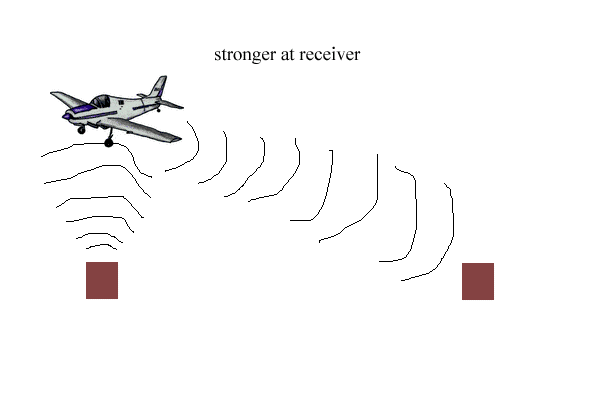
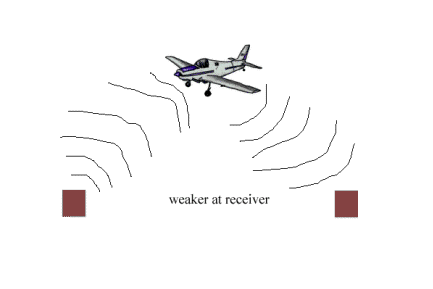
ANSWER:
Since radio signals fall off
roughly like 1/r2 (r is how far it travels) I
thought that this would be a relatively simple problem of calculating
the distance of the path of each and finding that the over the
transmitter path was shorter. However, choosing the height as 10 and
the ground distance as 500 (units are unimportant for qualitative
understanding), I found that the stronger at the receiver situation had
a longer path (about 510) than the weaker at the receiver
situation (about 500). So that ain't it! Next, the plane is not a
perfect reflector, so maybe that has something to do with it. I now
calculated, assuming a loss of half the signal upon reflection (and
still 10 and 500 distances), the following two scenarios: (I will call
the intensity at the transmitter I.)
- For the plane directly over
the receiver, the intensity it sees I/100 and the reflected
intensity is I/200. Now, that signal must travel a distance of
(102+5002)1/2, very close to 500. So
the final intensity is (I/200)(1/5002)=2x10-8I.
- For the other situation, the
intensity at the plane is I/(102+2502)=1.6x10-5I
and the reflected intensity is 0.8x10⁻⁵I . Now, the
distance to the receiver is (102+2502)1/2,
very close to 250. So the final intensity is (0.8x10⁻⁵)(1/2502)I=1.28x10-10I,
substantially smaller.
So, I surmise, the reason is the
fact that a much larger signal eminates from the plane when it is close
to the transmitter.
CORRECTED
ANSWER:
It has been pointed out to me that my calculations above
would have arrived at exactly the same conclusion without the loss of
half the signal upon reflection. In fact, that is completely right:
just multiply both answers by 2 for 100% reflection and the conclusion
is still the same! So, it has nothing to do with the reflectivity of
the plane but rather with the strength of the signal at the time of
reflection. I stand corrected!
QUESTION:
Why is there no sonic boom
from light or radio transmissions?
ANSWER:
A shock wave (sonic boom in the case of
sound) happens if the source of the waves is moving faster than
the waves themselves. Another example of a shock wave is the wake of a
boat if the boat moves faster than the water waves. Light and radio are
electromagnetic waves, not their sources. If you had a light source
moving faster than the speed of light, there would be a "lumen boom".
However, as you probably, nothing can go faster than the speed of light
in a vacuum. However, light travels more slowly in a material, for
example glass or water; then if a particle travels faster than that
light speed, shock waves occur. This is often seen in the water
surrounding a nuclear reactor since energetic subatomic particles
passing through the water are moving faster than the speed of light in
water; it is seen as a blue glow.
QUESTION:
If I have two cylinders, one
with an inside cross sectional area 2 square inches, and the other with
an inside cross sectional area of 1 square inch; each cylinder has an
airtight piston with an attached handle; each cylinder is the same
length; and each cylinder has a nozzle with an inside diameter of .5
inches; which cylinder will suck up more water with the nozzle if an
equal amount of force is exerted on the handle? And what are the laws
of physics that would govern this situation?
ANSWER:
You need the continuity equation and
Bernoulli's equation to do this. I find it easier to think about the
fluid moving the other way which is equivalent, so that is how I will
do it. I will use the following notations: at the the nozzle the speed
of the fluid is v2, the cross sectional area is A2,
and the pressure is P2; at the piston the speed of
the fluid is v1, the cross sectional area is A1,
and the pressure is P1.
The pressures are P1=PA+F/A1
and P2=PA where PA is
atmospheric pressure and F is the force applied. The continuity
equation states A1v1=A2v2;
this simply says that the rate of fluid in is the same as the rate out.
So, you may solve for v2 which is not of interest to us: v2=A1v1/A2.
Now, Bernoulli's equation says that P1+rv12/2=P2+rv22/2
where r
is the density of the fluid. (This is not the most general form; if the
nozzle and were at significantly different altitudes y then
there would be a rgy term added to each side of the
equation.) Now, if you do all the algebra you will find that v22=2FA12/[(A12-A22)r]. One important
thing to note is that if A1 is much greater than
A2 the speed out is independent of A2:
v2@2F/r. For your cases, A2=.5,
A1=1, and A'1=2 (units are
not important since the areas enter as ratios), then v22=2.67
F/r
and v'22=2.13 F/r so the thinner
piston moves fluid through the nozzle faster.
QUESTION:
If I drive slowly on my dirt
road it rattles my teeth. If I drive fast it feels better. What's best
for the suspension of my truck (and my teeth)? Driving fast or slow?
ANSWER:
If you have a bump and go over it you
experience an acceleration and Newton's second law says there must be a
force causing the acceleration. The faster you hit the leading edge of
the bump the greater the acceleration, so the greater is the force you
feel. This is basically how speed bumps work, However, if there is a
series of small bumps relatively close together the inertial of your
car might carry you from one to the other so that you do not have to go
up the leading edge. Also, since your springs are relatively stiff, a
high bumping frequency has the wheels bouncing but the car (and you)
not moving as much whereas at a slower speed the car and wheels and you
move more as one. I guess my rambling says you should go faster (as
long as you can maintain control).
QUESTION:
Is it possible the reason
why Electrons do not fall into the nucleus is; the closer an Electron
gets to the nucleus it's charge is diminished, or it begins to become
more positive and repelled? 2nd, the reason why it does not fly away
from the nucleus is; the farther away it gets from the nucleus, it
becomes more Negatively charged?
ANSWER:
Your suggestions are not
possible. One of the most sacrosanct of all physical laws is
conservation of electric charge. The charge of an electron never
changes under any circumstances.
QUESTION:
I have a question that no
one seems to be able to answer. If mass can be converted to energy at
the speed of light, under what condition(s) can energy be converted to
mass? I am trying to imagine what the inverse of the speed of light
might be.
ANSWER:
I do not know what you mean by "converted to energy at the speed of light"'
or "the inverse of the speed of light"; let's just say that mass may be
converted into energy. I take it your question is then "under what
condition(s) can energy be converted to mass?" Well, any condition you
like provided that rules like charge conservation, energy (including
mass energy) conservation, and momentum conservation are obeyed. Here
is one example: the nucleus of an atom has a mass smaller than the sum
of its parts (neutrons and protons). If you now disassemble the nucleus
you will, of course, have to add energy (that is, do work) which shows
up as increased mass of the system. Note that the inverse is also true,
that is if you take a bunch of neutrons and protons and push them
together you will get a net gain of energy by creating the final
nuceus; this is how stars work.
QUESTION:
Is it possible to create
elements like gold or titanium in the nuclear fission/fussion reactor?
Is it likely that we would be able to create at least a few atoms of it
sometime in the future?
ANSWER:
Not only is it possible, it happens all the
time. By definition, a fusion or fission nuclear reaction starts with
fuel and turns it into something else. In the case of fission, take
uranium, for example. When it fissions, it splits into two nuclei.
Those that you give as examples, gold or titanium, are unlikely (not
impossible) because the distribution of fission products tends to fall
mostly between rubidium and gadolinium (see
Wikepedia for more detail). For fusion, we get the sum of the
fusing nuclei, for example hydrogen plus hydrogen fuses to helium,
helium plus carbon fuses to oxygen, etc. Inasmuch as the early
universe was all hydrogen, the very existence of other elements today
proves that they were created (in stars) via fusion.
QUESTION:
I am interested in
determining the amount of friction (and subsequently heat) generated in
primitive friction fires. I have read about calculating coefficients
for static and dynamic friction, and am wondering if there is another
formula that is more applicable. The fire-making method I have in mind
involves the rotation of a wooden dowel (with a rounded tip, like a
half-sphere) in a wooden socket with a corresponding half-spherical
shape. I would like to be able to compare the amounts of friction for
various wood species, and use that information to determine how much
heat can be generated with a given diameter dowel. Any help would be
greatly appreciated.
ANSWER:
Friction is a very tricky thing. In its
simplest form, the frictional force, which will determine the heating
rate, is proportional to the normal force (how hard the two are pressed
together. In your case, however, the temperature varies and so the
proportionality constant (coefficient of friction) will not be a
constant at all but vary with the temperature. Physics is not just a
theoretical science but equally an experimental science. In a situation
like yours, the best way to study this problem is to do experiments.
QUESTION:
Are there places in an atom,
where the electrons are located, that make it more likely that
electrons will form bonds?
ANSWER:
I am not sure what you are asking. The
electrons most involved in chemical properties of atoms are the valence
electrons which are generally the outermost electrons.
QUESTION:
Why does light get dimmer as
it gets farther away?
ANSWER:
If you have a source which is radiating in
all directions, like a light bulb, then if you get a distance from it
which is large compared to the size of the filament, then, as you say,
the light gets dimmer as you get farther away. That is because light
carries energy and that energy gets spread out over a larger and larger
area as you get farther away. The intensity of light is defined as the
energy crossing a square meter in a second and that gets smaller, of
course, as the available energy spreads out. Not all light gets dimmer
as you go away: a laser is light which does not spread out but stays in
its narrow beam, so the spreading is very small so the intensity is
very nearly constant as you go farther away. Laser beams have been shot
to the moon, reflected back, and lose very little intensity.
QUESTION:
do have more than one point
free of electrical filed in a square with 4 charges at its edges
ANSWER:
I assume you mean equal
charges. Field will also be zero infinitely far away.
QUESTION:
Of what matter is moon made
of ?
ANSWER:
See
http://www.nasm.si.edu/exhibitions/cchoice/moonrocks/moonrocks1.htm
QUESTION:
I have heard that cold can
eventually "seep" through anything, no matter what it is made of. I was
wondering if this is correct.
ANSWER:
"Cold" is a qualitative concept and it is
meaningless to ask if "it" can "seep". If you have two objects with
different temperatures, then energy will be transferred from the higher
temperature to the lower temperature until equilibrium is reached
(equal temperatures); this will happen regardless of what is between
them (provided that it is an isolated system) since there is no perfect
insulator. The energy transfer, if there is a vacuum between them, will
be accomplished via radiation.
QUESTION:
Please tell me if you know
how to separate water into gasses with electricity or any other way for
that matter. - I would like the most to know how to do it at home and
possible safe one too, but anything is better tan none so please give
me any info that you can on this topic.
ANSWER:
Check out
http://www.reachoutmichigan.org/funexperiments/agesubject/lessons/energy/split_h2o.html
QUESTION:
I was watching the science
channel today and was learning about the theory of dark matter. I had a
fundamental issue with this idea because it simply places a unknown
into an equation that satisfies the answer which we expect/is projected
based upon our own understanding of physics. This idea simply seems too
easy a solution. I began thinking about quantum physics of which I know
little to nothing about. What I do know is that quantum physics is
necessary because the laws of physics which apply to our daily life at
human scale do not apply to that of subatomic particles. The show was
trying to explain the reasoning behind galactic rotation. The show
stated in order for galaxies to rotate at a uniform speed from their
inside to their outside without the galaxy destroying itself there must
be necessary unseen mass(Dark Matter). My question is why if on a small
anatomic scale physics is altered making mass behave differently
wouldn't it also, on a much larger scale relative to daily human life,
make particles also act in a completely unique form of physics? I was
wondering this because although it is a generally baseless theory the
idea would make dark matter totally unnecessary.
ANSWER:
Most astronomers and astrophysicists
seemingly have no problem postulating the existence of dark matter to
explain many observations which seem to indicate its presence. However
others, like myself, find this to be sort of akin to the postulation of
the "luminiferous aether" postulated to provide a medium through which
light waves could propogate. What you are suggesting is, in fact, quite
reasonable: until we can test with precision that our laws of nature
are the same at very large distances, it is somewhat presumptive to
assume that they must be. I should warn you, however, that most
mainstream astrophysicists would not be in agreement with this point of
view.
QUESTION:
If the earth suddenly
shrinks to half of its present radius, the acceleration due to gravity
will be what?and why?
ANSWER:
Assuming that the mass remains the same, the
gravitational force, and thus the acceleration due to that force, would
increase by a factor of 4 because the gravitational force is inversely
proportional to the square of the distance from the center.
QUESTION:
What is the temperature of
fire?
ANSWER:
It depends on many things, like what is
burning, what the environment is like, etc. Typical
temperatures are around 1500o C. A little more detail on
different kinds of fires may be found on
Wikepedia.
QUESTION:
Is it possible for a
helicopter to hover above the Earth and have the Earth move under as it
rotates so that the helicopter would "travel" around the Earth in 24
hours?
ANSWER:
Inasmuch as the earth drags its atmosphere
with it, the helicopter would have to travel at a speed much larger
than helicopters go relative to the air to remain in the same position
in space as you stipulate. So, no it is not possible.
QUESTION:
What happens to the atomic
number and mass number of a nucleus when it emit (a) a positron? (b) a
gamma ray?
ANSWER:
- charge decreases by one unit, so atomic number decreases by
one; mass number stays the same.
- mass number and atomic number are both unchanged
QUESTION:
I am a 9th grade student
currently attending Nelson County High School in Kentucky. The other
day i learned in physics class that light travels slower through glass
than it does through air. Does this mean that light travels slower
through matter of lower energy?
ANSWER:
Light in a vacuum is the fastest thing in
the universe. Light traveling through any medium is therefore slower.
The fact that light travels more slowly through a medium like glass is
why lenses work. I do not understand what you mean by "matter of lower
energy".
QUESTION:
Will carbon molecules hold
an electric charge, i.e. could carbon be magnetised?
ANSWER:
Don't know just what you
mean. Yes, you can make a C negative ion, that is add an electron to
it. However, this has nothing to do with its being "magnetised". I
think what you must mean is can you make carbon ferromagnetic. The
answer is no since ferromagnetism depends on the crystaline structure
of the material and the interaction of the outermost electrons with
their neighbors, and it is most unlikely that you could make carbon do
this. All materials are "magnetised" in some sense, either paramagnetic
(attracted to a bar magnet) or diamagnetic (repelled); the effects are
much weaker than ferromagnetism.
QUESTION:
If there are four
fundamental forces--gravity, EM, weak and strong--how does the Casimir
force fit in this scheme?
ANSWER:
The Casimir force has its
origins in the electromagnetic force (vacuum fluctuations of the
electromagnetic field). You can read a nice discussion at Physicsweb.org.
QUESTION:
If one were to release a
standard, 20 lb., 8.5 x 11 inch sheet of white copy paper from, say,
the space station, with adequate velocity to exit orbit and fall toward
earth. Could it survive the trip? I seem to be the only one to believe
that it could. The strongest claims against this theory so far have
been meteorological- perhaps it becomes soaked with water, etc. what do
you rhink?
ANSWER:
The possibility of water
causing shoul not even be considered since, obviously, passing through
a good thunderstorm could certainly cause the paper to go to pieces.
The situation would depend on the speed at which the paper was moving
when it hit the top of the atmosphere. For example if you just
"dropped" it, that is caused it to fall straight down (which would
actually mean giving it a velocity of about 18,000 mi/hr opposite the
shuttle, I would guess it would make it since it would hit the
atmosphere with a relatively small velocity. On the other hand, if you
released it with just slightly less speed than the shuttle has but
enough less to leave orbit, my guess is that when it hit the top of the
atmosphere that it would "burn up" and be destroyed.
QUESTION:
i've noticed many
similarities between gravitational fields and electric fields. Is there
an analog in electricity to a black hole?, an infinite electric field
with infinite charge at a point? If not, why not? If so, what sort of
physical reproductions does (or would) this have on surrounding matter?
ANSWER:
The answer is no because a black hole forms
because the gravitational force is attractive and so as you add more
and more mass to an object it eventually collapses under the huge
gravitational force (this is a bit of an oversimplification, but
essentially how a black hole forms). The electrical force, however, is
repulsive, so you the more charge you add the more the object wants to
fly apart.
QUESTION:
is it possible to trap light
in a box if it were filled with mirrors? and since things have color
because of light ( ex.blue things reflect blue light and absorb all the
others) when there is no light is everything actually invisible?
ANSWER:
Light would be trapped only for a very short
time after which it would be absorbed by the mirrors (heating them up
slightly); there is no such thing as a perfect mirror. For some numbers
showing how quickly the light would disappear, see one of my previous answers. Regarding
your second question, if you define "visible" as being able to be seen
by the human eye, then, yes, things are invisible if there is no light.
QUESTION:
If the sun were to disappear
in an instant, would the Earth spin off into space IN DARKNESS?? or
would the "final light" from the sun, taking some 7-plus minutes to
reach Earth, arrive prior to the "release" of magnetic pull/gravity
occurrence as experienced on/by Earth? Perhaps my question has to do
with the nature of gravitational pull--is it a "chain/rope"-sort of
essence or some sort of wave, which would, I think, have to be at or
less than the speed of light and means the light would go out first. I
find my uninformed bias is toward the "rope" form, in which case we
would by leaving orbit while the sun was still shining on Earth.
ANSWER:
The speed at which a gravitational field
propogates has not, to my knowledge, been measured. It is generally
believed that it propogates at the speed of light. Thus, the earth
would leave orbit and go dark simultaneously. In any case, no physicist
would believe that the appearance of any force would be instantaneous.
QUESTION:
Heres a physics question...
I have a rubber band and three toothpicks. I loop the rubber band
around two of the toothpicks, and hold them apart, stretching the
rubber band. I have someone hold the two end toothpicks. I then slip
the 3rd toothpick in the dead center of the rubber band, and start
twisting it, winding the rubber band from the center. Then, I let go of
the center toothpick, at the same time as my buddy lets go of ONE of
the end toothpicks. The third toothpick is still held firm. The
question is: Which toothpick spins faster, the center one or the end
one. And more importantly, WHY? What physical theory causes this?
ANSWER:
First, since the the speeds
will depend on when you look at them, let us revise your question so
that we ask which will have the biggest acceleration at the start, that
is which will acquire the greatest speed in the first short time. Your
question is equivalent, at the beginning, to masses on springs. The
middle toothpick is analogous to a mass attached to two identical
springs, each stretched by some amount. The end toothpick is analogous
to the same mass but attached to one spring stretched by the same
amount. So when you first release them, the one with two springs has
the greater acceleration. This will only be true immediately after
release because the half of the rubber band between the two movable
toothpicks will untwist faster.
QUESTION:
If you built a machine that
would swing a weight and "kick" a ball along the ground, controlling
all the variables, excepting that you double the weight, why would the
distance the ball travel only be 30% more?
ANSWER:
You have not given me enough information
about the machine, but a little consideration of the answer leads me to
think that the machine must simply be the head-on elastic collision
between two balls of different masses, one initially at rest. If the
"kicker" has a mass M and incoming speed V, and the
ball has a mass m and is at rest, then if you
conserve both momentum and kinetic energy you will find the ball,
after the collision, has a speed v'=2mV/(M+m). So, let us do two
numerical examples:
- If M=m, then v'=V.
- If M=2m, then v'=(4/3)V.
Guess that answers your question
since the distance the ball travels (while experiencing a constant
retarding frictional force) is proportional to the initial speed.
QUESTION:
In the acoustic doppler
effect, i have found that the higher the original frequency, the
greater the shift in frequency.
ANSWER:
Quite simply it is because
the frequency difference is proportional to the original frequency. In
terms of a percentage change, there is no dependence on frequency.
QUESTION:
Does a hockey puck reach
it's maximum velocity at the last instant of contact with the hockey
stick, or is there such a thing as (for lack of the proper terminology)
'residual acceleration' I have considered this at great length..
>From what I know in physics if there is no longer force being
applied to the puck there should not be any accelertion after the
contact....
Almost a logical deduction.. however seeing replays and it's almost an
instinct telling me that I might be wrong.. It doesn't feel like the
stick is travelling at a the same velocity as the puck is.. 100mph
shots and all.. Perception maybe different than reality.. anyway, if I
am wrong and there the puck continues to accelerate for a short
distance after leaving the stick,. it's because of the flex in the
stick, the energy transfered into the puck has not fully caused it to
accelerate.. possibly like the flex in a golf ball..
ANSWER:
A short answer to your long
question: The puck cannot continue to accelerate (gain speed) after it
leaves the stick. In the physics sense, it does accelerate but with a
negative acceleration, that is it slows down.
QUESTION:
my question is how is the
current flowing through the different resistors connected in series
same f it is an axiom, then its ok. but if it has reason behind it,pls
tell me
ANSWER:
No, it is not simply axiomatic. The reason
is the conservation of electric charge. Consider just two resistors
connected in series. A certain amount of electric charge enters one
resistor in a certain time (electric current). Similarly, a certain
amount of charge exits the other resistor. If the charge out is less
(greater) than the charge in, where is the charge going to (coming
from)? Electric charge cannot be created or destroyed, and since it is
not piling up or being drawn from either resistor, the charge in must
equal the charge out so the current in each is the same.
QUESTION:
I've always wondered if
"time" is a man-made concept or if it really exists. I've heard that
the fourth dimension is time, is this true?
ANSWER:
This is more a philosophy than physics
question. As a physicist, I would say that time exists independent of
my perceiving it. Our intuitive notions of time, such as that time is a
universal thing throughout the universe for all observers is now known
to be incorrect. Two identical clocks given to two different observers
will definitely not run at the same rates if the observers are moving
with respect to each other. This is the unavoidable consequence of the
theory of special relativity. Time is the fourth dimension in the sense
that when it is realized that time and space are entangled with each
other, the result again of special relativity, the mathematics of the
physics involving both space and time is very similar to the
mathematics of a four dimensional space. For example, motion in three
space may be described as a rotation in four space.
QUESTION:
A 50cm silver bar becomes
shorter by 1mm when cooled.How much was it cooled? coeff. of linear
expn=.000018/c.
Which should be my original length ? 50cm or (50-0.1)cm?
ANSWER:
The equation you use, presumably, is
DL=aDT=a(Tf-Ti)=(Lf-Li).
Since Tf<Ti
you must have Lf<Li so Li=50 cm.
QUESTION:
My cousin and I have a
dispute about the flushing power of a standard 1.6 gallon flush toilet,
versus an old-fashioned 5-gallon flush model. I use a lot of toilet
paper, and therefore must flush 2 or 3 times with the newer 1.6 gallon
models, or risk a clog, which has happened to me far too often. I
maintain that the 5-gallon flush model will be much more likely to
prevent clogs. Is there a formula for computing the pressure of a 1.6
gallon flush versus a 5.0 gallon flush? How would that be
mathematically computed with precision?
ANSWER:
There is no reasonable way
to compare them mathematically since they have different designs. The
low usage one is supposed to be designed to have comparable disposal
capabilities. Even if you are right that you, as an individual, must
flush more than once, from a conservation point of view it would still
be better to have an efficient toilet because you are likely not the
only user. My son uses way too much paper also and every once and a
while it clogs; I just pull out the old plumber's helper and in no time
all is well.
QUESTION:
Hello, I have solved this
question part of the way, but cannot figure out the end result! The
question is: In an x-ray imaging system operating at 70 kVp, each
electron arrives at the target with a maximum kinetic energy of 70 keV.
Because there are 1.6 x 10^-16J per 1keV, this energy is equivalent to
the following: (70keV)(1.6 x 10^-16J/keV)=1.12 x 10-14 J
Inserting this energy into the expression for kinetic energy and
solving for the velocity of the electrons, the result is: KE=1/2mv2
v2=2KE/m
v2=(2)(1.12 x 10⁻¹⁴ J)/(9.1 x 10-31 kg) =0.25 x 10¹⁷ m2/s2
I can get that far....the end result is: v = 1.6 x 10⁸ m/s
If i use the equation v= mv2, I get:
v = (0.25 x 10¹⁷) (0.25 x 10¹⁷)2
which gives me - v=(0.25 x 10¹⁷)(0.063 x 1034)
and my answer comes out to v = 1.6 X 1051 m/s
How do they get the answer v = 1.6 x 10⁸ m/s ?
ANSWER:
This looks like a
homework problem which the groundrules of my site prohibit! However, I
will give you the hint you need: your expression KE=mv2/2 is
wrong; this expression is true only for very slow (compared to the
speed of light) particles. The correct expression is KE=E-moc2
where E is the total energy, mo is the rest mass,
and c is the speed of light. E is given by E=(mo2c4+p2c2)1/2
where p is the linear momentum given by mov/(1-v2/c2)1/2.
Also, your equation v=mv2 is obviously
incorrect because it could be simplified to mv=1 which is
nonsense!
QUESTION:
My 11 year old has asked me,
"Does gravity bend light?" I did highschool physics about 20 years ago,
so am very rusty and not up to date with current thought. I have looked
at this discussion topic on the archives of many forums, but have ended
up very confused by the differing opinions/explanations. I would really
like an answer which is easy to explain to a child, but yet not so
simplistic that it is inaccurate. Am I asking the impossible? She has
read about the nature of light and also about gravity, and can't
understand how light can be affected by gravity, when it has no mass.
Is it because photons are energy and so can be used instead of mass? Or
is it that the gravitational pull around massive stars affects the
"space" around it and light just follows the stretched paths? If this
is true, how can some authors say that the light is still moving in a
straight line even when it is following a curved path?
ANSWER:
Here
is one explanation, probably the easiest for your daughter to
understand: Light being affected by gravity is a result of the
principle of equivalence in general relativity. This states that there
is no experiment which you can perform to distinguish between your
being in a gravitational field or in an accelerated frame of reference.
Thus, for example, imagine that you are in an elevator which
accelerates upward; if light enters through a hole in the side of the
elevator it will clearly appear to fall like a projectile because of
the acceleration of the elevator. So, the same thing will appear to
happen in a gravitational field the acceleration due to which is
exactly the same as the acceleration of the elevator. Hence, light
will "fall" in the earth's gravitational field with an acceleration of
9.8 m/s2. You might be interested in the answer to an earlier question.
Here is
another: If we look at the world as having a Euclidean "flat" geometry
and watch a ray of light pass a very massive object, we see the light
bend. But, the way that general relativity describes the world
says that, if we are in the vicinity of a massive object the space
itself is not Euclidean but is curved; in this space the light follows
a "straight line" in that non-Euclidean geometry.
QUESTION:
what is error on T when T =
1.04 * sin (2.8 ± 0.2)/ sin (58.2 ± 0.2)
ANSWER:
The largest contributor to the error will be
the sine in the numerator since sine is small and changing rapidly at
small angles so a relatively small uncertainty in the angle will lead
to a large uncertainty in the sine of the angle. You can get a rough
feeling for the percentage of the uncertainty by estimating the percent
error of that term: (sin2.8-sin2.6)/sin2.8=0.071=7.1%. What you need to
know is that the uncertainty of the sin(A±a)
is approximately cos(A)*a (because d[sin(x)]={d[sin(x)]/dx}dx) and that
the percent uncertainty of a ratio (A±a)/(B±b) is approximately a/A-b/B. Putting your
numbers in I get about 6.7% (in accord with our rough estimate)
uncertainty for T, or about ±0.004. {When you are doing your calculations
it is important that angles (and their uncertainties) are expressed in
radians, not degrees.}
QUESTION:
Does the flow of linear time
as we percieve it (disregarding its pyschological variations) vary as
you get down to the level of quantum mechanics? Secondly, if so, I've
read at that level, all time is simultanteous, that it doesn't exist at
all at that level. Is this true, and why?
ANSWER:
The answer to your question is that we do
not know. Read my earlier
comments related to this question. Regarding your second question,
I never have heard it said that "all time is simultanteous" whatever that means. I have read
that it is the opinion of some very deep thinkers that the reason that
not much progress has been made in unifying gravity and quantum physics
is that we really do not understand time very well.
QUESTION:
how is it possible that
light can be both a particle and a wave! i need to know it's ruining my
whole life.
ANSWER:
Ruining your whole life? How is it possible
that my tie can be both red and green? That is just the way it is. I
know that this is an unsatisfying answer, but science is based an
measurements (experiments) and if you study light and look for a wave,
you will find one but if you look for a particle you will find that
also. This is called the wave/particle duality and it is, essentially,
a statement of experimental fact. And you can do experiments which
unambiguously see both possibilities in the same experiment. The best
known example is to do a double
slit experiment with very low intensity. If the intensity is so
low that there is, say only 1 photon per minute passing through, then
it has to pass through one slit or the other, right? Wrong--you still
get an interference pattern. So, you say, light is therefore a wave,
not a particle. But, imagine that the screen detects the light using
the photoelectric
effect which cannot be understood unless you treat the light as a
collection of photons. This detector will work perfectly well in
displaying the interference pattern. This duality is not unique to
light: any particle will exhibit wave properties; e.g. that is
how an electron microscope works, by exploiting the wave properties of
electrons. Maybe I shouldn't have told you this since it may compound
your life-ruining distress! Wave/particle duality is a reality of
nature, that is all.
QUESTION:
A sample of a particular
radioisotope is placed near a Geiger couinter, which is observed to
register 160 counts per minute. Eight hours later, the detector counts
at a rate of 10 counts per minute. What is the half-life of the
material?
ANSWER:
This sounds suspiciously like a homework
problem to me! However, I will outline how to do it but not do it to
its final answer. The activity of a sample (counts rate) is an
exponential function: A(t)=A0exp(-lt) where A(t)
is the activity at time t and l is the decay constant related to the halflife by t=ln(2)/l. Since you know A
at two times (I would call the first one t=0), this equation is
actually two equations for two unknowns (A0 and l), so you can solve for l which gives you t.
QUESTION:
WHEN A 1,000 POUND PLANE HAS
WINGS THAT ARE BANKED AT 45* DURING A LEVEL TURN, THE CENTRIPETAL FORCE
ON THE PLANE IS EQUAL TO THE WEIGHT OF THE PLANE. USE THE PYTHAGOREAN
THEOREM TO FIND THE LOAD ON THE PLANE. [LOAD=WEIGHT+(CENTRIPETAL
FORCE)]
A. ABOUT 2,000 POUNDS
B. ABOUT 707 POUNDS
C. ABOUT 1,414 POUNDS
D. ABOUT 500 POUNDS
ANSWER:
This looks suspiciously like a homework
problem to me which are forbidden by the groundrules. However, it is
sort of interesting to me because it doesn't make a lot of sense. I
would have thought that load would be defined as the net force on the
plane. However, load is defined here to be the horizontal component of
the force the air exerts on the plane plus the weight (which is, of
course, vertical). This force has a magnitude of the square root of
10002+10002, so C is the answer with the direction pointing 450 below
horizontal. If the load were the force the air exerts on the plane, the
answer would still have a magnitude of 1414 lb but would be in a
direction 450 above horizontal. If the load were the net force on
the plane the answer would be 1000 lb horizontal.
QUESTION:
Does the wavelength of light
affect how brightly it shines?
ANSWER:
No, "brightly" is determined
by the amplitude of the wave and not by its wavelength.
QUESTION:
What is light?
ANSWER:
Wow, that is a concise question. The answer
is not! The nature of light has been of great interest over the ages.
Once science became a legitimate pursuit (as separate from philosophy)
the debate centered around whether light is some kind of wave or some
kind of particle. Newton thought it was a particle; it was later
demonstrated (in the early 19th century}, however, that
light behaves like a wave; see my earlier answer to a
similar question for more background. What was actually doing the
waving was a mystery until later in the 19th century when
Maxwell showed that light is waving electric and magnetic fields;
again, see my earlier answer.
Finally, at the beginning of the 20th century Einstein, in
explaining the photoelectric effect, found that light exists in
quantities no less than what is called a photon, one quantum of the
electromagnetic field. Hence, light really is like particles, a swarm
of photons. We finally understand that light is both, a situation
called the wave/particle duality; if you look for a wave you will find
one and if you look for a particle you will find that also.
QUESTION:
do all orbits in space
deteriorate? If not, why? Is it possible that the Earth's orbit could
deteriorate (as well as Mars, etc.) and cause global warming trends?
ANSWER:
For an orbit to "deterioate" (we usually use
decay to describe this), the orbiting object must lose energy. It can
do this by colliding with stuff, mainly gas and dust so that the energy
loss could be thought of like air friction on earth only much smaller.
An orbiting object will also lose energy by radiating gravitational
waves; this has been seen for some binary star systems. But, for the
earth, these are totally negligible and certainly have no effect on
global warming. The distance to the sun is much less influential than
the angle that the rays from the sun hit us; we are actually farthest
from the sun during summer.
QUESTION:
what would happen if there
was too much air pressure?
ANSWER:
Well, you don't stipulate what "too much"
is, so I will address an extremely increased pressure. The pressure due
to the atmosphere is about 1 ton per square foot. So why doesn't this
pressure crush you? The reason is that we have evolved in this
environment so that the pressure inside our bodies is about one
atmosphere; every cell in your body has a pressure inside which keeps
it from being collapsed. Now suppose that you double the pressure
outside. The pressure inside does not change and so you are crushed by
the net force in on you. One of the first things to go is your eardrums
which should not surprise you if you have ever dived to the bottom of a
swimming pool where pressure increases fairly dramatically.
QUESTION:
My questions pertain to
gravitational potential energy. Sepcifically, I'm a little confused
about how it works. My understanding is that when an object is moved
away from the earth (upwards) it gains gravitational potential energy
that is transformed to kinetic energy if and when it falls back toward
the earth. This understanding leads me to two questions. First, what
happens to that potential energy once an object moves beyond the
gravitational feild of the earth? Does that object still retain the
potential energy it gained as it moved away from the earth? Second, why
must I exert energy to hold something in a constant position relative
to the earth? for example, why must I exert energy to hold a text book
above my head. It is not moving towards or away from the earth, so is
not gaining potential energy, yet I am exerting energy by holding it up
against the force of gravity. On the other hand, a table does not exert
any energy in accomplishing the same feat. So w hat gives? where does
that energy go? Am I totally off base here?
ANSWER:
Your questions:
- An object in a gravitational
field never moves beyond the field since the strength of the field is
proportional to 1/r2 where r is the distance
from the center of the earth. So there is never a place where the field
is zero, just very small. The potential energy you are probably
familiar with is mgy where y is the distance vertically
from where you have chosen y=0. This works fine (but only
approxiately) as long as y is much smaller than the radius of
the earth; The correct potential energy is proportional to -1/r so as r
becomes very large the potential energy goes to zero;
but, note the minus sign: the potential energy gets smaller (more
negative) as r gets smaller, so the potential energy becomes
biggest when you are infinitely far away.
- You are totally confused
about what energy is. The way you impart energy to something is to do
work on it, and work is a force exerted over a distance. You are
exerting a force on the thing you hold over your head, but that force
is not acting over a distance so you are not changing any energy. It
makes no sense, from a physics point of view, to say that you "exert
energy".
QUESTION:
Is it true or not that one
can make larger structures such as planes, spacecraft (rotating) if we
make the walls thicker? Does making the walls thicker enable one to
build larger structures, without making them fall appart or deform?
ANSWER:
There is no answer to this question since
what is necessary to make something bigger depends on what the thing
is, what its location is, what it is made of, etc.
QUESTION:
This may seem like a strange
question and one that cannot be answered without some sort of bias
(religion, etc.), but if energy cannot be created or destroyed, where
does the energy in a living creature go upon death? What other forms of
energy is it transformed into, and what happens to the electrical
signals in the brain and other parts of the nervous system?
ANSWER:
What energy is there in a living being? It
is almost all bound up in the chemicals which make up the body. When it
dies, the chemical energy either stays there or ends up as heat if the
object decays. Regarding the electrical signals, an analogous question
would be what happens to the light coming from a light bulb when you
turn off the switch? The only reason the light bulb continues to glow
is that there is a source of energy pushing electrons through it and
when that source is removed the electric current simply ceases.
QUESTION:
OK, I have a sealed box with
a 60W electrical fan inside. The fan just circulates the air inside the
box. Does this box give off 60W of heat?
ANSWER:
A 60 W appliance is one
which consumes 60 W of power, that is it consumes 60 J of energy each
second. The appliance then converts this energy to another form of
energy. For example, a toaster will convert most of the energy to heat
(because it is designed to do that). A fan is designed to not convert
energy into heat, but rather into kinetic energy (of both the fan and
the air); the electric motor will heat up but not nearly as much as a
60 W toaster but probably more than a 60 flourescent light which is
designed to convert as much energy as possible into light. But if your
box is truly isolated from the rest of the world, much of the energy
initially converted into kinetic energy of the air will end up as heat
in the box and its walls.
QUESTION:
What is the
math/calculations to transform volts/meter into newtons/coulomb?
ANSWER:
A volt is a joule/coulomb, 1 V=1 J/C. A
joule is 1 kg m2/s2, so 1 V/m=1 kg m2/s2/m/C=1
kg m/(Cs2).
A Newton
is 1 kg m/s2, so 1 N/C=1 kg m/s2/C=1
kg m/(Cs2).
So, 1 V/m=1N/C.
QUESTION:
why does the d- block in the
periodic table have two valence electrons?
ANSWER:
This is really chemistry, not physics. I
believe it is due to the following:
The first 20 elements have s-
and p-shells. Beyond that, the ordering is not what you might expect.
For example, you might expect, after 1s, 2s, 2p, 3s, 3p, are filled
that next would come 3d. However, the 4s happens to have lower energy
than the 3d so it fills first. Therefore, as the nd-shell is filling
there are two electrons in the (n+1)s shell and these have wave
functions which extend farther out than the d-orbitals and thus are
more influential in determining the chemistry.
QUESTION:
How to shield an electronic
circuit or laboratory from stray electric fields, and why does this
work?
ANSWER:
Completely surround the circuit with a
conductor. The reason that this works is that the electrons are free to
move in a conductor. When the conductor is put into an electric field,
the electrons move around in the conductor. All such charge (or lack
thereof where electrons have left) will reside on the outside surface
of the conductor and be arranged in such a way that the field due to
these "induced" charges will exactly cancel out the field which induced
them inside the volume enclosed by the conductor. This is called a
Faraday cage (named after Michael Faraday who first constructed one).
If what you want to shield is quite large, just enclosing it with a
conducting mesh does a very good job as well. You should realize that
this is true only for static fields; if the field changes with time,
there will be fields inside the cage.
QUESTION:
If there was no cyntrifical
force on planets... would there still be gravity?
ANSWER:
First of all, there is no
such thing as a centrifugal force; I have repeatedly discussed that on
this site and you can read a bit about it by going to older answers and searching (do a
CTRL F) on centrifugal. The existence of the force of gravity is
universal and the gravitational attraction between two objects is
unaltered by anything else. Gravitational force between two objects
results from their masses and nothing else. What you may be thinking of
is that the apparent force of gravity is lessened somewhat by the
earth's rotation. Imagine standing at the equator: you have an
acceleration pointed toward the center of the earth of v2/R
where v is the tangential speed due to the rotation (2pR/24
hr)=7.3x10⁻⁵R and R=6.4x10⁶ m
is the radius of the earth. Putting in the numbers, your
acceleration would be a=3.4x10⁻² m/s2. A
force of ma is needed to keep you going around in circular
motion and the source of this force is gravity. The result is that your
apparent weight, the weight you read on a scale (which is actually not
measuring your weight but is measuring the force the floor pushes up on
you) would be slightly less than your actual weight. Since weight
is mg=9.8m your apparent weight would be (9.8-0.034)m,
about 0.3% less. If the earth rotated faster on its axis, this effect
would be bigger and eventually your weight would not be sufficient to
keep you in your circular motion and you would drift off into space.
But the point is that your weight is always the same regardless of
anything else--gravity is constant.
QUESTION:
how is the stella parallax
angle of a distant planet or star calculated?
ANSWER:
I presume you mean stellar parallax. I
recommend
this site for a brief animated tutorial.
QUESTION:
When chemical bonds form,
energy is released. Therefore, does water release energy as heat when
it freezes? If yes, does this explain why it is warmer when it snows?
Does the change of water from a gas to a liquid to a solid cause the
ambient temperature to increase?
ANSWER:
You must add energy to melt ice. Therefore
you must remove energy to freeze water. So, yes, water does release
energy when it freezes. Similarly, water vapor releases energy when it
condenses. However I doubt that these effects have any measurable
effect on air temperatures. It is often warmer when it snows because
the weather conditions favorable for snow (clouds, low barometric
pressure) cause it to be warmer; in other words, the warmer (less cold)
weather results in snow, not the other way around.
QUESTION:
While researching I found
out At one time it was proposed to launch satellite directly into a
circular orbit at a constant distant from earth using a giant WW
cannon. Can you pleas tell me why this proposal would not work
ANSWER:
Assuming that we had a cannon capable of
launching a projectile with sufficient speed (at least about 18,000
mi/hr), how would we aim it? One possibilty is horizontally. In
principle, this could work. It was actually Newton himself who first
imagined artificial earth satellites by proposing shooting a projectile
off the top of a high mountain with sufficient speed. There is a good
website where you can play around with launching satellites; if you
set the speed to 16,000 mi/hr you should see a nice circular orbit. In
practice this could not work, however, because the air friction due to
the atmosphere at such a high speed would either burn the projectile up
or cause it to slow down and hit the ground. If you aimed it up at some
angle, the resulting elliptical orbit would intersect with the surface
of the earth, that is it would crash before one complete orbit was
completed. What you need to do is first lift your satellite above the
atmosphere and then give it a horizontal speed with rockets on the
satellite. So a simple projectile will not work.
QUESTION:
what would happen if a
planet identical to Earth were to lie tangential to the earth, assume
that there is no impact between the two
heavenly bodies, one just appears. what would happen to gravity, the
planets,
the oceans, etc?
CLARIFICATION:
I meant that the crusts of
both planets would be just barely touching.
ANSWER:
The gravitational field due to two spheres
is the vector sum of the fields of each sphere. Hence, you could easily
calculate the gravitational force at any point in space (in particular,
of interest to you, on the surface of the earth) by just adding the
forces due to each planet. A few simple examples would be:
- At the point of contact the
gravitational force would be zero, so if you were located close to this
point you would be weightless.
- Along a line tangent to both
spheres and passing through the point of contact the force on an object
of mass m (i.e. the weight) would be directed exactly toward
the point of contact and wold have a magnitude of 2GMmd/(d2+R2)3/2
where G is the universal gravitational constant, d is
the distance from the point of contact, R is the radius of the
earth and M is the mass of the earth. Note that this is zero if
d=0 and approximately 2GMm/d2 if d
is much larger than R.
- At the point opposite the
point of contact, the weight of an object would be have a weight 10/9
times larger than if the new planet were not there and point vertically
down.
- At other points the weight
would not point vertically down anymore because of the force from the
other planet.
To compute these results you
need to know that the gravitational force due to a uniform sphere of
mass M on a point mass m a distance r from the
center of the sphere points straight to the center of the sphere and
has magnitude GMm/r2 where G=6.67x10⁻¹¹
Nm2/kg2 (only true if you are outside the sphere).
QUESTION:
The core of the earth is
'energized' by the compression of mass, since energy can be neither
created or destroyed, where prior did this energy exist?
ANSWER:
The simple answer to your question is
gravity. As a mass decreases in size its gravitational potential energy
decreases and this energy loss is made up by energy gain, kinetic
energy of the mass, that is it gets hotter. This is also how stars gain
enough energy (temperature) to "ignite", gravitational collapse. It is
thought, however, that part of the energy for heating the earth's core
comes from the decay of radioactive
nuclei in the core.
QUESTION:
Further on the "pull one end of a rope" idea - Do individual
elemental particles with mass behave the same way? That is, do they
have a "diameter", such that a force applied to say, the "right side"
of say, a quark, will be "felt" on the "left side" of the quark an
attosecond (or whatever) later?
ANSWER:
You have to be careful in
extending classical ideas into the realm of the very small. In quantum
mechanics, the appropriate way to describe subatomic physics, it turns
out that the idea of force is not very useful. Rather we use the ideas
of fields and potential energy. In classical physics, potential energy
is easily related to force associated with the field. There is no
useful way to define left and right but certainly the propogation of a
field, responsible for forces, is not instantaneous.
QUESTION:
In the article here --
www.iop.org/EJ/article/0143-0807/27/2/017/ejp6_2_017.pdf -- the authors
describe a process whereby sunlight is concentrated using the well
known parabolic dish method, but afterwards is directed into a large
sphere with a completely reflective interior. If one were to direct
solar energy into a sphere of this nature, and closed the "hole", could
one actually "store" the sunlight, and then let it out when needed?
ANSWER:
Well, I find I have no access to that
article since I am not a subscriber to the journal. However, I do not
need to see the article to answer your question. The answer is no, it
is not practical to store light using mirrors. The reason is that a
"completely reflective interior" is simply not possible and the light
is quickly absorbed. To get some idea of the numbers involved, see one
of my previous answers.
QUESTION:
In reference to
singularities, etc., I do not understand the concept of "nothing".
Since "nothing" is only understood as related or opposite to
"something" it would seem that "something" is primary and "nothing" is
imaginary. "Something" can be shown, while "nothing" can not be shown
except in a relative sense. "Nothing" is only useful in a limited sense
as a technique such as "zero". I think physicists use of "nothing"
shows nonsense. "Nothing" is nonsense in and of itself since the
thought of it alone, vis a vis "something", dissolves from the
imagination. Therefore, the singularity is truly something but as yet
not rationally described.
ANSWER:
I have no idea what your rant is about. I
have never heard a physicist refer to a singularity as nothing. It has
zero size but infinite density (for example if we think of a model for
a black hole). And physicists were the first to realize that a vacuum
is not empty at all but filled with virtual particles popping into and
out of existence (see vacuum
polarization). I should also note that most physicists I know do
not believe that a true mathematical singularity is a physical thing
because, although we might find "nothing" to be unphysical, we find the
notion of something being infinite as abhorrent! However, the use of
singularities in models is extremely useful and helps make our theories
comprehensible.
QUESTION:
If I want to create a higher
vacuum pressure in a container, than my vacuum pump can deliver, could
I create that vacuum pressure by placing both the pump and container
inside a second larger container, use the pump to evacuate both
containers, seal the larger container off and then pump out the smaller
container once more into the evacuated larger container. If my
understanding of vacuum pumps is correct, they create a difference in
pressure between the inside and outside of a given space, therefore it
should be possible by placing one evacuated chamber inside another to
multiply the pumps capability.
ANSWER:
The way a simple pump works
is that it pumps an amount of air out, compresses it, and expells it.
What determines the vacuum achievable is the rate at which air is
leaking in (or outgassing from inside the vessel) since when you reach
the point where the amount you take out in a cycle equals the amount
that leaks in. It is not the pressure differential which is most
important. The catch, however, is that if the vessel you are evacuating
is in a low pressure environment, less gas will leak in. So my answer
is yes and no--how's that for a hedge?
QUESTION:
Which will travel further
when kicked a soccer ball or an american football. They are roughly the
same weight, 410-450grams for a soccer ball and 421 for a football. I
am assuming that the drag caused by the odd shape of the football will
cause it to travel a lesser distance. Is there a way to calculate how
much less either as a distance or percentage?
ANSWER:
This depends on a lot of
things. However, the considerations I have thought of give the football
an edge over a soccer ball. I will assume that each is launched with
the same initial speed and angle. Were there no air drag, it would
surely be a tie. Now, I assume that the football has been punted by a
skilled kicker such that it spirals, that is spins around its lolng
axis of symmetry. When this happens, as you probably know, it goes
through the air pointy end first and is thus more aerodynamic than the
spherical soccer ball. In addition, the soccer ball is relatively
smooth whereas the football is knubbly. Although it is partly
nonintuitive, a rough ball suffers less air resistance than a smooth
ball because the rough surface carries a layer of air along with it
called the boundary layer which helps reduce air friction; this, in
fact, is why golf balls have dimples and tennis balls have fuzz.
Finally, I can think of one way the soccer ball might have an edge: if
the ball has a lot of spin in the right direction, lift will be
generated (like in an airplane wing, or more analogously, a curveball
in baseball). I doubt, however, that this effect will be as large as
the effects which make the football go farther.
QUESTION:
What keeps an electron from
crashing into a proton in an an atom?
ANSWER:
See my answer to an earlier question.
QUESTION:
If I google "einstein field
equations" and go into the Wikipedia site, the bottem of the first page
has "contents." I proceed to the section "The cosmological constant"
and therein find a version of EFE with Lamda in it. It looks like this:
Ruv - 1/2 R g uv + Lamda (guv) = 8 pi T uv. My question is this: Can I,
in a mathematically valid (algebraic) sense, move every thing except
Lamda from the left to the right side of the equation? More to the
point, is it mathematically valid to say: l=(8
p
Tuv + 1/2 R guv -Ruv) /guv
I don't know if I'm breaking any geometric convention. Thank you for
your thought.
ANSWER:
No, you may not do this. It is a matrix
equation and you cannot divide by a matrix.
QUESTION:
How can force carriers
affect two particles differently? For example: A virtual photon
interaction between two electrons causes them to repel, but an
interaction between an electron and an up quark causes them to attract.
The photons are the same, so what is different about those two
interactions that can cause different results?
(I asked this question on another website, and I was told only that I
was simplifying things too much. If I'm describing the process poorly,
please let me know!)
ANSWER:
You are indeed simplifying things too much.
The idea of particles passing photons back and forth is only a rough
schematic picture of what happens. The particles, quanta, which convey
a force (like photons do for the electromagnetic force) are not real
particles (photons) but rather virtual particles. They are photons
which cannot be directly seen, that is you could not stick a detector
between the two charged particles and be able to detect them. Their
existence defies energy conservation but that is ok as long as they
"exist" for a short enough time; the reason is that it is, according to
the uncertainty principle, ok for DE of energy to appear as long as it disappears
within a time Dt
where DEDt is less
(approximately) than Planck's constant. There is a very nice discussion
about virtual particles at
http://math.ucr.edu/home/baez/physics/Quantum/virtual_particles.html
QUESTION:
Concerning gravity. I'm very
confused (NB I,m 59 yr old NOT a student!)
In a sphere (like a planet) if every atom is fully surrounded by
similar atoms then, except at the surface, shouldn't gravity effects
cancel out?
OK, the heavier atoms will 'fall' to the centre but don't EM effects or
the smaller atomic radii of metal atoms (so they will move through the
planets core more easily) explain this?
If centre of planet is a plasma, what does this 'do' to gravity?
Has gravitational force of 'weightless' objects towards each other (eg
in a spaceship) ever been measured? (OK I know it's very weak).
ANSWER:
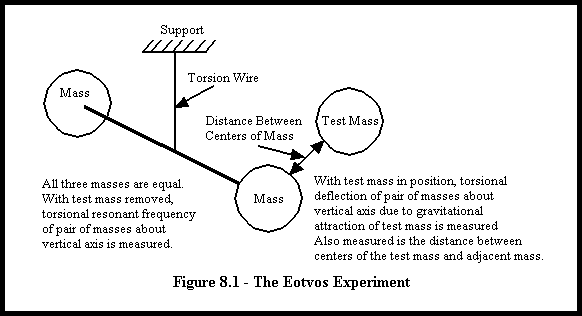
Whoa, too many questions.
The site groundrules state only single, well-focused questions, but I
will go ahead this time and address some of your questions.
- Imagine that you are the atom and you are one
mile deep into the earth. Then if you look "up" you will see many fewer
atoms than if you look down because it is a lot more than one mile
through the whole rest of the earth. So you will still feel a force
toward the center of the earth; it will however, be less than your
weight on the surface. It is easy to calculate the weight of something
inside the earth by the following trick: only that part of the earth
inside where you are exerts a force on you. Hence, if the earth
were hollow you would feel no force inside. Incidentally, your question
is related to one of the most famous problems in the history of
science. Newton delayed publishing his theory of gravitation for years
because he could not be sure that the force between two spheres was the
same as the force between two point masses at their centers. It is a
very difficult problem and part of the reason he had to invent calculus
was to solve this problem.
- Regarding
your second question: heavier atoms do not preferentially fall toward
the center of the earth. If they did then lead and uranium would be at
the core, then lighter and lighter atoms like onion shells as you went
out until the lightest would be on the surface. This is not how it is.
The reason is that all objects, regardless of their mass move the same
way (with the same acceleration) in a gravitational field.
- It does not
matter what the composition of the center is as far a gravity is
concerned.
- You do not
need to make the objects weightless to do this experiment. You just
have to be careful to make sure that all other forces on the objects
add up to zero. This experiment has been done many times. The classic
experiment was that of Eötvös (see inset picture) done in the
very early 20th century. A group at the University of
Washington has made many modern and very accurate measurements.
QUESTION:
I have a bunch of lasers and
the manuals all say that the tubes will last longer if they are run a
few hours a month. I used to work in analytical chemistry at an
undergraduate lab and the chemist said that the gas filled tubes for
the Atomic Absorption machine went bad if they weren't run all the
time. However, I pulled out a hollow cathode tube that looked like it
had never been used but was in a box that looked 30 or 40 years old and
it was very strong.
What is the physical reason for saying that gas filled tubes last
longer if they are run "A few hours a month"? I have a degree in
physics and have asked a number of PhD phycists and chemists this
question and have not received even an attempt at an answer.
ANSWER:
(Courtesy of Chad
Fertig)
Running a discharge tube generates pumping
action due to sputtering of the filament. This pumps away (some of the)
background gasses that inevitably leak into the tube. An Ar/Kr Ion
laser tube which hasn't been used in a long while will often need to be
run at low-ish current (low enough to prevent overheating) until the
pressure drops and the laser stabilizes to its normal operating
parameters.
If the background gas pressure gets too high, one may not be
able to light the tube and not trip the overcurrent protection
circuits. The laser engineers I have spoken with tell me that the shock
of lighting a tube at high-pressure can be enough to kill the tube
entirely.
I don't know how much of this discussion applies to small atomic
spectroscopy discharge tubes -- my experience is mainly with Ar/Kr Ion
laser tubes.
ANSWER:
(Courtesy of Uwe
Happek)
One should run the laser periodically to activate a getter
pump that traps unwanted aroms that slowly diffuse into the tube.
QUESTION:
If EVERYTHING in the
Universe doubled in size...?
.....would anybody notice?
What about the square-cube ratio?
The surface area of objects increases by the square, while volume
increases by the cube. If you doubled the diameter of a planet and the
height of the man standing on it, his mass would increase by a factor
of eight and the mass of the planet by a similar factor.
So the mans weight would be something like 64 times as much as
before.while the cross section of his legs would only be 4 times as
much.
The burden on each square inch of his legs would be about 16 times the
prior burden, without the extra strength to support it.
It would be like suddenly standing on Jupiter. He would collapse and
die very quickly by being 'squashed' to death by gravity!
Obviously this is a purely theoretical question but if the 'known' Laws
of Physics were applied to this, what would the answer be?
I may have twisted my knowledge because it has been years since I
studied. Simply take it that the universe has doubled (by magic?! :~}
). Would there be noticable consequences?
ANSWER:
I would not presume to make
a blanket statement one way or the other for this question (because we
physicists don't deal in magic!) I can, however, refute your specific
example. You have forgotten that the radius of the earth would double
and, since the weight is inversely proportional to the square of the
distance, the weight would be only 16 times greater (64/4). Hence your
new body would be ideally engineered to exist in your new environment.
QUESTION:
Light is massless and as
such is the only thing can can travel at this speed. For any object
with mass, it would take an infinite amount of energy to reach the
speed of light. Therefore the speed of light is an unattainable goal!
However, light can be caught by a Black Hole (I'm sure you know the
phrase - the gravity is so strong that not even light can escape!).
If light is without mass, how can it be caught by ANY gravity well?
Astronomers have also proved that light 'bends' around black holes in a
measurable and observable way.
What can the gravity be 'pulling in' if there is no mass to light? Am I
missing something?
ANSWER:
You are missing something--classical
gravitational theory, where the force is proportional to the mass, is
incorrect. Einstein's general theory of relativity is a theory of
gravity which has withstood all experimental tests so far. The central
idea of this theory is the equivalence principle which states that
there is no experiment you can do by which you can determine whether
you are in a gravitational field or an accelerating reference frame.
For example, suppose that you are inside a box with no windows and you
drop a ball and it accelerates down with an acceleration g=9.8
m/s2. Are you at the surface of the earth or in the middle
of empty space in a box which is accelerating with an acceleration g
in a direction opposite the direction you see the ball accelerate?
There is no way you can know without looking out a window. Now do a
similar experiment where you stand at one side of the box and shine a
beam of light across the box; it will follow a parabolic trajectory
down if the box is accelerating up, that's for sure (although for such
a small acceleration, it would be very difficult to observe; see one of
my earlier answers). The
equivalence principle thus asserts that the beam of light will "fall"
in a gravitational field.
QUESTION:
There is
a rope, say 20 mile long, and a person pulls the rope from one end,
point A.
Question: Will the other end, point B, move instantly or will it take
time?
ANSWER:
It takes time. Basically,
atoms in the rope are held together by the electromagnetic forces
between atoms and electric fields propogate with the speed of light, so
a very rigid strong rope would take a pretty short time for the other
end to start moving. A more stretchable rope would take longer.
QUESTION:
How many tons of TNT would
it take to be able to stop an asteroid with a mass of 7.2e15 kg moving
at 2436 m/s? Would we assume that the collision is ellastic or
inellastic and would we use the priniciples of the conservation of
energy or conservation of momentum?
ANSWER:
You are approaching this question in such a
way that there is no way to answer. It depends entirely how the "bomb"
of TNT is configured and is a very complicated question. You can do
some calculations:
- the kinetic energy of the
asteroid is about 2 x 10²² J
- the linear momentum of the
asteroid is about 1.8 x 10¹⁹ kg m/s
- the energy content of TNT is
about 4 x 10⁹ J/ton
Probably the best way to
approach how to stop the asteroid is to consider momentum. The time
rate of change of momentum is equal to the force applied, so suppose
you pushed on the asteroid for a year with a constant force such that
it stopped at the end of the year. Then the force would be (1.8x10¹⁹)/3.2x107)=5.6x1011
N=1.26x10¹¹ lb. The rate at which energy is expended is the
energy change divided by one year, (2x10²²/3.2x107)=6.3x1014
W. This is bigger than the entire energy consumption rate of the US,
about 1013 W.
What you should be figuring out
by now is that it is totally impractical to talk about stopping this
asteroid. When people discuss how to protect us from collisions from
asteroids, the idea is always to make a very small change in its path a
relatively long time before it would hit us. That means a rather small
change in momentum thereby requiring much less force. For example,
suppose you wanted to change this asteroid's trajectory by 0.010.
Then the momentum change would be about sin(0.01)x1.8x1019=3x10¹⁵
kg m/s. If you had an explosion which lasted 10 s, it would have to
supply a force of 3x10¹⁵/10=3x1014 N=6.7x10¹⁴
lb. This is still a pretty big force, you will agree. Here the energy
increase would be about 6.5x10¹⁴ J so the power over the ten
seconds would be 6.3x10¹³ W which, although still pretty
huge, could probably be achieved with a thermonuclear device over a few
seconds. I guess my message here is that making big changes in the
motion of something as large as an asteroid using brute force methods
are simply not possible with technology we have .
QUESTION:
If the maximum velocity of
any particle or electromagnetic radiation is the speed of light and if
light and other forms of electromagnetic radiation cannot escape a
black hole, then how could Hawking radiation be possible?
ANSWER:
Hawking radiation has nothing to do with
what the speed of the radiation is. The radiation, the existence of
which is still controversial, is due to esoteric quantum effects which
are too technical for this site.
QUESTION:
Is it possible for a
material to act as a superconductor at absolute zero. I understand that
matter can become superconductive at temperetures around absolute zero,
but I am unable to find a definative answer as to whether or not this
happens at absolute zero.
ANSWER:
Well, acheiving absolute
zero is not physically possible, so you need not concern yourself with
what happens there. However, you may approach arbitrarily close, so it
is meaningful to ask what happens in the limit of very small
temperature approaching zero. If the material is known to be
superconducting it has undergone what is called a phase change where
the resisitivity of the material suddenly drops to zero at some
temperature. Then the resisitivity would remain zero as temperature
approached zero. If the material did not undergo a phase change, it
would not be superconducting in the limit as temperature approaches
zero.
QUESTION:
How much one cubic inch of
sugar cube weigh?
ANSWER:
I looked up the density of granulated sugar,
from which sugar cubes are made, and found 849 kg/m3. From
this you can find, by using standard conversion factors, that the mass
of one cubic inch of sugar is 13.9 g or a weight of 0.491 oz.
QUESTION:
If you took a radio antenna
and had the technology to generate a eletrical AC signal across the
antenna with a frequency of around 6*1014 Hz, would you see
visible light coming from the antenna, or would it just be a really
fast oscillation of energy between eletric and magnetic fields?
If it would produce visible light, would similar frequencies give IR
and UV and so forth?
ANSWER:
You would see nothing. There might be some
EM radiation in the visible region but the intensity would be too small
to "see". The problem is that the antenna must have a size comparable
to the wavelength corresponding to the frequency for it to have any
appreciable intensity. The wavelengths for visible light are hundreds
of nanometers and so you would need to have an antenna comparable to
the size of an atom. In fact, atoms do act like little antennae and
that is where we normally get visible light.
QUESTION:
If a fine liquid filled
capillary tube is place horizontally and both ends are immersed in the
same liquid as that filling it, is the pressure at the midpoint of the
tube larger than that at the ends?
ANSWER:
Although I do not know a lot about
capillaries, I do know Newton's first law. If the pressure were greater
in the center than the left end, the fluid in the left half of the tube
would have a net force to the left which it cannot since it would be in
equilibrium. What I do know about capillaries is that they depend on
the meniscus to drive the fluid through the tube and there would be no
meniscus under the conditions you state.
QUESTION:
I actually have an idea that
isn't possible currently, but I'd still like to suggest it to you,
because I'm vey concerned about the effect of the greenhouse effect on
mankind. Seeing how things are going with it right now, time for all
life on earth may be running out faster than we think, and we MUST do
something more than just fighting oil companies emissions...
Now to the point - I't is finally time that people in the physics
community would take a chance at designing and building at least a
working model of an ozone particle regenerating machine. For the sake
of the earth and mankind, I think it's at least worth a good try.
ANSWER:
The ozone problem and the greenhouse effect
are not the same thing. The greenhouse effect comes from too much CO2
in the atmosphere which traps the energy which light brings from the
sun. The ozone problem is that ozone is needed as a shield against
incoming ultraviolet radiation from the sun but is depleted by
introduction of chemicals which interact with it (like chlorofluorocarbons in older refridgerants). I
believe that restrictions on these chemicals is making noticable
effects in solving the ozone problem. Regarding your suggestion,
building any machine which can have any kind of effect on something as
huge as our atmosphere would be an undertaking which would cost our
entire GDP and more!
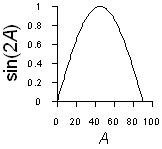 QUESTION:
Why is a 45 degree angle the
best angle to shoot a water baloon to get it to
go the fartherest distance?
ANSWER:
See my earlier answer
pertaining to projectile motion. Inasmuch as the range R of a
projectile may be shown to be R=v2sin(2A)/g
where v
is the speed at launch, A is the angle of launch, and g
is the acceleration due to gravity, you can see that the range is
proportional to the sine of twice the launch angle. At 450
the sin(2x45)=sin(90)=1 which is the biggest the sine can be.
QUESTION:
What exactly do scientists
mean by "folding a spectrum through a filter transmission profile" ?
What is folding?
ANSWER: (Courtesy
of J. Scott
Shaw)
In astronomy it means multiplying the
intensity of the spectrum by the transmission % of the filter at each
wavelength to get the resulting intensity at the detector. Or you can
do it from the detector to the spectrum, depending on how you need to
see the problem.
ANSWER: (Courtesy
of Richard S.
Meltzer)
I think this refers to the alteration of the
actual spectrum by the transmission of a filter so that what is
observed is so modified by the filter transmission. If one knows the
transmission of the filter as a function of frequency, one can deduce
the actual spectrum from the observed spectrum by dividing the observed
spectrum by the transmission of the filter.
QUESTION:
a light bulb uses 60J of
energy to give 6J of useful heat energy. true or false???
ANSWER:
False. An incandescent light bulb is only
about 5% efficient, that is 95% of the energy goes into heat. Your
question is sort of strange because I wouldn't call heat useful energy.
We usually use a light bulb for light, not heat, so it is the light
which would be thought of as useful. If the question had said "useful
light energy" instead, it would not have been far off.
QUESTION:
Can you tell me the
wavelength of the EM wave that would correspond to the photon emitted
when a hydrogen atom's electron falls from the n2 to the n1 energy
level?
ANSWER:
121.566 nm. See
http://hyperphysics.phy-astr.gsu.edu/hbase/tables/hydspec.html
QUESTION:
I am learning about
half-lives and am curious: is it possible to shorten the half-life of
radioactive decay?
ANSWER:
The short and practical answer to your
question is no. The half life for the transition from one state of a
system to another is determined only by the wave functions before and
after (a wave function is a mathematical construct which contains all
the information about the system). However, if you were able to change
the wave functions by changing the environment, you could change the
half life; for example if you put the radioactive nuclei in a very
strong electric field you would change the wave functions. However, the
force which holds the nucleus together is so strong, it would be
virtually impossible to make a noticable change in this way. What is
more conveniently done is to transmute the original nucleus: for
example, if you add a neutron to a radioactive nucleus you would likely
form a new radioactive nucleus but with a very different half life.
This has been discussed as a way of dealing with radioactive waste from
reactors.
QUESTION:
Is there any very important
reason too why a coulomb is 6.24x10 exponent 18 electrons? i do not
know very much about the coulomb
ANSWER:
The Coulomb (C) is defined in terms of the
Ampere (A). The Ampere is an electric current carrying 1 C/s. The
Ampere is operationally defined in terms of the magnetic force between
two current carrying wires. So the answer is that the fact that there
are a certain number of electrons in a Coulomb has no significance.
QUESTION:
In nuclear reactions, when
they are bombarding atoms with a neutron n for example, How do they get
just a neutron (fission) by itself to hit at a certain velocity?
ANSWER:
You are referring to nuclear
fission reactions in a reactor, I presume. Every time one of the fuel
nuclei splits into two pieces, it also releases several fast neutrons.
These neutrons may then be used to cause other nuclei to split and so
forth. This is called a self sustaining reaction--once you get it
started, it will keep going as long as one or more neutron, on average,
causes another fission. The problem is that fast neutrons have a very
low probability of being captured by a nucleus and are most likely to
just fly away; if we slow them down, however, they have a high
probability of causing another fission (simply because a slow neutron
spends more time passing through a nucleus than a fast one). So we must
slow them down for the reactor to work. The way that this is done is to
introduce a moderator which is efficient in slowing them down. Good
moderators are water or graphite.
QUESTION:
Besides being released in
beta decay and making up for the excess of mass when a proton+electron
are froce to bcome a neutron what does the elementary particle
"neutrino" actually do??
ANSWER:
What do you mean by "do"? The question is
more appropriately "what are the neutrino's properties?" To get a full
discussion of neutrinos I would recommend the Wikepedia article.
QUESTION:
What is the formula for the
range of a projectile?
ANSWER:
Neglecting air friction and assuming that it
lands at the same height at which it was launched, R=v2sin(2A)/g
where v is the speed at launch, A is the
angle of launch, and g is the acceleration due to gravity (9.8
m/s2). You can find plenty of derivations of this formula on
the web by googling "projectile range".
QUESTION:
;
We say that centripital
force is centre-seeking and that it pulls the rotating object to the
centre of rotation. If this is the case then what force is responsible
for pulling the object outwards. For example, with a yo-yo rotating in
a horizontal plain. The tention in the string pulls the yo-yo inward,
keeping it from flying off. However, what is the force that causes the
yo-yo to extend outard? Is this the centripital force? If so then
doesn't this mean that centripital force pulls outward on the yo-yo
while the force of tension pulls inward on the yoyo?
ANSWER:
A ball going around in a circle has an
acceleration pointing toward the center of the circle. Newton's second
law thus says there must be a force pointing toward the center of the
circle and this is called the centripetal force. Any number of forces
with components in that direction may contribute to the centripetal
force, but the simple example you give has just the tension in the
string providing the centripetal force. There are no other forces (in
the horizontal plane) acting on the yoyo. Your statement referring to
the yoyo "extending out" makes no sense; if the string breaks the yoyo
does not fly radially outward but continues in the direction of its
motion at the instant the string breaks. If you imagine yourself to be
the string, there will be a force outward on you which is equal in
magnitude to the tension in the string. This is because of Newton's
third law: if one object (string) exerts a force on another object
(yoyo) then the other (yoyo) exerts an equal and opposite on the first
(string). But this outward force is not on the yoyo.
QUESTION:
According to Einstein's
special theory of relativity ,velocity of light is a universal constent
.It does not change with respect to observers velocity relative to the
source of light .But I had
heard that Doppler effect occurs due to the relative velocity between
the source and the observer .Then if relativity theory is true,why
doppler effect occurs?
ANSWER:
You have answered the question yourself. The
postulate says that the speed is constant, not that the frequency or
wavelength are. The frequency or wavelength of light does depend on the
motion of the observer.
QUESTION:
I am a teacher and I was
wondering how I can address students' misconception that weight does ot
affect accleration due to gravity.
We did several controlled experiments to determine the variables that
affect the speed of a car rolling down a ramp. In one experiment with a
car and ramp, the weight was changed as the car was timed from point A
to point B. Some groups of students found that sometimes the more
weight added to the car, the faster it acclerated down the ramp, while
other groups found that the more weight added, the slower the car
rolled down a ramp. So now they are confused. How can I steer them away
from this misconception?
ANSWER:
The design of the experiment must take into
account all the variables. One of the most troublesome variables in
doing mechanics problems is friction and I am sure that changes in
friction as you change other variables is what is causing trouble here.
So, I propose the simplest of all experiments to convince them that
acceleration is independent of mass if it is the only (nonnegligible)
force present: just do Galileo's experiment of dropping a marble and a
bowling ball (or some similar pair) simultaneously and see them hit
simultaneously. This would be most effective out of a second floor
window, but you can drop them from six feet in the classroom and have a
pretty convincing experiment. Of course, you could also use a feather
and a bowling ball but the feather would be the loser by far, not
because of its (smaller) weight but because of its (larger) frictional
force. At a nearby college or university you might be able to borrow an
apparatus in which there is a feather and a marble inside a glass tube
which, if you pump the air out, the two will fall with the same
acceleration. If your students understand Newton's second law you might
find my previous discussion of this problem helpful. Another experiment you
could do if you have access to an air table is to use it for your races
and minimize friction.
I helped my son with a pinewood
derby a couple of years ago and I can tell you that it is not easy to
understand the physics of these little cars. One thing which is often
noted is that the fraction of the wheels rubbing on the axels is quite
important and using graphite as a lubricant often speeds them up.
QUESTION:
How much evergy is released,
when a drop of water changes its shape from a cube to a sphere of the
same volume? How much is the drop getting warmer as a consequence of it?
ANSWER:
The work done in changing the surface area
by dA
is ydA where y is the surface tension which, for
water-air interface near 20o C is about 73x10-3
N/m. The surface area of the cube is about 24% larger than the sphere
with equal volume (which I am assuming is easy for you to show). So the
energy released is about 0.24x73x10-3xA where A is
the area (4pr2)
of the sphere. For a sphere of water with radius 1 mm I estimate an
energy of about 2.3x10⁻⁷ J. I will leave it to you to
compute the temperature change for this amount of water when this
amount of energy is added; you just need to calculate the mass m
of the drop and set the energy equal to mcDT where c
is specific heat of water and DT is the temperature
change.
QUESTION:
I made this question up
myself when pondering how to teach Newton's 3rd law:
A pulse of electricity through a wire produces an electromagnetic field
that travels outward at the speed of light. This field encounters a
charge and exerts the appropriate forces on it. While the forces are
occuring on the charge, on what is the reactionary 3rd law force? I
believe that the closed loop nature of the fields would render the net
work done as zero.
ANSWER:
Here is a dirty little secret we never
reveal to our students in introductory physics: Newton's third law is
not always true! Particularly in electrodynamics, it is rather easy to
see in simple examples. The culprit, as you seem to have intuited, is
the magnetic forces. As a simple example suppose you have a particle
(#1) of charge q moving in the positive x-direction
with speed v along the positive x-axis and a particle
(#2) of charge q moving in the positive y direction
with speed v along the positive y-axis. Particle 1 sees
a magnetic field pointing in the negative z-direction due to particle 2
so it experiences a force in the positive y-direction; particle
2 sees a magnetic field pointing in the positive z-direction due to
particle 1 so it experiences a force in the positive x-direction.
Of course, each particle also experiences a repulsive electrostatic
force but these do obey Newton's third law. But the net force does not.
If the magnetic forces involved were due to magnetostatic forces, long
steady currents, Newton's third law would be obeyed (as in the well
known force between two long parallel current carrying wires on which
the definition of the Ampere is based). It turns out that for the
electromagnetic field, one must include energy and momentum densities
of the fields themselves to do Newtonian mechanics and then all is
well. If you want to pursue this further, I would recommend the
intermediate-level E&M book by Griffiths.
QUESTION:
My question regards a
discrepancy between answers I get when I work a problem using two
different approaches. This problem was given to me several years ago,
and although I got the right answer then, I was told that I could have
also used a different approach. I have tried several times since to do
this problem the other way, but have had no luck. The problem is this:
if a pole of length L is stood on end and released, if the initial
velocity is neglegible, what is the final velocity of a point at the
end of the pole when it hits the ground. I believe I originally solved
this problem using the concept of the potential energy being converted
to kinetic energy (mgL=(1/2)mv2), getting an answer of
v=(2(g)(L))^(1/2). I am now trying to solve it using calculus by
integrating the equation v2=2ad over all da from 0 to 9.81m/s2 (where d
is the arc length of the falling pole), and taking the square root of
both sides. When I do this I end up with an answer of v=((
PI)(g)(L))^(1/2). What am I doing wrong?
ANSWER:
Neither of your methods is correct. The
second method, using v2=2ad is wrong because
this equation is valid only if the point has uniform acceleration which
it does not. The first method is incorrect because you treat the
stick as a point mass at the end of the stick falling straight down
which is not what is happening. The only way to solve this problem in
closed form is to use energy conservation as you have tried to do;
however, you must use rotational dynamics to do this. So the potential
energy at the beginning is mgL/2 because the center of mass of
the body is located halfway up the stick; the kinetic energy when the
stick hits the ground is Iw2/2 where
I is the moment of inertia of a the stick about its end
(which is ML2/3 for a uniform stick of mass M
and length L) and w is the angular velocity of the stick (which
is v/L if v is the speed of the point at the
end). If you now equate the energies before and after and do the
algebra, you will find v=(3gL)1/2.
QUESTION:
Do physicists believe that
the world is continuous or discrete? In other words, is there a
smallest distance a particle can travel and/or a smallest increment in
time?
ANSWER:
This is an open question. Although nobody
has seen any evidence for the discreteness of space or time, many
serious theorists, particularly those working in quantum gravity,
believe that there does exist a distance which is the smallest possible
distance called the Planck length. This length is on the order of 10-35
m so it is not surprising that there is no experimental evidence for it
since this is 10-20 times the size of a proton! Similarly,
time is thought to have the smallest possible duration which is the
time it would take light to travel the Planck length, also very small.
QUESTION:
What guarantees that human
made particle colliders won't create black holes eventualy as they
reach higher and higher collision energys? I ask this because if i
understand it correctley, black holes aren't created only out of the
large mass of the stars that go supernova, but they are created by the
large density that the large mass of the star creates in it's center
when the atoms if its center collapse. What i mean is: The star that
went supernova was heavier than the black hole it creates, yet it is
not a black hole. So this means that black holes are created by their
large density and not their large mass. This is why i want to know
wether particle colliders could create a (dangerous) balck hole here on
eart, beacause they also, like supernovas make atoms collapse into
great densitys.
ANSWER:
The possibility of a black hole being
created is still speculative, but there is the real possibility that a
tiny black hole (say 300 proton masses) may be created. However, black
holes do radiate energy (called Hawking radiation) and such a black
hole, if it were to exist, would totally evaporate in an unimaginably
short amount of time, before it would have time to suck up any mass.
QUESTION:
If you were in a black room
with no doors/windows/external light sources and every part of your
body was the same shade of black as the room and you lit a match, would
you see your shadow? Would you see your own hand?
ANSWER:
I presume that by "black" you mean something
which is a perfect absorber of electromagnetic radiation. In that case
you would not be able to tell if light is falling on it or not by using
your eyes as you usually do, i.e. by seeing the reflected
light. On the other hand, the energy carried by the light would have to
go somewhere and it would show up in increased temperature of whatever
absorbed it. Now, all objects radiate electromagnetic energy but, in
your example, things look black not because they are not emitting any
electromagnetic waves but rather that nearly all this radiation is
outside what eyes can see (in the infrared). But the catch is that a
perfect absorber is also a perfect radiator, so all the energy from the
lighted match will be reradiated but mainly in the infrared so you
couldn't see it. If you had an infrared detector you would be able to
"see" the shadow, etc.
QUESTION:
I just moved to an area with
snow and find that whenever it is snowing in the night, there is always
this orange-ish "ambient light" that seems particularly bright, bright
enough that one can see fairly well to the point where one can drive
slowly without headlights in unlit areas. i am wondering what is the
source of this light. i am fairly sure that it is not moonlight (there
is light even when the sky is covered with clouds, and the intensity of
the light does not seem to change during with moonphase). It might be
street lights reflecting off the snow, since the color of the light is
orange-ish, but then again you can see this light even when you are
dozens of miles away from big cities, and the intensity of the light
does not seem to change as you travel further from big cities.
ANSWER:
I feel pretty sure that what you are seeing
is what astronomers call light polution. The characteristic orange
color you are seeing would indicate that the source is sodium vapor
lamps, often used for city street lights. The light, particularly if it
is not directed toward the ground and is transmitted upward can scatter
from snow, water vapor, dust, smoke, etc. in the air so that
you can see it quite readily even at surprisingly large distances from
the city of its source.
QUESTION:
All of the physics examples
for gravity and projectiles depict freefall or horizontal/angular from
fixed start locations, eg: a ball dropping over a cliff or a cannon
shooting a ball. And I understand the results.
However, I have been unable to find any answer regarding specific
vertical scenarios.
For example, if we are standing in an elevator that is not moving, and
drop a ball, it freefalls at 9.8 m/s/s. So we can easily calculate the
time from when it is dropped to when it hits the floor.
But what would occur if the elevator were moving upwards at a constant
velocity (not accelerating) of 2.5 m/s (the average elevator speed),
and you dropped a ball.
Would the time for both balls to hit the floor be identical?
If the ball in the upward moving elevator maintained a constant
vertical velocity of 2.5 m/s during its freefall lifetime in addition
to the applied force of gravity I would think that they would...
However, I would assume that the vertical velocity of 2.5 m/s would not
remain constant for the lifetime of the ball's fall, as gravity is
directly opposing that upward velocity. The ball's vertical upward
velocity should decrease as a curve due to the gravitational force
applied in the exact opposite direction.
Similar to what would occur with a projectile that is fired vertically,
the upward velocity decreases and it then falls back down accelerating
due to gravity.
Now since the elevator's floor is still moving upward at 2.5 m/s, the
ball dropped in the moving elevator should hit the floor first.
ANSWER:
The motion of the ball is the same in any
frame of reference which moves with constant velocity relative to the
stationary elevator. The dropped ball in the moving elevator takes
precisely the same time to reach the floor as it did when the elevator
was not moving. To help you understand this, keep in mind that when the
ball was released in the moving elevator, it had a speed of 2.5 m/s
upward as seen from the ground. Basically, you are touching on what is
called the principle of relativity, namely the laws of physics are the
same in all inertial frames of reference; an inertial frame of
reference is any frame which moves with constant velocity with respect
to a frame of reference (for example your stationary elevator) in which
the laws of physics are true. If your elevator had been accelerating
upward with an acceleration of 2.5 m/s/s it would have been a different
story. In this case, the ball would appear to fall with an acceleration
of (9.8+2.5) m/s/s and hit the floor sooner.
QUESTION:
I have a question regaurding
light and energy. It is known that it is impossible to accelerate a
particle as fast as the speed of light due to the fact that it would
take an infinite amount of energy. However, a photon's energy is
difined as E=hf, where h is the product of Planck's constand and f is
the frequency of the photon. So, why can light have a finite amount of
energy whereas an accelerating particle can not?
ANSWER:
The photon has no mass and therefore it is
exempt from this rule (as is any massless particle). All massless
particles necessarily travel with the speed of light and they are not
accelerated to get there, they are created already going that speed.
QUESTION:
Okay, hypothetically
speaking, if there was a chain strong enough to not break under the
ridiculous amount of stress and the chain was attached to the moon and
the earth (probably by a mad scientist) what would happen? Would the
moon slowly be drawn into the earth? Would the earth wind itself up in
the chain as it rotates upon it's axis and how fast would it wind up?
would the chain have to be built on the moon and lowered to earth? How
would the chain be affected by earth's gravity when it first hit the
atmosphere? If it was possible what type of material would the chain be
and how thick would it need to be? Would it heat up as it cut through
earth's atmoshpere?
ANSWER:
When you first start, there is no need for
the chain to be strong because the moon is held in its orbit by gravity
and any additional force (the tension in the chain) would disrupt that
orbit. To see this, imagine the earth and moon to be point masses and
there is a weightless chain between them;there is no tension in
the chain. Now, let's get a little more real: no chain is weightless
and so there would be tension in it just to support its weight but it
would vary from point to point and still exert no force on the earth or
the moon which would continue to orbit each other as if the chain were
not there. Now, let the earth become its normal size. Since the earth
rotates once on its axis every 24 hours but the moon goes once around
the earth every 28 days, the chain would pull the moon down like a
fishing reel. There is an analogous thing which has been discussed,
having an "elevator" into space (not as far as the moon, but farther
than where communication satellites are). Here, both to support its own
weight and the weight it carries up, the cable would have to be very
strong. It has been suggested that perhaps the cable could be fabricated of carbon nanotubes. You
might be interested in the Wikepedia article
on space elevators.
QUESTION:
I know that the length of an
organ pipe (as well as the speed of sound in air) determines the
frequency of sound produced within it. Does the diameter of the pipe
have any effect on the sound produced?
ANSWER:
What the length determines is the
fundamental frequency, but no musical instrument contains just the
fundamental. each note played by each instrument also contains what are
called overtones, other frequencies, usually simple multiples of the
fundamental. The relative intensities of the many frequencies produced
is called the timbre and it is what allows you to tell the difference
between an A played on a violin or an organ or a trumpet etc.
Geometrical properties of organ pipes other than its length determine
its timbre; design of organ pipes has evolved from trial and error and,
as such, is more an art than a science.
QUESTION:
What exactly is oscilating
when we're talking about the wave nature of a particle?
What are the bounds in which between it oscilates?
ANSWER:
There is not a physical wave which you can
visualize. It happens that something called the wave function, which is
intimately related to the probability of the particle being found at
some place at some time, satisfies a wave equation. This equation,
however, is not the usual one since its solutions are necessarily
complex, that is they contain both real and imaginary parts. An
imaginary number, the square root of negative one, cannot be physical
but often is very useful mathematically in describing the physical
world. To extract what you actually observe in nature from the
mathematics requires having techniques which remove the imaginary parts
of quantities. So, the oscillating is of a complex quantity and, as
such, is not visualizable.
QUESTION:
Suppose you are given two
iron rods, and you are told that one is a magnet and the other is not.
Using ONLY those two rods, how would you determine which was a magnet
and which was not?
ANSWER:
If you, at some distance
away, align one bar (A) perpendicular to the other (B) and pointed
toward B's center and bring it closer it will experience a strong force
along its direction if it is the magnet; this is because it will
attract B and Newton's third law says that A will feel an equal and
opposite force. On the other hand, if A is not the magnet, it will find
itself in a magnetic field which is nearly uniform and perpendicular to
its length, so it will become magnetized in the direction of the field;
however, a magnet in a uniform field feels no force so it will
experience very little force. I am assuming that the magnetized bar is
a simple dipole, that is one end is north and the other south.
QUESTION:
what keeps electrons
energetically orbiting a nucleus?
ANSWER:
What keeps a satellite orbiting the earth?
What keeps the moon going around the earth or the earth going around
the sun? In all cases, once you give an object the energy required for
a particular orbit, conservation of energy keeps it from changing. If
the earth were to suddenly stop moving and drop into the sun, it would
have far less energy; where did that energy go? To change the orbit you
need to add or subtract energy to/from the object. What is particularly
interesting about an electron in an atom is that an electric charge
running around in a circle radiates energy (that is what an antenna is)
and so the energy should radiate away and the electron fall into the
nucleus. However, it does not and this observation started the whole
branch of physics called quantum mechanics: one of the laws of nature
is that bound objects are allowed to exist only in specific (quantized)
energy states and therefore, if in such a state, a particle cannot
radiate its energy away except all at once by going to a lower energy
state. There is, however, a lowest state (called the ground state) and
if the atom is in that state, it must stay there.
QUESTION:
- Is nanomolecular technology
able to create a dimond saw blade from the carbon in the air?
- Are nanobots able to create
things out of carbon?
- What would happen if Carbon
was broken down again? (that is, carbon is an element, but can you
destroy or break it down futher?)
ANSWER:
- The only way to make diamond
is under extremely high pressures, so one could not just coat a saw
blade with carbon in the air and expect it to be diamond.
- Nanobots are still in a very
experimental stage and so what they can or cannot do is open to
question and interpretation. Most nanobots which exist have the purpose
of detection of something, for example bacteria or particular
chemicals. I don't think there would be a reason why, someday, a
nanobot couldn't fabricate things out of carbon or anything else.
- Normal carbon (12C) is
composed of 6 protons, 6 neutrons, and 6 electrons. You could make
anything you like out of those 18 particles. Some examples:
- 6 hydrogen atoms and 6 free neutrons.
- 3 helium atoms
- 6 "heavy hydrogen" atoms
However, this kind of
rearrangement takes much more energy than chemistry and is not easy to
do. The reason is that the force which holds a nucleus together is the
strongest force in nature so it is tough to break nuclei apart. You
could do some "chemical" type breaking apart with much less energy by
ionizing the atom, for example remove one electron and you have a
singly ionized carbon ion. You might find the Wikepedia article on
nanobots interesting.
QUESTION:
When accelerating from a
stop with your car door open, the door swings shut. Now given that the
force applied to the door is thru its pivot point there should not be a
net torque on the door, so it shouldn't move. To idealize the situation
I have imagined an axle with a rectangular mass attached accelerated
(normal to the axle) in deep space to negate gravity and air
resistance. I'm thinking the "door" would not pivot in this case, so
that the pivoting experienced in the original case is due to air
resistance, some kind of unbalance of applied forces, or maybe even the
fact that the car is not an inertial frame.
ANSWER:
Idealize the hinge to be frictionless. Then
there is no torque about the hinge. However, the hinge can exert a
force on the door (or else it would be left behind when the car
accelerated). The direction of this force is forward so that, according
to Newton's second law, the center of mass will accelerate forward, as
you know to be the case. Now, ask yourself if there are any torques about
the center of mass of the door. There is the forward force which
the hinge exerts and this exerts a torque which will cause an angular
acceleration about the center of mass. If you sketch that force, you
will see that the torque will tend to close the door. You were right to
be suspicious of whether the car and the door not being inertial frames
might be a problem. You may not apply Newton's laws in noninertial
frames but there are special exceptions, the most important being if
you ask about what happens in a frame attached to the center of mass;
even though not inertial, Newton's laws remain vaild in this frame.
That is why, after asking what forces there were on the door, I
switched to the center-of-mass frame.
QUESTION:
I am teaching physics at a
Kansas high school, and my students and I were debating over a problem.
The problem is as follows:
Two 20-N boxes are placed on both ends of an ideal rope. The rope is
then passed over two pulleys fixed on each of the two edges of a fixed
table, so that one 20-N box hangs on one pulley, and the other 20-N box
hangs on the other pulley (the rope being continuous over the two
pulleys).
We have been debating over the value of the tension in the rope,
whether it's 20 N or 40 N. Half of the class agrees with me that the
tension is going to be 20 N, but I cannot convince the rest of the
class that the tension is not 40 N, but rather, 20 N. (Or is it me
who's wrong?)
ANSWER:
Breathe easy--you are right! The tension in
this rope is 20 N. The tension at a point in a rope is defined as the
force which it exerts on what it is attached to. So you need to focus
on one box or the other. You now say, what are all the forces on that
box? One is its own weight which we know to be 20 N vertically down.
Another is the force which the rope exerts on it; technically we know
neither the magnitude nor direction of this force, but it is called the
tension in the rope at the point of attachment. There are no other
forces on the box. Since it is in equlibrium, all (both) forces must
add to zero, so the tension is 20 N straight up. And, for a rope of
negligible mass the tension must be the same everywhere on the rope;
otherwise if you inserted a tiny mass in the rope and the tension were
different on one side than the other, the tiny mass would not be in
equilibrium.
QUESTION:
I attached magnets (round,
penny-size, strong) magnets to each of the three blades of my small
wind turbine and a two-inch opposite magnet stick to the pole for more
power to push the blades. Then I placed the wind turbine into a wind
tunnel to test if if it generates more energy than without. It did
generate less energy...please explain why. Do I need a stronger magnet
stick ?
ANSWER:
As each magnet on the turbine approaches the
stationary magnet it is attracted but as it goes away from the
stationary magnet it is still attracted, so this force will cause the
turbine to alternately speed up and slow down so you will get no net
work from the magnets. Technically, you should have gotten the same
energy output but your experiment probably increased the friction of
the turbine and so you lost energy there.
QUESTION:
if you are in a train
traveling half the speed of light, and another train on a separate,
parallel track, was approaching you, also at half the speed of light,
would you see the passing train travel past you at the speed of light?
ANSWER:
Classically, that is what
you would think. But the theory of special relativity shows that
velocity addition in classical physics is wrong but you can only easily
see that it is wrong at very high speeds and half the speed of light
certainly qualifies! The speed you would see the other train
approaching would be 80% the speed of light.
QUESTION:
When boiling distilled water
in a pot, bubbles rise from the bottom. What is within those bubbles?
Would it be oxygen? If so, is the oxygen extracted from the water? What
happens to the hydrogen excess?
ANSWER:
When a liquid is heated enough it transforms
into a gas (this is called a phase transition). The bubbles you see in
a boiling liquid are simply little volumes of gas within the liquid, so
in your question there is just water vapor inside the bubbles.
QUESTION:
If you were to drop an ice
cube and a shot glass from 4 feet up, which would land and break first?
Why?
QUESTION:
My question to you involves
the feather and bowling ball freefall experiement in a vacuum. Now I
understand that by removing the factors of air resistance that you free
up the feather to fall much faster than it normally would. But the part
I'm having trouble with is that they do indeed fall, gravity is
obviously still involved and the ball still outweighs the feather many
times over. In fact the term "weight" is defined by the amount of force
gravity exerts on an object's mass. (not totally clueless, I just look
like I am) So by that term should not the ball fall much more quickly
since gravity has that much influence on it?
ANSWER:
Since these two questions are so similar, I
will answer them with one answer. Ignoring or removing air friction
results in all falling objects as having the same vertical
acceleration, 9.8 m/s/s; that is the speed of any freely falling object
increases by 9.8 m/s as each second ticks by. Hence, the ice cube and
the shot glass and the feather and the bowling ball will all hit
simultaneously. To understand the "why" you need to know two things:
- Newton's second law states
that the acceleration of an object is proportional to the force it
experiences and inversely proportional to its mass; if we define a unit
of force to be that which causes one kilogram to have an acceleration
of 1 m/s/s, then a=F/m if F is in Newtons.
- An object's weight, the force
which the earth exerts on it, is proportional to its mass. So we can
write that W=mg where, for now, g is just some
constant; if we measure the weight in Newtons and the mass in
kilograms, then we find (by simply measuring) that g=9.8 m/s/s.
Putting these two things
together for the case where the force in Newton's second law is the
weight of an object, then a=W/m=mg/m=g. Note that m
cancels out; this is the key to understanding. Although the weight is
proportional to the mass, the inertia (resistance to acceleration) is
also proportional to the mass, so all objects have the same
acceleration.
QUESTION:
Water is attracted to each
other right. So when you cut through ice are breaking this attraction.
I mean what happens when you break something or cut something at the
atomic/molecular level.
ANSWER:
In a solid, each molecule is bonded to its
nearest neighbors. The nature of the bond is very complicated, but is
similar to the bonds which bind molecules together. When you break a
solid, you break all such bonds which were along surfaces which appear.
QUESTION:
I am writing in the interest
of hopefully resolving a question which had arisen in my workplace. One
gentleman poses the hypothetical situation of a motionless tank sitting
on solid ice which he describes as "very slick and smooth - so much so
that if one were to toss a penny across the surface then it would glide
on endlessly." He posits that the tank is then started and attempts to
move forward. His position is that the tank will not be able to move as
the treads would simply spin on the ice. His detractor posits that the
treads are moved by the wheels inside the treads and that this would be
able to propel the tank forward. So, would this tank be able to move
forward or not? If so, what propertys of physics would make it be able
to move and, if not, why would this tank not be able to move forward?
The gentleman's scenario also posits that there is no friction between
the tank treads and the ice. Is it realistic, physically speaking, to
posit these two surfaces touching and no friction existing between them?
ANSWER:
How genteel you are! The gentleman who says
that the tank will not move forward if the ice is perfectly
frictionless is correct. It is the force of friction which accelerates
the tank forward, not the force which the wheels exert on the treads;
if the wheels exert a force on the treads, then Newton's third law says
the treads exert an equal and opposite force on the wheels so the two
cancell each other out. No it is not possible to have a perfectly
frictionless surface; it is possible to get a good enough
approximation, however, to do an experiment which should convince the
second gentleman.
QUESTION:
I assume that the "big bang"
theory is correct, but to accomodate the concept of infinity, it must
be that this process is repeated or cyclical. After the universe
expands for quite some time, gravitational pull will eventaully slow
down the speed of expansion until it stops, and then gravity will
create an accelerating contraction when all matter returns to a single
space and time, when another "big bang" takes place. While the universe
is contracting, history and time go backwards, and we live our lives
again in reverse, and all cosmological events are repeated in reverse
order.
This theory provides for infinity, and also for the concept of "eternal
life", that would be a cyclical event, half the time going backward,
but repeated for all eternity. Eternal life in this way may not be just
a religious belief. I don't know the math involed, but this may be the
"unified theory" unsolved by Einstein.
ANSWER:
Your basic premise, that the universe is
fated to collapse back on itself is not necessarily true. If the
universe has more than a critical amount of mass, it will eventually
fall back; if it has less than that amount of total mass, it will keep
going forever. Determining which of these possibilities describes our
physical universe has been one of the main quests of astrophysics for
many years. However, recently observations have been made that the
expansion of the universe is actually accelerating, so it seems more
likely that the universe will not collapse as you posit.
QUESTION:
What happens to all the
light photons that enter your eyes?
ANSWER:
For the most part, they vanish giving their
energy to heat or chemical reactions which initiate nerve impulses
which your brain detects and interprets.
QUESTION:
Why do high voltage devices
(power lines, transformers, etc) hum? They have no moving parts to
vibrate, so what causes the humming?
ANSWER:
If there is sound, then
obviously something must be moving. The hum you hear is usually 60
cycles (since that is the standard for AC) and results from electric
currents interacting with magnetic fields. Suppose you have a thick
wire which carries a current; then there will be a magnetic field
everywhere around that wire, including inside it. The current will
interact with the field and will experience a force which causes it to
move and since the frequency of the field is 50 Hz, so is the motion
(in response the the force) of the wire.
QUESTION:
if two people are moving
past each other at a constant speed in an infinite empty space, to
either one the universe would be static and the other person would be
in motion (relativisticly).
if two people were at a constant unmoving distance from each other, but
one of them was rotating at a constant speed, to either one the
universe would be static and the other person would be in motion,
correct?
so if they were far enough apart, wouldn't the rotating person see
their friend travelling faster than the speed of light (tengentially)?
ANSWER:
The two situations are not equivalent.
Assuming that in your first scenario each was an inertial frame (one in
which Newton's first law is true), then both are inertial frames and
each can rightly claim that he is at rest. In the second scenario, if
one is an inertial frame then the other (revolving around it) is not,
so the rotating frame cannot claim to be at rest.
QUESTION:
I recently heard that if you
shoot a bullet straight out with one hand and drop a bullet to the
ground from the same height with the other hand then both bullets will
hit the ground at the same time. Is this true and why. It would seem
that the bullet being shot would have much more energy behind it abd
take longer to expend that energy and hit the ground.
ANSWER:
This is what happens
assuming that there is no air friction (which is actually a pretty poor
approximation for something going as fast as a bullet). But, if there
were no air, they would hit simultaneously. The reason is that they
both move identically in the vertical direction, that is they both have
the same acceleration vertically whereas the one shot moves with
constant speed horizontally. So, imagine having a horizontal spotlight
which cast a shadow of the shot bullet on a screen, a way of looking
separately at its vertically motion. The shadow would move in exactly
the same way as the dropped bullet.
QUESTION:
If the earth were to see an
extreme increase in mass, would it colapse and form a black hole?
ANSWER:
That depends on how big an
increase of mass. If big enough it could collapse because of the
gravitational force.
QUESTION:
i am working on a pendulum
and i want to know how the shorter the lenght of string the quicker a
pendulum completes a period? Could you also tell me how the lenght of
the string affects the period of a pendulum?
ANSWER:
The pendulum is a standard problem which any
elementary physics text will explain in detail. If the amplitude is
small (it does not swing through too big an angle), the period is
approximately proportional to the square root of the length; for
example, if you make the length 4 times longer, the period will be
twice as long.
QUESTION:
If one places a lightbulb
inside of a mirrored chamber, such that all surfaces other than the
lightbulb itself are made of the best mirrors available, then turns the
lightbulb on, does the chamber get brighter and brighter? What will
happen eventually? During this process, if one open the chamber, will
he see a flash of light?
ANSWER:
The answer to your question is that, even if
the mirrors were extremely reflective, say 99.9% of the light was
reflected, and since light travels so incredibly fast, a pulse of light
is gone before almost any time has elapsed. It might be helpful for you
to read an answer to an earlier
question sort of like yours.
QUESTION:
My friend and I are arguing
over which science one should study first. I say chemistry because it
is a "central science" which helps one understand other sciences, but
he says physics does this. Any thoughts?
ANSWER:
Physics is more fundamental
than chemistry; scientists generally say that if you understand
something in terms of the laws of physics, you understand it from
"first principles". So you are right, from a philosophical perspective
and physics should be studied first. Chemistry may be thought of as
applied atomic and molecular physics. But, most educators would agree
with your friend as can be seen in any high school science curriculum;
chemistry should be taken first. The argument for this point of view is
that physics requires much more mathematics to do properly, that is,
chemistry can be understood empirically without knowing a lot of
mathematical details. If you are good at math and have had enough of
it, then physics might be better to take first. Actually, I took
physics first in high school and fell in love with it!
QUESTION:
I was recently watching a
programme about the Hubble Space Telescope and the pictures it had
captured. It mentioned that the pictures it captured were of galaxies
forming millions of years ago-If this is so- Could it then be possible
for man, should he a find a way to manipulate space travel, be able to
position himself at a certain area of space, at a certain distance and
witness the birth of the milkyway itself? or indeed the birth of
Earth?..........perhaps even the birth of man?
ANSWER:
Suppose that something happened here on
earth 500 years ago and you were located at a distance of 500 light
years from the earth with a very good telescope. Then you would be able
to witness that event right now. But, here is the rub. You cannot get
there from here before the light from the event reached there because
it is physically impossible to travel faster than the speed of light;
in other words, you could get there in just under 500 years and you
would be able to witness what happened here tomorrow.
QUESTION:
My family is astounded with
long thin projections of ice that form regularly and randomly on top of
ice cubes since I began placing the ice cube trays in the freezer door.
Even when the door is unopened from the time the trays are filled until
the time the ice is well hardened, the needle like spears that usually
slant in various directions at about a 45 degree angle, still form.
Some of these projections reach a length of about an inch. On some
cubes there are large fat lumps that raise up somewhat like a low
volcano. The trays are stacked one on top of the other and the cubes in
the bottom one does not, of course, have these curious growths. Can you
explain how this happens?I
ANSWER: (Thanks
to Professor Craig
Wiegert)
I've also witnessed this phenomenon.
(Unfortunately, automatic ice
makers seem to be largely immune to this curiosity, so it's been
several
years.) The creation of these ice spikes has to do with the fact that
the ice cube freezes from the outside in. The top surface starts to
"crust over" first, with the ice growing outward from the edges of the
cube (in the same way that lakes freeze over in colder climes).
Meanwhile, the sides and bottom of the cube also start to freeze.
Because ice is less dense than water, the growing "skin" of ice starts
to crowd out the unfrozen water at the center of the cube. The water
has nowhere to go but up. If the top surface of the cube is mostly
frozen except for a thin spot in the middle, the water will be pushed
out of that opening to form a bump. When the conditions are right, the
"bump" will instead become an ice tube (freezing from the outside in,
remember) and the water will be able to rise even higher. The end
result is the ice spike.
Better descriptions, with lots of nice photos, movies, and some
experimental results, are available at:
http://www.its.caltech.edu/~atomic/snowcrystals/icespikes/icespikes.htm
and
http://www.physics.utoronto.ca/~smorris/edl/icespikes/icespikes.html
The best example I ever saw was in my family's backyard birdbath when
we
lived in Oregon. A cold front had swept through overnight, and the next
morning we found an ice spike at least 4 inches tall protruding from
the
center of the basin. There's probably a picture tucked away somewhere
in a family photo album...
QUESTION:
In deriving the equation for
pressure of an ideal gas, is the force exerted by a gas molecule on the
wall given by change in momentum/time between coliisions or change in
momentum /collision time?
ANSWER:
You do not actually want the force delivered
by an individual molecule but the average force per molecule averaged
over many collisions. If you knew the time per collision, you could add
many collisions, divide by the number, and find the average force per
molecule. But, if you watch a single molecule and find the time between
collisions for that molecule, you will find the same result without
having to know the details of the collision itself. You get momentum
transfer per unit time which is force due to that molecule.
QUESTION:
When matter and anti-matter
come into contact,is the destruction complete.Do no elementry particles
remain?? Is it just "gone"?
ANSWER:
Many different things can happen. The best
known matter/antimatter annihilation is when an electron and a
positron, both at rest, annihilate. In order to conserve energy, two
photons come out (photons are essentially light, electromagnetic
radiation but with no mass). Since physicists think of photons as
elementary particles (even though massless), the answer to your
question is no. If one or both of the electrons have energy (are
moving), it is possible for new particles (with mass) to be created in
the process. The most important thing is that the energy (including
mass energy, mc2) must be identical before and after
the "destruction".
QUESTION:
If you were to drop two
equal boxes of equal dimensions built with the same material and you
filled one with ping pong balls and the other with bricks. You than
proceded to drop them both simaltaneously out of an airplane at 2000
feet. Which one would hit the ground first and why?
ANSWER:
In an elementary physics course you are
taught that all objects have the same acceleration, so from that
perspective the motion of the two boxes would be identical and they
would therefore hit the ground simultaneously. However, in the real
world there is air friction which is normally neglected when you first
learn about free fall. However, air friction is not negligible
particularly if speeds get very large. So, as you stipulate, the
geometries of the two objects are the same, they will both have equal
air friction for a given speed. However, when the air friction force
equals the weight of the object, it will stop accelerating and fall at
constant speed; therefore the lighter box will stop accelerating sooner
and therefore hit the ground later.
QUESTION:
Hi! Why doesnt an electron
emit radiation as it goes around the atom
is it not really accelerating?
Does the equal + and - charges make the dipole invisible.
ANSWER:
This may be an unsatisfying answer, but it
doesn't because it doesn't! The problem is that our laws of classical
physics do not work at very small distances (or at very large speeds).
It turns out that an object must be described in terms of its "wave
function" which is, essentially, a statement of the probability of
finding it somewhere. When you do the calculations using the branch of
physics called quantum mechanics, the wave function is zero unless the
electron is in only certain states (including the ground state), so the
probability of finding it in a slightly less energetic orbit (as it
would tend toward if radiating energy away) is zero; hence, no
radiation. An alternative way to look at it is to say that the
electron should be thought of as a wave; it turns out that the
wavelength of the wave is exactly right to fit in the orbit so the wave
interferes constructively with itself (just like a vibrating guitar
string). However, for a different orbit, the wave each time around
"destroys" itself.
QUESTION:
My wife and I were in a car
accident last night and I want to know how many G's our bodies
withstood. I weigh 175 and she 140. We were hit from behind at a speed
of 65-70 mph while at a complete stop. I was driving a 4Runner and the
woman who hit us was driving a Dodge Caravan. I'm afraid I don't have
the exact weight of each vehicle.
ANSWER:
That question cannot be answered. It depends
on how long the collision lasted, whether the cars stuck together, how
fast each car was going after the collision, etc. The
information you have given me is mainly irrelevant to computing your
acceleration (g's). Here is how you could make a rough estimate:
suppose that after a quarter of a second you were going 20 miles per
hour having started from rest. Then your average acceleration would
have been (20 mi/hr)x(1 hr/3600 s)x(5208 ft/1 mi)x(1 g/32 ft/s2)/(0.25
s)=3.7 g.
QUESTION:
I’m a PhD student in
philosophy interested (but not working in) the philosophical
foundations of relativity. I have a couple of questions dealing with
the speed of light and special relativity. The main question is number
3, the other two are auxiliary. Your response would be greatly
appreciated. I will also greatly appreciate it if you could let me know
whether there is some bibliography available dealing with this kind of
issues.
- Why is the relativistic
length contraction – as it appears in the Lorentz transformation – a
function of the speed of light?
- Conceptually, it is possible
that the speed of light had a different value than it actually has. How
would that have affected special relativity (in particular length
contraction for fast-moving bodies)? I recommend your looking into the
Mr. Tompkins in Wonderland books by George Gamow.
- Suppose we will discover a
"form of light" (call it light*, symbolized c*) whose speed is double
the speed of light, and it is also invariant. This would enable us to
send signals at this speed and to use these signals to synchronize
clocks so that we may provide an empirically meaningful definition of
simultaneity. Do we need to revise special relativity and base the
Lorentz transformation for length on this new value (c*), instead of c?
Which of the following possible responses should be the case and why:
a) we can do that; b) is it impossible to do that; c) we must do that.
ANSWER:
- The answer is that the fact
that light has the same speed in all frames of reference leads to this
result. It is simple algebra and, if you are seriously interested, you
should take the time to learn the basics of special relativity.
- Special relativity would have
the same form it does. If the speed of light were 100 miles/hr, effects
like time dilation and length contraction would be everyday phenomena
which we would not find puzzling at all. I recommend your looking into
the Mr.
Tompkins in Wonderland books by George Gamow.
- This seems extremely unlikely
since light is just a manifestation of electromagnetism and its speed
is predicted by Maxwell's equations. For a new kind of invariant speed
to exist, there would have to be another fundamental force in nature
the theory of which predicts radiation of that speed. Since there is no
good quantum theory of gravity, that is a remote possibility; gravity
waves, however, have never been directly observed although their
existence has been inferred from energy loss of binary systems. It is
usually assumed that gravity waves move with the speed of light, but
that is unverified. Regarding your simultaneity question, there is
never any problem defining when two events are simultaneous. The
problem is that events simultaneous in one frame of reference are not
simultaneous in other frames; having some other universal speed is not
going to change that.
QUESTION:
Why there is a
weightlessness in an artificial satellite?
ANSWER:
See the answer to the following question.
QUESTION:
I always wondered about this
question and was hoping you can shed some light on it for me.
I noticed on Star Trek, they have gravity on their spaceships. I know
this is a sci-fi program and realize its all fictional based on some
scientific facts. But, I always wondered , why can't we put gravity on
the spacestation we have orbiting our planet now?
I know we have simulated 0 gravity on earth. Why can't gravity be
simulated on a spacestation in space?
ANSWER:
The only way we know to "simulate gravity"
is to be in an accelerating frame of reference. If you are in a frame
accelerating down with an acceleration of 9.8 m/s2 near the
earth (e.g. a freely falling elevator) you will feel weightless. That
is why you are weightless in the space station because it is in free
fall, just like the elevator but it is a free falling projectile. To
create "gravity" you would have to have a local acceleration of 9.8 m/s2;
the way to do this is to have a very large donut shaped space station
(say maybe a few hundred meters across) which is rotating with the
right speed so that you could walk around the inside of the outer
surface feeling as if there were gravity.
QUESTION:
Suppose a star is 2 light
years from earth. A ship leaves earth and travels to the star and then
returns to earth. If the ship travels at very close to the speed of
light , it should take close to 2 years for the trip, as measured by
someone on earth. But would the time for the trip be close to 0 , as
measured by someone on the ship? Mathematically, if t is the time for
the trip, as measured by someone on the ship, and v is the velocity of
the ship, does t tend to 0 as v tends to c ?
ANSWER:
The answer to your questions are "yes" and
"yes". Of course, you made a small mistake in that it would about take
4 years to make the round trip at close to the speed of light. You
might be interested in my previous discussion of the twin paradox.
QUESTION:
Why does light travel faster
than sound? In Grade 11 physics, I am learning that everything that
goes through the same medium should travel at the same speed.
ANSWER:
It is incorrect to say that everything that
goes through the same medium has the same speed. When I walk through
air, I don't go at the speed of sound. Maybe what the idea is is that
all waves traveling in a particular medium have the same speed. The
medium through which sound travels is air and all sound waves go
(approximately) the same speed. However, when light passes through air,
air is not the medium through which allows it to travel, that is if we
take away the air, the light will still go through but the sound will
not. Finally I should note that even the statement that all waves in a
medium have the same speed is incorrect. The speed which a wave moves
through a medium depends on its frequency; this is called dispersion
and is why a prism splits white light into a rainbow.
QUESTION:
According the Law of
Conservation of Mass (or matter), matter is neither created nor
destroyed, it simply changes form. So, when a baby is gestating, where
do the atoms that make up that fetus come from? My thought is that the
matter is coming from two sources: the sperm and egg to begin with, and
from the food that the mother is ingesting to nourish the fetus. (And I
suppose the air she is breathing contributes to the nourishment of the
fetus.) Would that be correct? I figure that's where new plants come
from....they pull atoms of nourishment from the ground and that helps
build the plant itself.
ANSWER:
First of all, there is no such thing as
conservation of mass. Energy is what is conserved and matter is a kind
of energy (you know, E=mc2). The idea of
conservation of mass is a 19th century concept and comes from chemistry
where it is generally assumed that if you have a certain mass of
hydrogen and the appropriate mass of oxygen and if they combine to form
water, the mass of the water will equal the sum of the masses of
hydrogen and oxygen. However, if you could make an accurate enough
measurement, you would find that the water had a little less mass than
the hydrogen plus oxygen (because you must put energy in to break the
water apart and it shows up as mass in the end). That said, the forces
holding molecules together are incredibly weak and so the change of
mass in chemical reactions is incredibly small, so, for all intents and
purposes, mass is conserved. And therefore, you are right that the
mother supplies all the mass (after conception). And, yes, plants get
their mass for growth from the ground and the air.
QUESTION:
I am investigating a factor
that affects the period of a conical pendulum, so after a little
theoritical work* I decided to vary the lenght of the cord while
keeping other variables constant. My question is "does the initial
speed affect the period?" and What is the best way to design this
experiment using simple lab equipments?
* I came up with this formula>
T = 2pi*sqrt(L*cos(a)/g)
T = period
sqrt = square root of ()
L = lenght of the cord
a = angle between the cord and the vertical
ANSWER:
Your equation is right. The
initial speed does not appear in the equation, but the motion certainly
depends on it because for the pendulum to be a conical pendulum with a
particular angle a, it is necessary that the speed be just
right. Hence, v is "hiding" in a. In fact, you should
be able to show that v=sqrt[(Lg sin2(a)/cos(a))].
Design your experiment so that you can vary L as well as a
so that you can measure T and compare experiment with theory.
The tricky part might be launching it with the right speed at each
angle; trial and error is probably ok.
QUESTION:
The Heisenberg Uncertainty
Principle states for a photon that: (certainty of energy)*(certainty of
lifetime)=k
If a photon's speed is always = c, then a photon can't age. My question
is: if photons don't age, then how can there be uncertainty about their
lifetime?
ANSWER:
"Aging" has nothing to do with anything
here. Also, you should state the uncertainty principle in terms of
uncertainties, not certainties. In the case of a photon, its energy is
exactly hf where h is Planck's constant and f
is the frequency of the associated electromagnetic wave. Hence, the
uncertainty of the energy is zero, so to obey the uncertainty
principle, the uncertainty of the lifetime is infinite; as you know,
photons are stable particles.
QUESTION:
Electrons have two possible
states, spin up and spin down; no one electron is forbidden from
changing from one state to the other, yet how does an electron create
the energy from within to change states?
ANSWER:
For an isolated electron,
there is no energy difference between the two states.
QUESTION:
if i understand correctly
light travels at a fixed speed, and so it takes, for example, 8 minutes
for sunlight to travel to earth.
if this is so, is everything is see in the past, allowing for the
light's travel time?
and if so, is an object i see at 50 metres closer in time than an
object seen at 100 metres?
ANSWER:
This is certainly right. In simple physical
terms, when you make a physical measurement you must make allowance for
the time of transit of the information to you.
QUESTION:
When I studied the force of
gravity in a college physics class, I always wondered how one object
could exert a force on another object or how one "knew" the other was
there. Later, in trying to understand Einstein's general theory of
relativity I came to understand that gravity is not due to objects
acting upon each other but rather from a distortion that occurs in the
geometry of space-time (like the bowling ball on the trampoline idea)
which results in the illusion of an attraction. More recently, I've
been reading about a particle called the graviton which physicists
hypothesize travels back and forth between massive objects at the speed
of light resulting in the "attraction". So, which one is it? The
distortion of space-time or the "messenger" particles zipping back and
forth? Or both? And if both, how do the two concepts fit together?
ANSWER:
The operative word here is "hypothesize".
The idea of a graviton is based on expectations that we should be able
to understand gravity from the perspective of quantum physics. However,
there is no remotely successful theory of quantum gravity and it
remains one of physics' "holy grails". The theory of general relativity
is very successful but not reconcilable with quantum mechanics.
QUESTION:

The discussion is if there
was such a thing as a indoor wakeboard training facility would the
hydro dynamics be such that if water speed was equal in the following
scenarios could equal amounts of 'big air' be obtained.
- A 200# wake boarder is being
towed behind a boat at a distance of 60' at 20 mph. The wake height is
24" high and has a 45 degree angle on the outside of the wake. The wake
boarder has sufficient skill to cut in from outside the wake and obtain
a height of 36" and travel 20'. Rope mounting height is 36" above water
level.
- The same 200# wake boarder is
in a wave pool capable of creating the same water conditions as being
towed behind a boat at a distance of 60' at 20 mph. Same wake
characteristics and same skill level from the same wake boarder. Will
the Wake boarder be able to obtain the same height and distance as he
would behind a boat? Same rope, rope height same everything.
Some of us say yes some say no.
Some are of the opinion that forward momentum generated by the boat
would enable greater distances to be obtained. Others say that the
height and distance would be equal because it is the speed of the water
going by and the ability to generate speed perpendicular to the
direction of the water that provides the speed to obtain height and
distance.
ANSWER:
You are going to have the water going by in
#2 with the same speed as the boat in #1--good. You are going to have a
wake with the same characteristics (same height and motion relative to
the wakeboarder)--good, although I am not convinced that it would be
easy to actually do this since the wake shape has to be essentially at
rest relative to the wakeboarder whereas the water per se is not. What
you do not talk about is the air. In #1 there is a significant wind in
the face of the wakeboarder so you better have a big fan for #2. I
believe that air friction will play a very important role after he
lifts off, that is he will essentially fly like a ski jumper. I think
that if you don't forget the air, it will be a pretty good simulation.
Incidentally, the boat has nothing to do with the mechanics of
the wakeboarder because they are not in contact so the boat cannot
exert any forces on him. Whatever happens to the wakeboarder depends
only on his interactions with water, air, and rope (and, of course
gravity).
QUESTION:
around 1930, Dirac solved
electron spin and magnetic moment by treated the electron as a point
particle. i ask, is the electron a point? what is meant by a point
particle?
ANSWER:
To the best of my knowledge, nobody has
measured a structure of an electron, that is it really appears to be a
point particle, something which occupies zero space. However, most
scientists I know are uncomfortable with infinities in nature and such
a particle would be infinitely small and have infinitely large density
(because it has nonzero mass). Another aspect of your question is that
elementary particles all, as you know, exhibit wave-like properties and
as such the meaning of "size" becomes sort of fuzzy.
QUESTION:
Regarding the Stern-Gerlach
experiment of 1922 concerning space quantization, does this mean that
electrons come in two flavors, spin up and spin down?
ANSWER:
Spin up and spin down have meaning only if
up and down have a meaning. Hence, you must first choose a coordinate
system in which to make measurements. When you do this, you may say
that electrons have two possible states, spin up and spin down.
However, a particular electron may be in a state which is a combination
of some probability of each. Quantum mechanics is weird!
QUESTION:
Given the length of a column
of air in a musical instrument changes the frequency of the note
(shorter column, higher pitch), I assumed that this was why adding
water to a wineglass changed its frequency when made to "sing".
However, on reflection, adding more water to a wineglass lowers the
pitch. Given adding more water decreased the length of the column of
air, this can't be the correct explanation (shorter column of are
should increase the frequency).
Moreover, I've done the same "experiment" with the wineglass submerged
to the same depth as it was previously filled (ie., water is at the
same height on the outside, as it was previously on the inside). The
pitch was the same in both cases.
I've also noted that the same volume of water at a higher temperature
increases the pitch of the note. My question is what is the correct
explanation for the change of pitch of a "singing" wineglass? (I think
that is must be something to do with the damping effect of the water in
direct contact with the glass. This makes sense given at a higher temp,
the density of the water is lower, therefore the absorption of sound
energy is less for the same height of water in contact with the glass.
Less absorption, less change in frequency.)
ANSWER:
The reason is that it is not the air column
but rather the glass which is resonating. Think of a mass on a spring:
if you increase the mass (inertia) you decrease the frequency and I
think that is what you are doing by adding water, increasing inertia
against vibration. In that light, it is not surprising that you get the
same frequency whether the water is inside or outside the glass
(although I would not expect them to be precisely the same). The
temperature effect may simply be that you are changing the elasticity
(spring constant) of the glass by changing the temperature; try heating
the glass without adding water.
QUESTION:
Since the speed of light is
a finite number why would it take an infinite amount of energy for a
spacecraft to trave at the speed of light? *i understand that the
faster you go the more massive you become, but you cannot be infinitely
massive to reach a finite speed. It doesn't make sense to me.
Maybe Infinite mass and infinite energy should be replaced by "unknown"?
ANSWER:
You are thinking about this all wrong. What
you have to do, once you understand relativity, is to compute the total
amount of work which you must do in order to acquire a speed v for a
particle whose mass is m. In classical physics this turns out
to be mv2/2, but classical physics is only
approximately true and becomes invalid for high speeds. The correct
expression for the kinetic energy, the work you do, is mc2/(1-v2/c2)1/2-mc2.
(Here m is the mass of the object at rest.) This expression may
be shown to reduce to mv2/2 for v much
smaller than c but clearly becomes infinite for v=c.
Thus, to accelerate a particle to the speed of light requires an
infinite amount of work (energy).
QUESTION:
I am a 16 year old student
currently enrolled in Physics at my high school. I was given an extra
credit assignment in which I have to figure out all the steps to
convert meters per second to miles per hour. I need to know every
single step in completing the conversion. I have done research, and
have found nothing that has helped me out. Thank you for your time.
ANSWER:
The trick to unit conversion is to
repeatedly multiply by 1.0 (we can always do that, right?) until the
units are what we want. Since I will not do your homework for you (it
violates the groundrules of this site!), I will work out an analogous
problem. Suppose that I want to convert a pressure expressed in pounds
per square inch (psi) to the more "scientific" expression of newtons per square meter. For
a concrete example, let's do 14.7 psi which is about atmospheric
pressure:
14.7 (lb/in2)x(1 in/
2.54 cm)2x(100 cm/1 m)2x(1 N/.225 lb)=1.01x10⁵
N/m2.
QUESTION:
How much helium does it take
to fill a standard balloon ? Is there a way to measure helium ?
ANSWER:
First your second question: there is
certainly a way to measure helium, or anything for that matter. One way
is to simply measure its mass (in grams or kilograms). Another, often
more useful way, is to measure its molecular weight in moles where you
have one mole unit for each molecular weight unit. For example, atomic
hydrogen has molecular weight of 1 but it normally occurs as the H2
molecule, which is two hydrogen atoms bound together so its molecular
weight is 2. Hence, one mole of H2 gas has a mass of 2
grams. Helium has a molecular weight of 4, so one mole of hydrogen has
a mass of 4 grams. The reason that a mole is useful is that 1 mole of
any material has the same number of molecules, about 6 x 10²³
which is called Avagadro's number. Of course once you know Avagadro's
number, you could also measure the amount of helium by stating the
total number of atoms in the sample.
Now, to your first question: I
do not think there is such a thing as a "standard" balloon, and it
depends on how much you blow it up. Suppose we have a balloon which has
a volume of about one gallon which would be about 4 liters which is V=4
x 10-3 m3. The pressure would have to be bigger
than atmospheric, so let's say that it is about 2 times atmospheric
pressure which would be about P=2 x 10⁵ N/m2.
Suppose that the temperature is room temperature, about 200C
which is, in absolute temperature (kelvin) about T=2730K.
Now there is a very useful equation called the ideal gas law, which
works extremely well for most gasses at normal conditions which is PV=nRT
where n is the number of moles of the gas and R is
called the universal gas constant and has a value of about 8.3 for the
units of things I have used here. So, n=PV/RT=0.35 moles. So,
since a mole is 4 grams, the mass is about 1.4 grams. This answers your
question. By the way, 0.35 moles is about 2.1 x 10²³ atoms.
QUESTION:
I was just wondering, could
the principle of superposition of waves be used to muffle or even
silence a noise projecting from a sound source? So, perhaps if a source
of sound was project a particular frequency, and i places another
source of the same frequency and ampilitude in another position, say
half a wavelength behind, could the original noise be silenced?
ANSWER:
Yes. In fact, that is how noise-cancelling
headphones work--the external sounds are captured by a microphone,
flipped, and added back to the incoming sounds. Then you hear only
(almost) the sounds being sent to the headphones, music, talk, etc.
Pilots often use this device so that the hear only other crew members,
ground controllers, etc. The answer to your second question is
also yes but you must also take care that the two speakers are in
phase. This kind of destructive interference is responsible for "dead
spots" in concert halls.
QUESTION:
Why is heavy water (D2O)
used in moderators of Nuclear Power Plants instead of normal water (H2O)?
If heavy water (D2O) absorbs and slows down the neutrons
emmited in fission what happens to it?
ANSWER:
The purpose of a moderator is to slow
neutrons down so that they will be more probable to be absorbed by a
fuel nucleus (e.g. uranium) and cause a new fission. And each
new fission becomes the source of more neutrons, but they are fast and
the moderator slows them down. If you use something like lead as a
moderator, it would work poorly because the scattered neutrons would
have almost no loss in speed (think of bb's bouncing off bowling
balls). But, if you use something light, like hydrogen, then you are
bouncing neutrons off something about the same mass which will quickly
slow them down (think of a head-on collision between two billiard balls
where the cue ball stops dead). So, hydrogen gas or liquid would be the
best moderator, but hydrogen is very explosive, so we use something
rich in hydrogen, water. But the problem is that a single proton can
easily combine with a slow neutron (to create a deuteron) but that
removes the neutron which we want to use to cause more fissions. The
purpose of the moderator is not to remove neutrons, so we try
the next lightest atom, deuterium, which is chemically identical to
hydrogen but has a mass about twice as big. It is not quite such a good
moderator, but it has a very small probability of absorbing neutrons.
In the event that it does absorb a neutron, it becomes hydrogen with
one proton and two neutrons and is called tritium. Tritium is
radioactive and harmful to the environment.
QUESTION:
I've
heard of this experiment: Two parallel mirrors are set up and a laser
is fired perpendicularly between them. It is then possible to view the
beam of laser light (maybe with some dust or smoke between the mirrors)
falling towards the earth with an acceleration of -9.8 m/s/s. Is this
possible? If so, has this ever been performed?
ANSWER:
It is true that light will
fall with an acceleration of 9.8 m/s2 (but retaining a
constant speed, that is the vertical component of the velocity would
increase), so in principle your device would work. But, think about the
scale of things. If the mirrors were 3 m apart, it would take 10-8
s for the light to go from one to the other. In this time the light
would "fall" 9.8 x (10-8)2/2 m which is about 5 x
10-15 m, about the size of a nucleus! I reckon (gt2/2)
that it would take about a hundredth of a second to fall 1 mm, right?
But in this time, light travels 3 x 108 x 10-2 =
3,000,000 m, a million reflections in our device. But no real mirror is
completely reflective; an amazingly good mirror would be 99.9%
reflective, but a million reflections would leave you with about 10-435
(.9991,000,000) of the initial intensity! Clearly, this
seems to be an impossible experiment and I very much doubt that any
variation of it has been done.
QUESTION:
Would a type of nuclear
reaction take place if a proton entered a specific atom at a certain
rate, or if a neutron entered at a certain rate? Is this considered the
splitting of an atom or just one atom becomming another atom? Would
there be any kind of an explosion? What happens to the gluons in each
case?
ANSWER:
Just about anything which is energetically
possible can happen. Take some examples: a proton could be absorbed by
the nucleus and stay there creating the next element in the periodic
table; it could knock out a proton while passing through creating the
previous element in the periodic table; it could knock out a neutron
creating the next lightest isotope; the struck nucleus could split into
two heavy, but much lighter than the target, nuclei (called fission);
and just about anything you can think of, as long as there is enough
energy carried in by the proton to do it. "Splitting of an atom" is a
qualitative term but usually refers to fission. Neutrons are better for
causing nuclear reactions since slow neutrons can interact easily with
the nuclei whereas, since the proton and the nucleus both have positive
charge so it takes a much faster proton to get close enough to the
nucleus to interact with it (the nuclear force is very short-ranged).
Anything you can do which involves a single atom will not cause what
you would call an "explosion", but if you make many things happen at
once so that a large number of nuclei participate, you could get
something observable on a macroscopic scale. That is how an atomic bomb
works (or a reactor): one neutron causes a fission, but a fission
releases several other neutrons and some of those will create new
fissions, and so on and so on. There is no reason that a third grader
needs to be thinking about gluons!
QUESTION:
Assume two identical objects
A & B, with a rest mass of m, moving relative to each other at a
velocity V. The question is this: what is the energy equivalent of A?
According to relativity theory, the energy of A = mc2, where
I assume, m is the mass of the object from the point of view of an
observer in the same frame of reference as A.
BUT, also according to relativity theory, when an object moves, its
mass increases, which we will call M [capital M). So the the energy of
A, since it is moving relative to B, = Mc2.
There then appears to be a paradox: the energy equivalent of mass A is
two different amounts, depending on whether the observer is in the
frame of reference of A (stationary) or B (who sees A moving at
velocity V). The object itself has no way of knowing whether it is
moving, so it seems there should be only one correct answer.
Is this a paradox?
ANSWER:
You do not have to do
special relativity to answer this question. Energy is a relative thing,
its absolute value has no meaning; all that matters is the amount by
which it changes when things happen. Take a book which sits on the
table (and I am doing this nonrelativistically). If I choose the
position of the table top as the level of zero gravitational potential
energy, then this book has zero energy. If I run past it, however, it
moves relative to me with some speed v and therefore has energy
of mv2/2 (kinetic energy). If I raise it some
distance above the table top it now has some amount of potential
energy. It is always the same book but with just about any amount of
energy I like. No paradox. In relativity, mc2 (with
m the mass of the object at rest is called the restmass
energy). If an object moves its energy is Mc2 (with M
the mass it has when moving). The kinetic energy is by definition Mc2-mc2
and this will be approximately mv2/2 if v is
very small compared to c.
QUESTION:
V=IR
Either increase R or I Voltage(V) will increase
Which of the two we are increasing in a step up transformer while
increasing the voltage as far as I know Current (I) decreases while
stepping up the voltage than is it the R that we are increasing?
ANSWER:
A transformer is not an "Ohmic device" and
so Ohm's law is not true. The reason that I decreases when the
voltage increases is that energy must be conserved and the power, the
rate at which energy is consumed (or delivered) is P=IV. So Pinput=Poutput.
QUESTION:
In Global Warming, I
understand there is a shifting of visible energy to longer wavelengths
by the land mass and oceans which then radiates this energy to the
greenhouse gases in the atmosphere which in turn re-radiates the energy
back to earth. 1. What accounts for the shifting of the energy from the
shorter 400- 700 nm range) to the longer IR & ‘heat" wavelengths?
Is it analogous to Fluorescence spectral shifting phenomena? 2. In a
theoretical situation, if only pure visible wavelength energy fell on a
perfect black body, would the black body absorb all of this energy,
raise its temperature and reradiate it (at longer wavelengths) outward?
ANSWER:
Question number 1: Matter
absorbs electromagnetic energy and the result is that it heats up; a
hot object radiates energy but mostly in the infrared region.
Question number 2: Yes, except
that the radiated spectrum would depend on the final temperature of the
black body. I.e., if the black body were originally very hot
such that most of its energy was at short wavelengths, the final
spectrum would be hotter and peak at even shorter wavelengths.
QUESTION:
How does a ballon gain
positive charge?
ANSWER:
What normally happens, since it is
negatively charged electrons which can be moved around most easily in
normal matter, is that an object becomes positively charged by losing
electrons.
QUESTION:
if you shot a bullet
directly up, when it came back down would its speed be the same as when
it left the gun or does terminal velocity prevent that.
ANSWER:
If there were no air friction, the speed
would be the same. But there is significant air friction which takes
kinetic energy away from the bullet, so it is going more slowly when it
hits the ground. Incidentally, because the earth is rotating, the
bullet would not hit precisely at the point from where it was fired
straight up.
QUESTION:
So we move with the earth
through space as it both orbits the sun and rotates on it's axis. Now
the closer we get to the speed of light the slower time passes for us.
Does this mean even when stationary on the ground our perception of the
passage of time is altered because the earth is moving fairly fast
through space? If so how much faster do we move through time then
someone not moving along with the earth or anything else. If not why?
ANSWER:
In your own frame, time will progress at a
perfectly normal rate. It is only the rate of your clocks relative to
clocks in motion with respect to you which run slower. See my
discussion of the twin paradox in an earlier
question. Incidentally, the motion of the earth is far too slow
for any easily measurable effects to be observed since the earth's
speed relative to any other clock you are likely to compare it to is
very small compared to the speed of light.
QUESTION:
Does the Heisenberg
Uncertainty Principle say (a) that particles have a definate position
and momentum, but we are incapable of ever knowing them both
simultaneously or (b) that particles do not have a definate position
and momentum at all?
ANSWER:
Technically, one may know one (position or
momentum) with perfect precision if we are totally ignorant of the
other. However, we can never be totally ignorant of either in practice
(for example, surely the particle in question is somewhere in the
universe). So, both your (a) and your (b) are correct, but (b) cannot
be by itself a statement of the principle because the degree to which
we can know one is determined by the degree to which we know the other.
QUESTION:
What is the shortest
wavelength (I assume in the gamma range) that has ever been
experimentally observed.
ANSWER:
The most energetic photon which I could find
reference to was a cosmic ray of energy 3.2 x 10²⁰ eV
(observed in 2004 by the Fly's Eye Detector). Since E=hf and f=c/l, l=ch/E=(3
x 108 m/s)(4.1 x 10-15 eV s)/(3.2 x 1020
eV)=3.8 x 10⁻²⁷ m. Here, h is Planck's constant and
c is the speed of light.
QUESTION:
Can you tell me if anyone
has studied the conection between gravity waves and bremmstralung? For
example if a charged mass were orbiting a significantly larger mass it
would emit both gravitational waves, (at least according to general
relativity) and electromagnetic waves. Has anyone studied at least the
theoretical model
of this? How would the energy radiated by one field compare to the
other, both separately and simultaneously?Would they radiate less
energy when simultaneous?
ANSWER:
Electromagnetism and General
Relativity are separate theories. In the case you suggest, both gravity
waves and electromagnetic waves would be emitted and would have nothing
to do with each other as far as we know (although some have suggested
that general relativity may have effects on electromagnetism). Both
phenomena have been fully explored theoretically. I should of course
include a disclaimer here: nobody has ever directly observed a gravity
wave but some physicists are trying very hard.
QUESTION:
can matter at absolute zero
be seen ?
could dark matter be this ?
i mean, if matter was at absoulte zero,
is it possible it still has mass but we
cannot see it ?
ANSWER:
Matter exactly at absolute zero cannot be
because of several laws of physics. However, let's suppose that there
were a chunk of matter at absolute zero. Could it be "seen", that is
detected? Well, if it were just sitting there by itself in totally
empty space we could not "see" it but then we could not see a nearby
piece of matter at any temperature. If light were to strike it, I do
not see why the light would not be either reflected or absorbed, and in
either case we could detect that so we could "see" it.
QUESTION:
Why does light travel in a
srtaright line and sound don't?
ANSWER:
Light does not travel in a straight line
necessarily any more than sound does. The simplest example is a mirror
which clearly changes the direction of light. Light is also bent by
entering a different medium which is how lenses work. Light is also
bent (ever so slightly) by gravity. Light is also bend by diffraction
(for example, you can never make a perfectly sharp shadow of something
because light bends as it passes the edges.
QUESTION:
I have a problem with the
standard explanation of atmospheric pressure as beeing caused by the
weight of the air lying above.
If i have a hermetic closed bowl of glass (or something else), so there
is no way forces can be transmitted from the inside to the outside, how
am I to explain the pressure in the bowl as caused by the weight of the
air above ?
ANSWER:
What matters is the environment when you
close the bowl. If you simply close it in atmospheric pressure, there
will be atmospheric pressure inside it. If you were then to pump the
atmosphere away, the pressure inside the bowl would still be the same.
If you were to pump more air into the bowl, the pressure would increase
and pumping it out would decrease the pressure. These subsequent
changes would be due to you, not the atmosphere.
QUESTION:
I'm not quite sure that I
understand the theory of relativity. Is it true that light NEVER slows
down; that instead, time is slowing down? (such that the m/s speed of
light is the same as always, but a second becomes longer)
ANSWER:
The speed of light in a vacuum is always the
same, regardless of the motion of the source or the observer. As a
consequence of this, moving clocks run slowly (which is called "time
dilation"). Light does move more slowly in a medium (say glass, air,
water,...) which is responsible for optical instruments like
eyeglasses, cameras, telescopes, etc. working.
QUESTION:
If the half life period for
say Uranium is constant then it should be that every atom of particular
mass of Uranium degrade simultaneously and say after the half life for
one atom whole number of atoms in that mass should get degraded and
hence no more remians mass of Uranium but some thing else. Is it so?
ANSWER:
What half life means is that at that time
half the number of original atoms will be converted into something
else. It is useful only for a very large number of atoms because
radioactive decay is a statistical process and you cannot know when any
given nucleus will decay, only what the probability for decay is. After
many half lives almost all the uranium will be gone.
QUESTION:
What generates more energy?
A explosion or an implosion? Also, which takes more energy to create?
ANSWER:
This question has no meaning in physics. In
the overall picture, energy is conserved in any case. Take a
conventional bomb (TNT): Energy is chemically released from the
explosive TNT and reappears as light, heat, sound, and the kinetic
energy of the fragments. The same is true for the case of implosion:
Chemistry provides energy but there are no fragments flying out so more
of the original energy ends up as heat, light, and sound than in the
case of the explosion. In all cases, something provides a certain
amount of energy and it shows up somewhere else.
QUESTION:
How does beta particle
radiation produce heat energy? Does it do it by merely striking a
nucleus and increasing the movement of the atom? I have never read
material that explains that a beta particle strikes a nucleus and
increases the vibration or movement of the atom itself.
Or is the heat energy produced when the beta particle knocks an
electron off of an atom and then the atom later picks up another
electron and so produces heat in an indirect fashion (an exothermic
reaction where the atom picks up an electron)? To me that would be the
conversion of kinetic energy of the beta particle to heat energy.
ANSWER:
The beta particle is just an
electron (or positron) and loses its energy almost entirely by
interacting with the atomic electrons, not the nuclei. Atoms become
excited or ionize, then deexcite and emit electromagnetic radiation
(light, x-rays, etc.) which gets reabsorbed and eventually ends
up as heat, increased kinetic energy of the absorber atoms.
QUESTION:
Using the electron flow
model is it correct to assume that flow is from the earth to the
generator?Is it correct to assume that the earth is negative in regards
to the generator?Or is the generator more negative than ground?
ANSWER:
One of the most important points about
electric potential is that its zero is arbitrary. We usually call the
point where we define zero potential to be "ground" or "earth", but
that point need not be the actual physical earth. The one thing which
you may be certain of is that electrons will always flow from low
potential to high potential. Thus, if you call the earth zero potential
and if your generator is at +5 volts, then electrons will flow to the
generator. On the other hand, if the generator happens to be at -5
volts, electrons will flow from the generator.
QUESTION:
I am fascinated by
magnetism, most likely because I do not understand its limits. I
recently read somewhere that it has been determined that gravity
"flows" at the speed of light (i.e. if the sun were to inexplicably
vanish, it would still take eight minutes for it to disappear from the
sky and for the earth to drift from it's orbit). Does a magnetic field
behave similarly, or is it instantaneous in effect?
ANSWER:
Electromagnetic fields all
propogate at the speed of light. Thus, if you created a magnet on the
sun, it would take 8 minutes before you saw the magnetic field on the
earth.
QUESTION:
What is equivalent of 250
rpm in x gravity?
ANSWER:
I presume that you want to know how many g's
of acceleration 250 rpm is. Well, you have not given me enough
information because the acceleration depends on the radius of the
circle the object is moving in. The acceleration of an object with
speed v moving in a circle of radius R is v2/R.
So the acceleration of an moving at 250 rpm which is 250/60 rps=4.17 s-1.
So, the speed would be v=2pR x 4.17=26.2R m/s. So, the
acceleration would be a=(26.2R)2/R=685R
with the answer being in m/s2 if R is
expressed in m. The acceleration due to gravity is 9.8 m/s2,
so a=685R/9.8=69.9R in g's. So, for example if R=0.5
m, a=35 g's.
QUESTION:
If e=mc2 than what does
happen when --e=-mc2. Will time stand still? If you go backward and
time is always trying to catch up would you not be caught in in a loop.
ANSWER:
Sorry, this question doesn't really make any
sense. You might want to study some about Dirac who postulated a filled
"negative energy sea". When a particle is elevated from this sea to the
realm of positive energy it leaves a hole behind. This hole is an
antiparticle.
Note to this
questioner: I cannot answer your questions about a career in physics
because the email address you gave me does not work. Also questions of
this sort I will often answer but not here because this site should be
reserved for physics questions.
QUESTION:
During the past several
months, I have been working my way thru an "Elementary Modern Physics"
by Weidner & Sells (circa 1962). For the most part, I been able to
handle the majority of the problems, but have slammed into several that
I can't breakdown. One of these is as follows:
"What is the mimimum speed of a particle such that its kinetic energy
can be written as its total energy E, and therefore as pc, with an
error in total energy no greater than 1%?" This implies that this is in
the extreme region where E~pc (momentum) & this confirmed by the
solution below.
I have not been able to set-up the equation required to yeild the
solution = 0.9995c. What seemed routine at first has become
something else.
At least one author said to ignore the rest mass energy in the extreme
region, but when I do that I get E=pc or mc^2 = mvc , hence v=c &
this not correct. There has to be some small factor (~1 in 2,000) to
achieve the text's solution. However, when I write E = Eo + KE &
try to work it thru I get "bogged down" in the algerba with
(1-beta^2)^0.5 factor.
I'm about out of bullets & to the point of frustration. It's clear
to me that I have missed something in my understanding of the set-up of
the initial equation. I am asking for any coaching & direction you
or perhaps a graduate student might have.
I'm also working thru a similar one that has a different twist
......."it asks what's the maximum speed a particle can move so that
its KE can be written as 1/2 Mo*v^2?" If I can solve the one above then
I think this one will fall out.
ANSWER:
A detailed answer may be read here.
FOLLOWUP
QUESTIONS:
- You indicated that m always
refers to rest mass (Mo), and I assume that
the momentum (p) in these equations refers to the classical momentum
p=Mo*v,
- otherwise the terms would not cancel out? I did not see
any use of
the gamma term. Am I correct?
- also, since you knew that this was "slow speed relative to
c "...........
is this the reason to use classical in this application?
ANSWERS:
- No, p is relativistic momentum, mu/sqrt(1-u2/c2)
where u is particle speed.
- The gamma is in p. I view linear momentum as the
thing that is redefined in relativistic mechanics, not mass. It must be
redefined to have momentum conserved in an isolated system.
- What I know is that in the limit of small u special
relativity must reduce to Newtonian mechanics. Hence, we must have T=.5mv2
for u<<c or equivalently pc<<mc2.
The email address you used to send your
question does not accept my email to you!
QUESTION:
If there was a circular race track, and it had three
lanes; one car on the inside lane and one car on the outside lane.
Would the centrifugal (or is it centripetal) force of the cars be equal
if it takes the same time for them to complete a lap. Because while the
one on the outside lane is traveling faster; it has a softer angle. The
one in the inside lane is travelling slower but with a sharper angle.
I thought of this when tryingt o go to sleep in the car and feeling the
centrifugal force when going round bends.
ANSWER:
First let's get straight the difference
between centripetal and centrifugal forces: an object moving with speed
v in a circle of radius R will have an
acceleration (called centripetal acceleration) v2/R.
Because of Newton's second law, a force must cause this acceleration,
so F=mv2/R. If you are riding in a car
and leaning on the outer door, the door pushes on you with with this
force, called the centripetal force. Because of this real
push, you have the perception of being pushed against the door with a
force equal to the centripetal force; you are not really being pushed
into the door, you just feel that way. In physics this is what we call
a "fictitious force" and, in this case it is called the centrifugal
force. Another example is when the car is accelerating you feel that
you are being pushed back into your seat but what is really happening
is that the seat is pushing forward on you.
Now to your question: Since the
speed v=2pR/T if the
period is T, the centrifugal and centripetal forces (mv2/R)
will not be the same for both cars because v2 is
proportional to R2. The ratio of the forces would be
Fout/Fin=Rout/Rin,
that is the outer track would have larger force.
QUESTION:
What are colours, does it have any physical mass?
ANSWER:
Color is a qualitative way to describe the
differences between wavelengths of visible light as perceived by our
eyes and brain. It is not an object, so to ask if it has mass is
meaningless. Photons, from which light is composed, have energy but no
mass.
QUESTION:
if there is an object with zero inertia, and there are
enormous forces of the same strength pulling at it from all directions,
so the all cancel out. will it take some effort to move this object? or
will the object be like.. nothing?
ANSWER:
Dynamically, an object with zero net force
on it (as you describe) is identical to one with no forces on it, so we
need only ask ourselves what happens when we exert a force on an object
with zero mass. It will experience infinite acceleration because a=F/m;
by the same token, an object with zero mass can have an acceleration
when there is no net force on it. This all sounds quite bizarre, but
keep in mind that there is nothing with zero mass (photons do not count
because classical mechanics does not apply to them.) We often talk
about objects with zero mass in elementary physics problems, for
example "...the pulley is massless and frictionless" but these should
be understood as approximations, that is the mass of the pulley is very
small compared to other masses in the problem. A force acting on an
object with very small force will result in a very large acceleration.
QUESTION:
Do photons have mass?
In one of your answers you say no. My penquin dictionary of science
says, no mass. However, in the September 2006 issue of ASTRONOMY, the
article, ASK ASTRO page 63. It is stated that the photon's mass is less
than 10(-50)kilograms. Or 14 orders of magnitude smaller than a
neutrino. Very low mass, yes, but there is mass. Is a photon massless?
ANSWER:
When we say that photons have no mass, we
mean that every measurement we have ever made is consistent with their
having no mass. However, it is often of interest to test the limits of
our knowledge: how accurately do we know that the photon is massless?
Most likely the article you were reading put an upper limit on what the
mass of a photon could be based on experiments, 10-50 kg.
QUESTION:
I was wondering whether or not one could accelerate a mass
of about 1 kilogram in a large particle accelerator to nearly the speed
of light. If this is possible, how fast would the mass go, how large
would the particle acclerator have to be, and how much energy would be
needed to acclerate the mass? Also, what type of energy is released
when two particles or in this case one kilogram objects collide or what
percent would be light and what percent would be heat.
ANSWER:
It is not feasible to accelerate a 1 kg mass
in a particle accelerator because the 1 kg mass is not charged. Even if
you caused it to become highly charged, the force of gravity on it (its
own weight) would be larger than any electrostatic force you could
exert on it so the accelerator would not work. The speed, if close to
the speed of light as you stipulate, would be about 3x10⁸
m/s. The energy would be about 1026 times larger than the
energy of a proton having the same speed. The energy of 1 kg going 99%
the speed of light would be about 6.4x10²⁰ Joules. If you
accelerated it to this energy over the time of one year, you would have
to continuously supply over the year about 20,000 Gigawatts of power!
There is no way to know exactly what will happen when two objects
collide.
QUESTION:
Do electrons contain photons? Electrons emit photons when
elevated to higher energy level. E=mc2. Photons are massless
but are energy. Does not all energy have mass? What happens to photons
in a beam of light in a dark room when the beam is switched off?
ANSWER:
We do not think of electrons as "containing" photons
although they are thought to be surrounded by a cloud of virtual
photons popping into and out of existence. The emission of photons from
excited atoms is due to a creation of a photon, not the "release" of
one. Not all energy has mass, the photon being the perfect example.
Every object has a total energy part of which is due to its mass and
part of which is due to its motion (kinetic energy). Photons get
absorbed by the walls in a dark room.
In future, please note that one
of the groundrules for this site is to ask single, well-focused
questions.
QUESTION:
Could the comparison of an atom and a solar system exist
with the current understanding of nano science. I.e. do electrons orbit
the nucleus of an atom in relation with a nuclei's weight or mass? Do
the nucleus' of atoms emit light?
ANSWER:
No. Gravity is not the force which holds the
electrons in their orbit. It is the electrostatic force (the attraction
between the negatively charged electrons and positively charged
nucleus) which does it. Gravitational forces in an atom are entirely
negligible compared to the electrostatic force. Mass, however, is not
irrelevant, however. The mass of an electron is very small compared to
the mass of the nucleus, so the nucleus, for all intents and purposes,
remains fixed as the electrons orbit. If the mass of an electron and a
proton in a hydrogen atom were equal, the two would orbit about a point
halfway between them, much like a binary star.
Regarding your second question,
yes a nucleus emits "light" but not light you could see. When an atom
emits light it is often within the visible spectrum. The
electromagnetic (called gamma rays) waves emitted from nuclei are much
more energetic and thus of a far shorter wavelength than your eye can
see.
QUESTION:
I'm a photographer. I take photos that take advantage of
what I call 'gravitational lensing'. I set up a black rod between the
camera and the subject. If I get just the right 'focus' setting on the
camera I can get the the background and the rods out of focus but the
areas of overlap seem to come into focus. My guess is that, when the
photons travel from the background to the camera they are pulled closer
together by the mass of the rod and therefor they appear in more focus.
The best examples are images #0518a and #0512 at http://www.morgan-anderson.com/artwork/2005Works.html
I've been working with this phenomenon for a couple years and, while I
have a cursory understanding of it, I'd like to know for certain what
I'm doing. So My question is: what is the physics behind this?
ANSWER:
Let's first dispense with what the
explanation cannot be. Since the gravitational pull on light is so
incredibly weak, there is no possibility that the mass of the rod can
have any observable effect on light; deflection of light passing close
to the sun, with huge mass, is extremely small and difficult to
observe. For this reason, you should probably not call, even
whimsically, what you are seeing "gravitational lensing" because,
whatever it is, it certainly has nothing to do with gravity. What it
most looks like is diffraction. When you put an obstacle in the way of
light, the light which comes from either side of the object interferes
and results in light and dark fringes. What worries me about this
explanation, however, is that diffraction is usually hard to see except
for monochromatic light and what you see seems to come from the whole
spectrum. So maybe there is some explanation from geometrical optics
(optics which does not depend on the wave nature of light), but I would
need more information to make any further guess: how thick are the
rods, is there more than one of them, where are they relative to the
camera, where is the focus of the camera when you see these effects?
Being a photographer, you should probably take it upon yourself to
learn about diffraction.
QUESTION:
I teach Science in Oconee County, Georgia. In class one
day we were discussing the Northern Lights and they are "cosmic
radiation" that is being burned up in our atmosphere at the poles due
to the high concentration of magetism from the earth's magnetic field.
I had two questions, wondering if you guys might be able to help me
answer the questions:
- I wanted to make sure I was correct in the cause for the
northern and southern lights.
- I had a student ask, why we couldn't use large magnets or
even the magnetic north/south pole to stop large scale radiation type
attacks, ie. whether it be a nuclear war, an atomic bomb, or even to
help clean up something like the leak at the Russian nuclear plant?
ANSWER:
Referring to northern lights as
"radiation...being burned up" is inaccurate. Here is a brief
explanation: There is a constant stream of electrons and protons which
come from the sun called the "solar wind". (During times of intense
sunspot activity the intensity of these particles increases.) If the
earth did not have a magnetic field, these particles would simply plow
through the earth's atmosphere (ionizing and exciting atoms as they
went) and then hit the ground where they would lose all their energy.
But, because the earth is like a giant bar magnet, these incoming
charged particles get deflected and their tendency, because of the
nature of the magnetic force, is to spiral around the magnetic field
lines toward the poles. Hence, there is a concentration of these
charged particles around the poles (which is why the aurora phenomena
are usually very far north or south) and as they follow the field lines
down, they strike the upper atmosphere. When these energetic particles
hit the air, they ionize (knock off an electron or two) the atoms along
the way and when these ions recombine with electrons, light is
emmitted--hence the "lights" part of the phenomenon. So,
you see, it is not really a case of radiation being "cleaned up" at
all. The cases you refer to are nuclear radiation and there the most
damaging radiation is usually gamma radiation which is very energetic
electromagnetic radiation (like x-rays but even more energetic); since
gamma rays have no electric charge, they are totally unaffected by
magnetic fields.
QUESTION:
Does the refractive index of salt solution change with its
concerntration? If yes, what is the best way to determine it?
ANSWER:
I can't imagine that it would not vary.
There are numerous ways to measure index of refraction, too many to
enumerate here. Generally, you need to have a setup which allows you to
measure the angle of refraction for a known incident angle and use
Snell's law. Another way to do it is to measure the critical angle of
total internal reflection.
QUESTION:
I know that we see the colors of the visible spectrum from
the interaction of the different frequencies of visible light as seen
from our eye and our brain. In other words, there is no intrinsic
"color" property for a specific frequency of light. My question is
this. If our eyes were sensitive to say the ultraviolet region of the
EM spectrum instead of the visible region and the things around in our
environment (i.e. trees, concrete, buildings) reflected and absorbed
the uv light like they do visible light, would our eyes discern
different "colors" for different frequencies within the uv region? In
other words, is there anything special about the visible section of the
spectrum or is it simply that our eyes were made to see this region?
ANSWER:
The idea of color is, as I see it, a purely
subjective thing. In fact, how do I even know that what you see as
green is the same as I see as green? The only thing, from a physics
perspective, which matters is that you and I are able to distinguish
between different wavelengths of the spectrum to which our eyes are
sensitive (assuming that neither of us is color blind). Also, it is
necessary from a scientific point of view, that our observations be
repeatable, that is green, once I have learned it, will never look red
to me. Animals have a variety of color sensitivity which you can learn
about on the web by googling "color vision in animals". Insects, which
have an entirely different eye structure from other animals, use
primarily ultraviolet light since the resolution of their eye is
maximized for very short wavelengths. There is no simple answer to your
question since it depends on the detailed structure of your eye (rods,
cones, etc.), but there is no reason why, had our eyes evolved like the
insects to see ultraviolet light, we could not, in principle,
distinguish between different wavelengths of ultraviolet light.
QUESTION:
Usually when I get bored, I spin my chair. First I take a
spin with my legs in. When I strech my legs out, the speed decreases,
which is abvious because of the laws of the centrifugal force. The
weird think, though, is when I retract my legs again, the speed
INcreases after it has decreased. I asked my scince teacher about this
conundrum, and her suggestion was that perhaps I retracted my feet fast
enough to give my spin energy enough to spin faster. To me that just
doesn't seem right.
ANSWER:
First of all, there is no such thing as "the
laws of the centrifugal force", so though it may be obvious to you that
you slow down, it should not be! What you are experiencing here is
conservation of angular momentum. Angular momentum is the product of
the angular velocity (for example, the number of revolutions per
second) and the moment of inertia the object has relative to the axis
about which it is rotating. Moment of inertia is essentially a measure
of how far away, on average, the mass of the object is from the axis of
rotation. So, when your legs are in your moment of inertia is smaller
than when your legs are out. The angular momentum of an object remains
constant (is conserved) if there are no external torques on the system.
You and the chair spinning can be approximated as having no torque,
although there is some due to friction which will eventually, as you
know, cause your angular momentum to vanish (because you stop
spinning). But, over the short term, your angular momentum stays about
the same, so if you put your legs out your angular velocity must
decrease and if you pull them in, it must increase. This is the same
principle dancers and skaters use to increase their spin rate by
pulling in their arms.
QUESTION:
Classical physics texts all have common problems where a
horizontal force acts on a triangular wedge with a rectangular block
(of smaller mass) sitting on the wedge's incline (the net force
accelerates both masses). Some problems have the surface between wedge
& block as frictionless & some don't. However, in all the
problems I've seen, the surface between the wedge & horizontal
surface supporting it are frictionless. Is this done to avoid the so
called 3 body problem, or is there another reason? Just curious.
ANSWER:
I am a stickler on the way you state
problems like this, so first let me reprimand (!) you for a conceptual
problem: The force pushes on the block and not the wedge and therefore
the force does not accelerate the wedge, the block (which is touching
it) does. The only thing you must make sure of is that there are not
more unknowns than equations. If you add friction to the table surface,
you have not added an unknown since it is proportional to the normal
force between the wedge and the table. So, if you can do the
frictionless problem you can do the one with friction. It has nothing
to do with the 3-body problem in which you cannot write an analytical
solution to the motion of three bodies mutually interacting via central
forces (like a planet with two moons).
QUESTION:
I am trying to find the launch angle required for a ball
to clear the net of a tennis game. For example if I want to perform a
drop shot no matter where I stand in the court, I want to place the
ball so that it lands close to the net at the opposite side while
making sure that it clears the net.
I manage to work out the formula for calculating the initial start
velocity required for the ball to reach the destination but I can't
quite figure out the formula required to clear the net. There is one
in-efficient solution I came up with, that is that I can just check if
it manage to clear the net, and if the ball failed to clear the net I
can increase the launch angle... but there got to be a better solution
for this.
ANSWER:
You seem to have too many unknowns as far as
I can figure out what you want to do. Here is what you can do: you can
choose a particular distance from the net, an initial velocity, and an
unknown launch angle, and an initial height from the ground. Then,
stipulating that the ball just clears the net, you should be able to
solve for the angle. You will get two answers: one corresponds to a
fairly low trajectory and one corresponds to a lob. The lob will hit
closer to the net.
QUESTION:
In my readings about relativity, much is made of the
equivalence of gravity from a mass, and acceleration due to thrust,
such as a space ship either sitting at sea level on a planet vs. the
same space ship accelerating at the equivalent rate in free space. In
fact, these two situations are supposed to be indistinguishable by
experimenter or experimenters within the space ship.
However, wouldn't they be able to discern which by using two
plumb-bobs, which in the case of being under thrust would be parallel
to each other but at rest on a body of matter, would each point towards
the center of mass of the body, and therefore make an angle
(vanishingly small under realistic conditions, but this is a thought
experiment, after all) to each other?
ANSWER:
You are right, you could distinguish between
an accelerating frame and a nonuniform gravitational field, for example
from a planet. The adea you allude to assumes the
gravitational field to which you compare the accelerating frame is
uniform.
QUESTION:
Many references define gyroscopic precession as "a
phenomenon occurring in
rotating bodies in which an applied force is manifested 90 degrees
later in
the direction of rotation from where the force was applied." This does
not
jibe with my understanding, which is that gyroscopic precession is the
movement of a rotating body in a gravitational field, where the axel on
the
axis of rotation is secured at one end, and such axel sweeps out a
cone.
If my understanding is correct, what do we call the phenomenon
described
above? My old college physics text describes the phenomenon, and
obviously
mathematically models it (with vector cross-products), but does not
name the
phenomenon.
ANSWER:
Remember that Newton's second law for
translational motion may be expressed as force equals the time rate of
change of linear momentum. In rotational physics, the corresponding
statement is torque equals time rate of change of angular momentum.
Imagine a top spinning about an axis through its center of mass and in
empty space. Its angular momentum is along this axis and, since there
are no torques on the top, the spin axis stays fixed (no precession).
For example, the angular momentum of the earth points along the axis
and from south to north poles; the fact that this direction always
points to the north star demonstrates that the angular momentum is
constant (conserved). Now take the top and exert a torque on it (a
spinning top, unless standing straight up, has a torque due to its own
weight). The result, due to Newton's second law is that the angular
momentum vector will not remain constant; the way it changes is to
change its direction, hence precession. This is a simplified
explanation; the top problem is one of the classic problems in
classical mechanics to understand in all its gory detail. I hope this
gives you a better qualitative understanding.
QUESTION:
If two rockets of the same weight were placed at the same
height, and one was dropped in free fall and the other launched
horizontally, wouldn't the one dropped hit the ground before the one
flying would? (assume wind resistence is negligible)
ANSWER:
Yes, because I presume you mean by
"launched" that its rocket is burning; in principle, it could keep
going horizontally until it ran out of fuel. You are, I think,
confusing this with the situation where it is projected horizontally
but does not have a rocket engine. In this case, both hit the ground
simultaneously.
QUESTION:
Is the statement correct: "Today the temperature is 40
degrees Celsius and yesterday it was 20 degrees Celsius so it is twice
as hot today as it was yesterday"
ANSWER:
Although "as hot" is a qualitative
statement, physicists would say certainly not. It is the Kelvin
temperature which determines the energy content of something, and the
Kelvin temperature is 273 degrees below the Celcius temperature. Thus
the two temperatures would be 313oK and 293oK.
Maybe you could say that 40oK is twice as hot as 20oK
QUESTION:
What is the angular momentum of the spin axis of an atomic
nucleus? I have only heard about this in advanced physics. Is there any
way one could reverse the spin axis of the angular momentum of an atom?
ANSWER:
The angular momentum of a nucleus is the sum of the
angular momenta of its components. Each proton and each neutron has a
spin (always 1/2 in appropriate units) and an angular momentum due to
its orbital motion (always some integer in appropriate units); for each
particle, its total angular momentum is the sum of these (always a half
odd integer, i.e. 1/2, 3/2, 5/2...) If the nucleus has an even
number of protons and of neutrons, the ground state angular momentum is
always zero because it is energetically favorable for pairs to sum up
to zero angular momentum. Only nuclei with odd numbers of particles or
with an odd number of protons and neutrons have ground state angular
momenta. The total angular momentum of a nucleus is usually referred to
as its spin. To "reverse" the spin, you just need to flip the direction
of the spin vector. So you should think of taking a spinning object and
pointing its spin axis in the opposite direction, not stopping and
reversing it; the effect is the same.
QUESTION:
Does everything in the universe rotate in the same
direction?
ANSWER:
No. However, most things in the solar system
do; if viewed from the north star, most objects in the solar system
rotate counterclockwise.
QUESTION:
Lets say you had two rocket ships docked at a space
station. They decided to leave the space station at the exact same time
in completely opposite directions at 99% the speed of light. Both
rockets traveled for one year (relative to the rockets time) and then
at the exact same time reversed their directions and went back to the
space station. The space station has now "aged"... thousands of years
from when they left. Have the two rockets aged at the same rate? Would
they each only be two years older compared to each other then when they
left? Would the same apply if they traveled next to each or
perpendicular to each others direction? How does special relativity (I
think that is what it's called) effect these ships since you cannot say
that one ship is moving 198% the speed of light compared to another
ship which may be concided stationary.
ANSWER:
I have earlier answered just about
the same question.
QUESTION:
"energy is matter, and matter is energy"
Is this statement true?
ANSWER:
Matter is, indeed, a form of energy. This is
the famous E=mc2 relation of special relativity. I
do not think most physicists would say that energy is a form of matter,
however. That would sort of be like saying "horses are animals and
animals are horses"!
QUESTION:
Determine the distance to which the painter of weight "w"
can climb without causing the ladder to slip at its lower end. The top
of the 15kg ladder has a small roller and at the bottom of the ladder
the coefficinet of static friction is 0.25. The ladder is 1.5m away
from the bottom of the side wall.
I have drawn the free body diagram and realise that we need to be in
equilibrium, my problem is the last step, How do I use this information
to find the weight of the painter and how far from the wall it is?
ANSWER:
Although you do not specify it, I presume that you know
the length of the ladder. Your solution should have three equations:
one from setting the sum of the torques to zero and two from setting
the sum of the forces (x and y components) to zero. Thus you may find
three unknowns. You do not know the weight, the position of the
painter, the normal forces of the wall and floor on the ladder; the
frictional force by the floor, may be espressed in terms of the others
since f=mNfloor.
Seems to me that you have 4 unknowns and therefore cannot solve the
problem.
QUESTION:
can thermal expansion be stopped
ANSWER:
Of course, you just have to push on the
ends. This is analogous to containing a gas in a tin can and heat it
up; it wants to expand but cannot because the volume is constrained so
the pressure increases instead.
QUESTION:
I know that when I look at a flourescent bulb through a
diffraction grating, I see emission lines, but why, when I look at a
hot wire filament type bulb through a diffraction grating, do I not see
the absorbtion lines of our own atmosphere between the wire and the
grating? Why do I see a complete spectrum?
ANSWER:
Absorbtion is a relatively low probablilty
event and there is not enough air between you and the light bulb to
cause enough absorbtion to be seen.
QUESTION:
I was looking recently at old photos of the Space Shuttle
in orbit. In one particular photo, an astronaut is outside the
shuttle--untethered and over 300 feet from solid footing. He is, of
course, equiped with his jet pack (an EMU or something like that), but
my question is this: how, once the astronaut has exited the shuttle,
does he remain at the same speed as the shuttle is going? Let me
clarify....
The shuttle is going 17,000 mph or so in orbit, as anyone sitting
inside is also...what makes a person who leaves the shuttle while it is
in orbit stay in orbit along with the shuttle, despite having drifted
300 feet or so away from the departure point? The caption along with
the picture described the astronaut as a "literal human satalite." Why
doesn't the shuttle speed away from the man once he leaves?
ANSWER:
The only thing which determines the speed is the orbit in
which the satellite moves. When the astronaut originally leaves the
shuttle, he has the same orbit and moves with the same speed. But if he
does something which moves him 300 feet away (for example, 300 feet
farther away from the surface of the earth) he will now have a
different orbit and a different speed. However, his percentage change
in orbit radius is so incredibly small that the speed difference will
be incredibly small also. In principle, if you wait a long time the two
will get farther and farther apart.
QUESTION:
this is technically a "homework" question, but i disagree
with the answer given in the textbook--hopefully you can tell me why
their answer is valid. (or not)
"an electron travelling at 0.25c and of rest mass 9.11*10-31
kg collides head on with a positron with the same mass but travelling
at 0.5c. when matter and antimatter meet in this way they anihilate
eachother to produce energy, how much energy is released" the answers
to the textbook just use E=mc2, with the rest masses of the
particles eg:
E=2*9.11*10-31*(3*108)2
E=1.64*10-12 J
However it seems illogical to me that the velocity of the particles
(significant fractions of the speed of light) doesent influece the
energy output. My initial reaction is that the relativistic mass (Mv)
should be used instead.
ANSWER:
I would tend to agree with you that you
should include the kinetic energy of the two particles in the total
energy released. Thus, E=9.11x10⁻³¹x[(1-.252)-1/2+(1-.52)-1/2]x(3x108)2=1.79x10-13
J. Then, for example, if the annihilation resulted in two photons (the
most common), their energy would sum to 1.79x10⁻¹³ J, not
1.64x10⁻¹³ J as the book has it (there must be an error of a
factor of 10 in your answer above).
QUESTION:
im a senior citizen who completed a short senior course on
physics so maybe this is stupid.
l. is a photon also an electron?
2. does an electron ever break down into another particle and are all
electrons charged?
ANSWER:
1. No. A photon is light, it has no mass and
no electric charge; an electron has both.
2. No, an electron is a stable particle. It is possible to collide
electrons with other particles and create new particles which do not
include any electrons.
QUESTION:
Is it true (as people say) that if you are out-of-doors
and trying to talk to a large group of people (e.g. a class of
students) that you should stand upwind of your listeners so that the
wind will carry the sound toward them rather than away? In other words,
in a moderately windy environment, does the direction of the wind have
an effect on how the sound travels through air?
1. I understand the Dopler effect, but that refers to a moving sound
source. My question is a about a stationary source and receiver.
2. For the sake of this question, let's *not* factor in that the
apparent sound of the wind changes when a person turns toward or away
from the wind source. That may have more to do with the shape of the
listeners ears. I am interested in the behavior of sound waves.
ANSWER:
The doppler effect refers to either a moving source or
a moving observer (the fomulas are different, but the qualitative
effects are the same). A wind is equivalent to a moving observer. If
you stand upwind of the receiver, the sound will be doppler shifted to
a lower frequency; downward to a higher frequency. But the intensity
will be unchanged. If you think of your sound as being directed at a
particular observer (like, for example a flashlight beam if it were
light), then you could get in trouble if you had a crosswind which
would result in the sound aimed at the observer missing him.
QUESTION:
Is is possible for something, a particle perhaps, to have
mass but no volume? Matter is defined as anything that has mass and
volume. But, is there anything that exists as a mass without volume?
Much Mahalo for your help,
ANSWER:
Yes, such a thing is called a "point mass"
or a "singularity". Black holes are thought to be singularities as are
electrons.
QUESTION:
I may be wrong, but it seems to me that a freezer full of
cold food is colder than the same freezer att he same temperature but
filled with air. Is one actually a few degrees colder than the other?
ANSWER:
"Colder" and "at the same temperature" are
contradictory. Colder means at a lower temperature.
QUESTION:
Would it be possible to engineer an antenna which could
radiate extremely short pulses of only 1 period ? (e.g. for a 1GHz
frequency, the pulse would last only 1 nanosecond )
Would it be possible to radiate a period and a half ? (e.g. for a 1 GHz
frequency, the pulse would last 1.5 nanoseconds )
ANSWER:
It is possible but the engineering is not
really the antenna but the electronics to generate the pulse. However,
is you take exactly one period of 1 GHz sine wave, what you are left
with is something which does not have a single well-defined frequency
but is rather made up of all frequencies with 1 GHz being the maximum
of the distribution. This is a classic example application of Fourier
analysis of waves. This kind of "chopping" is routinely done with
ultrashort laser pulses.
QUESTION:
Gravity and free fall. This is driving me crazy. Is the
moon really in free-fall? How does this relate to the notion that the
moon's "desire" to go straight is acted on by the earth's gravity and
results in an ellipse? And astronauts – are they really in free fall,
or just some metaphorical free-fall? Why don't the moon and astronauts
just..you know..fall? I keep reading websites on this, but I am still
confused.
ANSWER:
Is a stone which you throw horizonatlly in
free fall (neglecting air friction)? It is because anything which is
moving only under the influence of gravity is said to be in free fall.
Imagine your throwing the stone faster and faster; it will go farther
and farther until finally it goes all the way around the world and hits
you in the back! This is a satellite. (This is not my idea, but rather
was devised by Newton to understand the motion of satellites. Try it
yourself at
http://galileo.phys.virginia.edu/classes/109N/more_stuff/Applets/newt/newtmtn.html
QUESTION:
Imagine a man pushing a 10 kg cart horizontally across a
frictionless plane, accelerating it from 0 m/s to 20 m/s in 10 s. What
are the forces acting on the cart? I understand that there's F, the
man's push, and W, the cart's weight. What should F be? Is it just
simply: A) F = ma = (10 kg)(20 m/s - 0 m/s)/10 s = 20 N or B) F = ma +
W = (10 kg)(20 m/s - 0 m/s)/10 s + (10 kg)(9.8 m/s/s)= 20 N + 98 N =
118 N? Shouldn't W be simply neglected because it is perpendicular to
the direction of the object? Is the resistance the man feels when he
pushes simply the inertial mass, or inertial mass plus weight? (I know
you cannot add mass and force but well...)
If W isn't neglected, shouldn't the object dig diagonally into the
surface, by the usual addition of vectors?
ANSWER:
Your answer (A) is the right one. Your
reasoning is correct that this force is not in the direction of the
acceleration. What you have not noted is that the plane exerts an
upward force on the cart which is (for this problem) equal to the
weight so that the net force in the vertical direction is zero as it
must be since there is no acceleration in the vertical direction.
Weight is a force (which the earth exerts on a mass) and mass is mass,
so it is the inertial mass which is the m in F=ma.
QUESTION:
I was just wondering why when you rub two items together
(like your hand on carpet for example) heat is generated? Where does
that energy come from?
ANSWER:
It comes from you. When you cause the two
surfaces to move against each other you do work (a force acting over a
distance) and work adds energy to a system, in this case heat energy.
QUESTION:
A recent experiment which involved converting energy into
matter was accomplished at S.L.A.C. (short for Stanford Linear
Accelerator Center). But while converting matter into energy is an easy
feat, converting energy into matter is not so simple. Furthermore,
whenever matter is being converted into energy, some of it is
inevitably lost due to the second law of thermodynamics. However, you
could compensate by disintegrating some rocks and adding in that energy
too.
In Star Trek, the way the
transporter works is by separating crew members at the atomic level and
converting them into energy. Once they arrive at the appointed
destination, the process is reverse. Granted, Star Trek is just a tv
show, but let's say for the sake of argument that the transporter
operates by converting people into energy and vice-versa.
1) In order to convert a person
into energy, wouldn't that mean burning up that individual?
2) Would the person survive the
procedure, or would the individual ceased to exist and be replaced with
a replica, who was literally born into existence once the energy was
reconverted back into matter with the information? (Note: I know this
question sounds a bit philosophical but I'd be very interested in your
opinion anyway.)
ANSWER:
Several comments on your question.
- The second law does not allow energy conservation to be
violated.
- It is not really hard to convert energy into mass. If you
take a CO2 molecule and pull it apart (adding energy by
doing work) it gets heavier; however, the amount of mass you make is
too small to measure because chemistry is a crummy way to get or store
energy. However, if you take the nucleus of an atom, say iron, and pull
apart all the protons and neutrons in it, it will get measurably
heavier.
- What is tough is to convert energy purely into mass. An
example of where this does happen is when a photon spontaneously
creates an electron positron pair. This may be made to happen provided
the photon has sufficient energy and it passes through a strong
electric field (e.g. near some nucleus).
- In your star trek question, "burning up" is not turning the
person into pure energy, rather it is like the inverse of the CO2
example above. Carbon in the person combines with oxygen in the air to
make CO2 thereby releasing some energy, but all the carbon
and oxygen atoms are still there.
- Your question #2 is too far out to be physics, particularly
since there is no such thing as "beam me up Scotty".
QUESTION:
Hi. I've heard that particles (light, for instance) can be
sped up to speeds much higher than the normally travel at. Could a
similar process be used to accelerate the movement of radio waves?
ANSWER:
Particles may be accelerated to any velocity
slower than the speed of light c (assuming that you have the
energy to do it) but electromagnetic waves (including both light and
radio waves) travel through empty space move with a speed of c, no
faster, no slower.
QUESTION:
WHY COULDN'T INERTIA OR MOMENTUM BE CONSIDERED AS AN ETHER
WAKE? IF AN OBJECT GAINS MASS AS IT ACCERATES WHAT IS THIS MASS, WHERE
DOES IT COME FROM IF NOT SOME CONCEPT OF ETHER?
ANSWER:
I have no idea why you invoke the ether to explain mass
increase, particularly since it is generally acknowledged that there is
no such thing. Here is the orignin of "mass increase". If one defines
linear momentum as (rest) mass time velocity like we do in classical
physics, we find that the total linear momentum of an isolated system
is not conserved. this is a very bad situation from the perspective of
mechanics since the notion of a force is useless and the valuable ideas
of energy have no validity. However, if we redifine the linear momentum
as the quantity [1-(v2/c2)]-1/2
times mass times velocity, both the linear momentum of an isolated
system and its energy are conserved. So, you need not ever say that
mass increases, it is just that momentum must be redefined to be
useful. Many people choose to say that m is redefined and
momentum isn't (still mass times velocity but a new kind of mass), but
that is a point of view, not some kind of law.
QUESTION:
A recently published book on baseball pitching claims that
an arm/hand assembly travelling at 31 mph will allow for a ball to be
released at 95 mph. The author's contention is that, because of the law
of conservation of momentum, the larger mass of the arm travelling at
31 mph will transfer momentum to the smaller mass of the ball, thus
causing it to accelerate to 95 mph in order to satisfy that law.
It is my contention that there can be no transfer of momentum unless
there is a sudden decrease in velocity of the carrier due to an
external force being applied, thus allowing the carrier to "give up"
it's momentum to the unconstrained object (the ball).
I proposed this question. What event has occurred from a point 1
millionth of a second prior to ball release and a second point 1
millionth of a second after release that causes momentum to be
transferred?
The masses of the arm and ball have not changed. Therefore, the only
variable in the momentum equation to change is velocity. If the
velocity is reduced by internal means, muscular relaxation, the
momentum will be not be transferred to the ball but dissipated within
the body. There is no external force, like a brick wall to stop the
arm, therefore there can be no transfer of momentum to the ball.
Am I correct here? Any help would be greatly appreciated.
ANSWER:
I feel quite certain that the speed of the
part of the "arm/hand assembly" (as you call it) which is in contact
with the ball is moving with the same speed as the ball when it is
released. It is totally fallacious to talk about the speed of the
"arm/hand assembly" because each part is moving with a different speed:
- the shoulder has a small speed due to motion forward of the
body
- the elbow has a speed which is the vector sum of the
velocity of the shoulder and the velocity of the elbow due to its
rotation about the shoulder
- the wrist has a speed which is the vector sum of the
velocity of the elbow and the velocity of the wrist due to its rotation
about the elbow
- the hand (and ball) has a speed which is the vector
sum of the velocity of the wrist and the velocity of the hand due to
its rotation about the wrist
So, you see, it is not so
simple.
QUESTION:
Studies over the years seem to indicate that lightspeed is
slowing down. If so, is it because photon emmisions are somehow
calibrated with the quanta about stable matter and is a result of those
particles being in a state of deceleration?
ANSWER:
I think that this is quite speculative and
not at all verified experimentally. Since the speed of light is what
physicists call a "fundamental constant", the question is an important
one in physics and philosophy since by definition, a constant cannot
change. At this point, trying to understand why a constant of nature
might change is perhaps premature.
QUESTION:
Why is the speed of light given by 1/sqrt(permittivity
*permeabillity)? What is the great mistery behind such a simple
relation?
How these two parameters combine to give the speed of light?
Why does the vacuum (nothing...) has physical properties such as
permittivity and permeability?
ANSWER:
This is the great triumph of Maxwell's work
in the 19th century. There are laws of electromagnetism
which can be summarized in four equations, now known collectively as
Maxwell's equations. The quantity e0
(permittivity of free space) is just a proportionality constant which
tells you how strong the electric force is and, of course, it appears
in the equations. Similarly, the quantity m0
(permeability of free space) is just a proportionality constant which
tells you how strong the magnetic force is and, of course, it appears
in the equations. (In this context, there is nothing wrong with empty
space having permittivity and permeability because one certainly does
not need matter between charges or currents for them to exert forces on
each other.) When Maxwell messed around with the equations he
discovered that they could be rewritten as wave equations and that the
speed of these waves had to be 1/[e0m0]1/2. That this happened
to be the speed of light was the point in the history of physics that
we understood what was doing the waving in light waves--electric and
magnetic fields.
QUESTION:
I've always understood comets or meteors crash into the
ground at a very high speed. Is the meteor in the atmosphere for such a
short amount of time, that it can't be slowed to terminal velocity
ANSWER:
I believe that would have to be the reason.
Or else, it may be that the terminal velocity would not be particularly
slow.
QUESTION:
If someone built a very tall vacuum chamber and dropped a
bowling ball in it, assuming the ball is dropped a great distance from
the ground, how fast could the ball fall? Would the Earth have a
maximum pull on the ball? How long would it take to reach that speed?
ANSWER:
If the ball were a large distance from the
earth (essentially infinite) the speed it would acquire when it hit the
surface of the earth would be equal to the escape velocity, the speed a
projectile shot straight up would have to have to totally escape
earth's gravity. Of course, it would take infinite time to fall from
infinitely far away, but if you were to drop it from some distance r
away from the earth you could calculate the speed from energy
conservation solving the following equation for the speed v:
v2/2-MG/R=-MG/r where
R is the radius of the earth in m, M is the mass
of the earth in kg, and G=6.67x10⁻¹¹ (Newton's
universal gravitational constant). Calculating the time would be
possible but perhaps more involved than you want to get into!
QUESTION:
Is it possible for something
to orbit a black hole?
ANSWER:
Certainly. In fact it is thought that there
are binary star systems in which one star becomes a black hole and the
other continues orbiting. Eventually, though, the orbiting partner will
be sucked in.
QUESTION:
If uranium has a greater
binding energy per nucleon than helium 4, then why is helium 4 much
more stable?
ANSWER:
Because there are no decays
which are energetically possible for helium 4. There is just "nowhere
for it to go."
QUESTION:
If a mass of 10 kg
compresses a spring 1m, then the spring constant k is 10/1 = 10N/m. And
the elastic potential energy stored in the spring is therefore 0.5 x 10
x 1 = 5J (0.5kx2).
However the gravitational potential energy lost by the mass is mgh = 10
x 10 x 1 = 100J.
I thought these two amounts of energy should be the same. No other
energy is added or removed.
It is probably obvious but I'm stumped. What am I missing here?
ANSWER:
You have several things wrong. First, the
weight of a 10 kg mass is 10x9.8=98 N, so that is the force which the
spring exerts to keep the mass in equilibrium at a compression of 1 m.
So, k=98 N/m. The energy of the compressed spring is now 49 J.
Now, what is the gravitational potential energy? It is whatever you
want! The gravitational potential energy is always arbitraty to within
an arbitrary constant and so you may choose the level of zero
gravitational potential energy to be anywhere you want:
- If you choose y=0
where the mass is now, then the total energy of the system is 49 J+mgy=49
J.
- If you choose y=0
where the mass was when the spring was not compressed, then the y=-1
m total energy of the system is 49 J+mgy=49
J+10x9.8x(-1)=-49 J.
- If you choose y=0 to
be halfway between, then y=-1/2 m total energy of the
system is 49 J+mgy=49 J+10x9.8x(-0.5)=0 J.
My advice is not to memorize mgh
but mgy which emphasizes that there is no magic place where h=0.
QUESTION:
When an alpha particle moves
through an atom it will leave the atom undeflected if it is far enough
away from the nucleus. What interactions are there with the electrons?
Why do the electrons not attract and therefore deflect the positive
alpha particle?
ANSWER:
Most certainly the alpha
particle interacts with the electrons. But, the alpha particle has a
mass about 8000 times bigger than the electron so it is like throwing
bowling balls at bb's--the bowling ball is deflected only a miniscule
amount. However, this is the mechanism by which alpha particles lose
their energy going through matter; they have many collisions with
electrons giving each electron a tiny amount of energy but eventually
lose a large fraction (or all) of their energy. As you probably know,
alpha particles don't go very far in matter--even a piece of paper can
stop an alpha particle of a few thousand volts of energy.
QUESTION:
During a radioactive decay,
when an electron is emited by the nucleus the overall charge on the
nucleus must be positive, since there one more proton than before, why
do equations not include the positive sign?
ANSWER:
I am not sure I know what you mean by the
equations not including a positive sign. Here is what happens in
negative beta decay: if the nucleus has too many neutrons and too few
protons to be stable (somehow it knows!) and so one neutron
spontaneously turns into an electron, a proton, and a neutrino. The
electron and the neutrino are ejected and the proton stays behind in
the nucleus. So electric charge is conserved, that is the remaining
proton and ejected electron have zero net charge (the neutrino is
uncharged) and the original neutron had zero charge. The atom left
behind, however, has one too few electrons so it is a positive ion.
There is also another kind of beta decay in which the nucleus has too
many protons and too few neutrons to be stable; here one of the protons
changes into a neutron, a positron (the antiparticle of the electron
and with positive charge), and neutrion. Here the atom is left with one
too many electrons, that is it is a negative ion.
QUESTION:
Imagine a lightsource (i.e
Flashlight) located someplace incredibly far away from me, the space
between the lightsource and myself is empty and there is nothing else
in the universe. Once I turned the light on, would I eventually get to
see the light no matter how small the source is, or would the light
"wear out" at some point?
ANSWER:
It certainly never "wears
out". But whether or not you can detect it depends on how intense it
is, how far away it is, and the nature of the source. The simplest
source to think about is a point source the intensity of which falls
off like 1/r2. Eventually, we will be far
enough away that the intensity becomes so small that we must think of
the light as photons instead of waves. The intensity will then be very
few photons per second per square meter. In principle, though, as long
as you made a very big detector capable of detecting a single photon
and waited long enough, you would eventually see one. If you used a
laser instead of a point source, the light would not fall off strongly
with distance and, provided that your detector intercepted the beam,
you would easily be able to detect it. However, no laser is really
perfectly collimated and the comments for the point source would be
applicable to some extent for large distances.
QUESTION:
Is there an upper limit as
to how hot ordinary matter can get? Since temperature is really the
average energy of the particles of matter, it would appear that
eventually the average speed of the particles would approach the speed
of light. Since nothing can go faster than light, what happens to super
enegetic particles when more and more engery is applied to them? Do
they get more massive? If so, at what temperature do these relavistic
effects become significant?
ANSWER:
Although there is an upper limit to the
speed a particle can have, there is no limit to how much kinetic energy
it may have (because kinetic energy is not mv2/2 in
relativity). For example, a particle with speed 0.9999 of the speed of
light has ten times the kinetic energy as a particle with speed 0.999
the speed of light (only 0.1% slower).
QUESTION:
I recently read an essay
written by Lee Smolin and he stated that protons and neutrons have the
same mass, yet a neutron is heavier. Now it is my understanding that if
any two things have the same mass then they have the same weight. So,
is it possible that electromagnetism or weak force have an affect on
gravity's pull on mass, thereby affecting the neutrons weight? If not,
I am interested in your theory.
ANSWER:
I don't know the context of
the statement, but unless you misunderstood his meaning, it is in the
context of some theory of quantum gravity in which mass and weight have
different meanings than in classical physics. You are right that we
normally specify that W=mg and so all particles with the same m
should have the same W.
QUESTION:
Why are electons considered
negative? Is there anything that makes them specificly negative or is
that just the charge that scientists assigned it?
ANSWER:
There is no good reason. All the mathematics
of electricity and magnetism would be just the same if we called
electrons positive. The important thing is that there are two kinds of
electric charge (unlike gravitational mass for which there is
apparently only one kind) and it is convenient to label one positive
and one negative. The convenience is in the mathematics; e.g.,
if the force between two positive charges is repulsive, then so is the
force between two negative charges because the force depends on the
product of the charges. By the same token, the force between a positive
and a negative charge will be attractive. Incidentally, it was Benjamin
Franklin who originally labelled the the kind of charge which electrons
happen to be as negative (electrons had not been observed individually
in his day).
QUESTION:
I'm wondering how much
slower light travels in non-vacuum environments, i.e. air, water, etc.
Maybe you have a chart comparing the medium that the light is
travelling in to speed in whatever unit, say % of c.
ANSWER:
There is a well known physical constant
called index of refraction, n. It is defined as n=c/v
where v is the speed in the medium. Some typical indices of
refraction are air: 1.0003; water: 1.333; flint glass: 1.66; diamond:
2.42.
QUESTION:
Is electricity just
magnetism at rest? Why do we treat electromagnetism as two separate
vectors?
ANSWER:
You might say that magnetism
is what happens when you put electricity in motion. You are right that
we should not treat electricity and magnetism as two different things
since they are really both parts of electromagnetism. We treat them
separately for two reasons. First, this was the historical development
and it has therefore become deeply embedded in the language of physics.
Secondly, the associated phenomena are much easier to understand
mathematically if we talk about these two vectors; the correct and
rigorous way to discuss electromagnetism is to use what is called the
electromagnetic field tensor, a single mathematical entity, but a
tensor is a more difficult concept to grasp. It is the nature of
electromagnetism that it cannot be fully described using a single
vector field, but two vector fields can contain the information which a
single tensor field does.
QUESTION:
If light exhibits Doppler
phenomenon, an observer during a "blueshift" will measure photons of
greater energy than are being emitted. How does this phenomenon account
for energy conservation?
ANSWER:
Suppose that there is a stone at rest. It
has zero kinetic energy. Now run by it with a speed of v; now
it has a kinetic energy of mv2/2. No puzzle, right?
The same is true of photons (except they cannot be at rest and their
kinetic energy is their whole energy and not mv2/2).
There is an important lesson here: the absolute amount of energy in a
system is always arbitrary to within an additive constant, it has no
real meaning. What matters is how energy changes (for example, if it
doesn't change, energy is conserved.)
QUESTION:
How would you find the speed
that the center of the earth is rotating when the outermost part of the
crust is spining x amount of kmph?
ANSWER:
The very center of the earth
has no speed (due to the earth's rotation) at all. If a point of the
surface of the earth at the equator has a speed V and the earth
has a radius R, then to find the speed v of a point a
distance r from the earth's axis of rotation, you would use
the equation v=Vr/R. It is important that it is the distance
from the axis which determines the speed. Therefore someone at the
equator has a speed V but someone not on the equator has a
speed less than V and someone at the north or south poles has a
speed of zero.
QUESTION:
What would the effect on the
perceived gravitational pull of our planet if the rotation (or spin) of
the planet was increased by a factor of 4? I would assume that the
increased momentum at the outer edges would cause items on the surface
to experience a lower gravitational pull. Unfortunately, I can not
locate any equations to summarize this. Can you lend any assistance?
ANSWER:
The answer to your question
depends on where you are. The effect would be zero at the poles and
maximized at the equator. I will work it out for the equator. The first
thing you need to do is calculate your acceleration. Since you are
moving in a circle, your acceleration is v2/R=(2pR/T)2/R=4pR/T2=4x3.14x6.4x106/(3600x24/4)=0.17
m/s2; here v is the speed of something on the
equator, R is the radius of the earth, and T is the
period ("length of day" which you stipulate to be 24/4=6 hours). This
is the centripetal acceleration and the direction is toward the center
of the earth. The sum of all forces on you must add up to your mass (m)
times this acceleration. The forces on you are your own weight mg=9.8m
(down) and the force that the ground exerts up on you, call
it N. So we have N-9.8m=-0.17m, or N=9.63m.
The force N is the force by which you perceive how
heavy you feel, so you feel about 1.7% lighter than if the earth were
not rotating; if you were standing on a scale, which measures the force
you exert on it, not your weight, it would read 1.7% smaller than your
actual weight mg.
QUESTION:
What are independent
variable and dependent variable.
ANSWER:
An independent variable is one over which
you have control in a particular experiment. A dependent variable is
one which depends on other variables, one over which you do not have
control. For example, suppose you want to know how the length
(dependent variable) of a stick depends on its temperature (independent
variable). Then you make measurements of the length of the stick at
various temperatures and then analyze your data. The data analysis is
often done by plotting the dependent variable as a function of the
independent variable.
QUESTION:
c is a universal
constant, why would this be? If light travels through different mediums
the velocity is changed, correct? Like when light travels through a
diamond, its speed is 88,000 mi/s. Is "c is a universal
constant" stating that c can never be exceeded? Please explain,
thanks!
ANSWER:
The universal constant is the speed of light
in a vacuum, not the speed of light. What the usual relativity
postulate states is that the speed of light in a vacuum is independent
of the motion of the source or the observer.
QUESTION:
Is empty space granular? I'm
asking because the more I read about the nature of "nothing" - the more
it seems like "something."
ANSWER:
I don't think anybody really knows whether
there is any limit as to how small a volume can be.
QUESTION:
It's generally accepted that
all elements other than hydrogen were originally formed in the interior
of stars. But couldn't those elements be created when hydrogen atoms
collide outside a spinning black hole too?
ANSWER:
Anything which would give atoms sufficient
energy to overcome the Coulomb repulsion of the nuclei could result in
nucleosynthesis. However, anything other than inside a star will result
in a negligible amount of such material.
QUESTION:
why does a drop of water
burn the very hot oil ?
ANSWER:
It doesn't. What happens is
that the oil boils the water which vaporizes.
QUESTION:
Is it possible to determine
the spring constant of a bush (pine) ?
(We need to estimate somebodies weight)
ANSWER:
A bush is a pretty poor approximation of an
ideal spring, that is the amount by which a particular weight would
compress it is probably not proportional to the weight (that is, a 200
lb person would probably not compress the bush twice as much as a 100
lb person). But, if it were a reasonable approximation of an ideal
spring, you would merely have to calibrate it by measuring the amount
of compression x caused by a known weight W. Then the
spring constant would just be k=W/x.
QUESTION:
I am a high school physics
teacher with a question concerning conductors. When a solid, conducting
cylinder is charged, the static charge will reside on the surface only.
When that same cylinder has moving charge (current), however, the
current distributes itself throughout the cylinder. Why the difference?
ANSWER:
First, there are two kinds of electrons on a
conductor: conduction electrons (typically on the order of one per
atom) and the remaining electrons bound to the atoms. Then one can
either add or subtract electrons to the material; this is the charge
which, when equilibrium is reached, must reside on the surface.
Similarly, if you put the conductor in an electric field, conduction
electrons will move around but they will eventually come to rest with
charge residing only on the surface. This is because if there is an
electric field inside the conductor the conduction electrons will move,
that is they will not remain at rest. Therefore, if you maintain an
electric field inside the conductor, electrons will move in response to
the force they feel and if you take them out on end and put them in at
the same rate at the other end, a steady current will flow through the
conductor. This is what a battery does: by maintaing a potential
difference (voltage) across the conductor it therefore maintains an
electric field inside the conductor which causes the charges to move.
(It also acts like a "pump" removing electrons from one end of the
cylinder and moving them to the other.)
So, in electrostatics the whole
conductor is at the same potential, the electric field is only outside
and perpendicular to the surface and all charge resides on the surface;
for a steady current a potential difference is maintained which causes
an electric field to exist inside the conductor which causes conduction
electrons to move through the volume.
QUESTION:
I am not educated so please
forgive me for the simplicity of the question. I realise that
mathematically perfect shapes and flat surfaces cannot always exist in
the natural world.
If a perfect flawless sphere rests on a perfectly flat surface how much
of this sphere is in contact with the surface? Does it matter how large
the sphere is?
I would also like to know how much weight would be concentrated at this
almost negligible point of contact?
ANSWER:
A perfect sphere would be in contact with a
perfect plane at only one point. It does not matter the size of the
sphere. The sphere would
push down on the plane with a force equal to its own weight (assuming
the sphere and the plane are at rest), and all this force would be at
the point of contact. The pressure on the plane, the force per unit
area, would be infinite since the area of a point is zero.
QUESTION:
If I were able to place two
photon detectors in space, one a mile above and one a mile below a
hypothetical single atom that was just in the process of emitting a
photon, would both detectors be able to detect said photon? In other
words, is the direction an emitted photon travels in arbitrary or is it
somehow predetermined, or is this a case of the famous wave/partical
duality?
ANSWER:
Normally the emissions of
photons is isotropic, that is a photon is likely to go off in any
direction. But this is not because each atom is equally likely to emit
in any direction, but rather because the whole collection of atoms
whose radiation is being observed are randomly oriented. However, if
the atoms happen to be aligned in some way for some reason, the
radiation pattern will not be isotropic but will emit more intensely in
some directions than in others. That is because each atom is, in
essence, a little antenna and antennae have radiation patterns. Atoms
usually have electric dipole radiation patterns.
QUESTION:
why don't a roof collapse
from atmospheric pressure
ANSWER:
Because the pressure also pushes up from the
underside.
QUESTION:
Can water be heated due to
convection inside a satellite?
ANSWER:
The simplest kind of
convection, free convection, depends on the buoyant force to move the
fluid. Since the buoyant force is a gravitational effect, then in an
environment like a satellite there would be no convection. However,
convection has many other subtleties. You can get more information at
http://scienceworld.wolfram.com/physics/Convection.html
QUESTION:
I was wondering, if you can
(in theory) use antiprotons in a rocket, why can't you do it with say
positrons, or antiquarks?
ANSWER:
You could, but, having smaller mass each
positron annihilation would release far less energy. Antiquarks could
not be used because we cannot isolate quarks.
QUESTION:
Why does the period of a
pendulum increase as its lenght increases?
ANSWER:
Because when you solve Newton's second law
you find a frequency which decreases with increasing length. The
details may be seen at
http://www.kettering.edu/~drussell/Demos/Pendulum/Pendula.html
QUESTION:
If you are in an air-filled
spaceship and you open the door you are not sucked into space, the air
inside rapidly expands out the opening and you are pushed out, not
pulled. A vacuum is not like gravity, it does not pull or attract,
something else has to push. Suction is actually some other force
pushing matter towards the area of less density or pressure. For this
reason, I say there is no force of suction, it's a misnomer. The
absence of mass is not a force, it can't be. Decreasing mass or
pressure doesn't create force, not for gravity or air pressure or
anything. "Suction" is like "centrifugal force", a virtual force or an
effect caused by other forces.
Lift from an airfoil is from air pushing up from underneath, low
pressure over the wing is not pulling it up. Which is not to say the
leading and trailing edges and upper side curvature play no role, they
do. The air effects above the wing work by increasing or enhancing the
upward force on the bottom of the wing. It's easier to push something
one direction if the force pushing back is less.
ANSWER:
Suction is a qualitative word, not
scientific nomenclature. You are right that the net force pushes you
out, a larger pressure on your back than on your front; similarly the
airplane--a smaller force down on top than up on the bottom.
QUESTION:
This year I was taking both
AP physics and anatomy and physiology together and found something
which did not make sense. I asked both of my teachers and they are both
right in their aspect. According to Bernoulli's equation, as a tube
increases in diameter, the pressure increases in the tube compared to a
smaller diameter. But in the circulatory system, when the diameter of
the artery is decreased by the buildup of cholesterol on the walls, the
pressure increases. Also, when I asked my mom, who is a doctor, she
says to decrease the blood pressure of a patient they give medicine
which dilates the arteries. This is the exact opposite of what they
should be doing according to Bernoulli's principle.
ANSWER:
I think the problem here stems from the fact
that blood is not an ideal fluid which is required for Bernoulli to be
right, nor is the contact between the artery/vein walls frictionless.
The more resistance there is to flow of the fluid, the harder you have
to push it to move it along. Hence, an artery with deposits on it,
while requiring the blood to move through with higher speed and
therefore lowering pressure due to Bernouli effects will have a higher
resistance to flow and require higher pressure to move it through. I
recommend your reading the selection in Wikepedia about
blood pressure.
QUESTION:
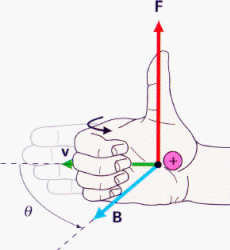
What determines the
direction in which a photon will go when we consider that it is
perpendicular to fluctuating electric and magnetic fields? What
determines it will go forward or backward?
ANSWER:
At some instant and at some point in space,
the electric and magnetic fields are perpendicular to each other. If
you take the fingers of your right hand and curl them from the electric
field to the magnetic field, then your thumb points in the direction of
propogation. I could not find a picture specifically for this, but the
picture to the right works if the green vector (labelled v) is
the electric field, the blue vector (labelled B) is the
magnetic field, and the red vector (labelled F) is the
direction of travel of the wave. (Also, q=90o.)
QUESTION:
Mike is going on a road
trip. he's on the highway moving at a constant speed in his car. he
notices that objects that he passes that are straight in front of him
(the gravel on the road, the white dashed lines) move fast (as fast as
the car), and as he begins to gaze sidewards, he notices that things
don't move as fast as the things right in front of him (the road signs
seem to be moving slower than the coke can right in front of him as he
passes both). He notices that this trend continues right down to the
mountains 30 miles to the side. they're are barely moving, if at all...
Now you'll realize that none of the objects are actually moving; it's
mike that's moving. everything is moving relative to him. is there any
formula that can measure the "speed" of these objects where the
relatives speeds of different objects, depending on their distance from
mike?
ANSWER:
All objects at rest have the same velocity
relative to Mike. But, the appearance is what counts to him. A distant
mountain will appear to be the same size as a rock by the roadside. It
takes the rock maybe 1/10 of a second to "move" its own size but the
mountain may take 100 seconds to move its size. Hence, the mountain appears
to be moving more slowly because the apparent sizes are the same.
QUESTION:
Would it be possible to get
supplies to mars by creating a giant "pod gun" ?
this "pod gun" would use a contained explosion of hydrogen (much like a
real gun) to launch a "pod" of supplies into space.
ANSWER:
Any method which accelerates an object to a
velocity greater than the escape velocity (the speed an object must
have at the earth's surface to escape earth's gravity) would work.
Questions of practicality and cost would be the determining factors.
QUESTION:
How do electrons leap from
one side of an atom to another without traversing the space in between?
ANSWER:
What makes you think that they do? The
proper way to think about an electron in an atom is to say that it is a
probability distribution, that is it might be anywhere with a certain
probablility being associated with each small volume in space. Hence
you might make a measurement and find that the electron is on one side
of the atom and later make a measurement and find it is on the other.
This did not mean that it went discontinuously from one side to the
other.
QUESTION:
I would like to know if a
magnet's pole can be neutralized by insolationing or by anyother way .
ANSWER:
The only way to do that is to superimpose it
on the opposite pole of another magnet. The important physical
principle here is that the pole of a magnet can never exist alone, it
is always accompanied by an opposite pole.
QUESTION:
It is given that there are
two masses (bowling balls for instance) present in a vacuum. there are
no outside forces acting upon them. no gravity, no air resistance,
nothing. Both masses (the bowling balls) are the exact same shape and
diameter. However, one has a mass of 10kg, while the other has a mass
of 100kg. both objects are at rest relative to us as observers. If two
equal forces where applied to both these objects at the same instant
(say we put two identical rockets on these bowling balls) and fired
them for exactly the same amount of time, would both objects go exaclty
the same distance, or would one go farther then the other, and if so,
which one? And regardless of the answer, why does this occur?
ANSWER:
You have hit on the central ideas of
Newtonian physics. First, after getting either ball moving by your
rocket, it will not stop after you turn the rocket off--it will keep
going forever, so the question of which ball goes farther is moot.
However, if you mean which ball goes farther during the time the
rockets are on, it is the less massive one. This is because Newton's
second law says that the acceleration of an object (the rate of change
of its speed) is proportional to the force it experiences divided by
the mass; hence, with equal forces the one with the smaller mass has
the larger acceleration. Hence for equal times the less massive ball
will acquire more velocity and hence go farther.
QUESTION:
Is it just arcing that
causes a transformer to explode? Is there
some flammable material (e.g. oil) inside it that causes the explosion?
Seems like an arc would make the transformer melt, not explode.
ANSWER:
There is flammable material inside; if
arcing occurs, there is likely a high current inside which provides the
heating necessary to ignite the flammable material.
QUESTION:
Why do keepers of the famous
clock Big Ben in London add or remove coins from the bottom of the
pendulum to speed up or slow down the clock if the mass of pendulum has
nothing to do with the pendulum's period?
ANSWER:
Because Big Ben's pendulum is not a simple
pendulum, that is it is not a point mass attached to a massless string.
It is what is often referred to as a "physical pendulum" and its period
is determined by its moment of inertia and the moment of inertia
depends on how much mass there is and where it is.
QUESTION:
I have a theory that the
movement of a body in the universe is relative to other objects. Ergo,
nothing can be absolutely still. Do you agree that everything in the
universe is moving, and that no object is entirely at rest?
ANSWER:
If, as you suggest,
everything is relative, then "at rest" is a matter of definition. That
is, I can define myself, for example, to be at rest and then everything
else in the universe moves unless it happens, as my computer is right
now, to be at rest with respect to me. On a deeper level, nothing can
be at rest because of the Heisenberg uncertainty principle because you
cannot precisely know the velocity of something without being
completely ignorant of where it is.
QUESTION:
When I get out of a car
while wearing running shoes I get shocks from the metal door frame.
However, when I exit the vehicle while wearing insulated boots I do not
get shocks. My question is; All other conditions being the same, would
I not still carry a static charge that would be discharged when I
contact a proper ground? And why not?
ANSWER:
I am not sure what you mean by insulated
boots, but what you want to do is have a good electrical contact
between you and the ground when you get out. What is actually happening
is that you have a static electrical charge on you when you get off the
seat of the car. If you have shoes which have soles which connect you
electrically to the ground, the charge leaks off. If the charge cannot
leak off, it will seek a way to get off and will do so through the car
(which, in spite of the tires being rubber and appearing to be not a
good conductor, is actually a quite good path to ground). Before you
touch the door, there is a large voltage (thousands of volts!) between
you and the door because of your electric charge; this voltage causes a
spark to jump which hurts. The best way to defeat this is to hold the
door as you are getting out so the charge leaks off without there being
a spark. So, my suspicion is that your running shoes have soles which
insulate you from the ground but your boots do not. Incidentally, the
problem is greatest when the humidity is low because a lot of water
vapor in the air lets the charge leak off through the air.
QUESTION:
As a shotgun fires, the bb's
make a pattern that gets wider and less dense with more distance. So
how can light leave a small source and fill all the void in between for
what seems could be an indefinate distance? i.e. the sun
ANSWER:
Because a shotgun is more like a flashlight
than the sun. The light from a flashlight is pretty well collimated and
spreads a little. The light from a source like the sun goes out in all
directions. However, the intensity of the light from this kind of
source gets smaller as you get farther away quite rapidly--if you go 10
times as far away, the intensity of the light gets 100 times smaller.
That is why, of course, star appear much dimmer than the sun even
though the sun is a pretty average star.
QUESTION:
if heat is the vibration of
atoms why doesn;t it feel like vibrations but well heat?
ANSWER:
The vibrational frequency of
a typical atom in a room temperature solid is on the order of 10 THz,
that is about 10 million million vibrations per second. To put this
frequency into perspective, you cannot hear more than about 20,000
vibrations per second. Your body has no mechanism by which it can
respond to such a rapidly changing stimulus. Furthermore, the vibration
of a single atom against your skin would be imperceptible and the atoms
are all vibrating with random phases.
QUESTION:
if gravity is approximated
by a constant and if the frictional force is proportional to the
velocity, show that a free-falling body (i.e. no restoring force)
approaches a terminal velocity
ANSWER:
Since the downward force is mg
(constant) and the upward force is bv (b is constant, v
is speed), the net force will be mg-bv down. The
frictional force starts at zero but as v increases the net
force gets smaller. Eventually the speed will be big enough that the
net force will be zero, so the speed will remain constant. The terminal
velocity will be mg/b.
QUESTION:
If you wanted to use your
laser beam to hit a space station that was traveling above the
atmosphere and just above the horizon, would you aim the laser above,
below, or directly at the station YOU SEE FROM EARTH? (the index of
refraction of space is exactly 1.0, while the index of refraction of
air is about 1.001)
ANSWER:
Since light is reversible, that is light
traveling from you to the space station will follow the same path as
light traveling from the space station to you, you should visually aim
at it.
QUESTION:
Hi, quick question, a few
friends and I had a little debate the other day. Basically the premise
of the debate was that if humans somehow started to dump all our
garbage into space the mass of the earth would be affected enough to
somehow affect earth's orbit. Their contention was that everything is
produced by the earth as in what humans make from it therefore if we
started jettisoning it into space it would affect earth's mass to alter
its orbit however miniscule. I saw something really wrong with this, in
my view there are many variables not being taken into account here that
affect earth's mass and its relation to the sun and its orbit and that
garbage is too small a variable or another counteracting variable would
negate any effect it could have if it was sent into space. Yes a little
bit of a weird topic lol, but any insight would be appreciated.
ANSWER:
If the earth's mass suddenly decreased by
half, the period of the orbit (one year) would be totally unaffected.
The period of the orbit of a satellite is independent of its mass if
the sun's mass is very large compared to the earth's mass (2x1030
kg vs. 6x1024 kg, a ratio of about 3/1,000,000). To
be exact, it is the reduced mass of the system which matters; that
would be msunmearth/(msun
+mearth), but, since msun>>mearth,
the reduced mass is incredibly close to mearth, and
the dependence of the orbit on the mass is completely negligible.
Technically, however, your friends are right that a change of mass will
affect the orbit; it is just that for even a huge change in mass (a
large fraction of the earth's total mass) the effect would be so small
as to be unmeasurable.
Another problem to consider is
the possible disruption of the earth's orbit because of how the mass
was ejected. For example, in the extreme case where you jettison half
the earth's mass into space with some velocity the remaining half would
recoil with the same velocity which would certainly seriously alter the
orbit. But if you jettisoned a million tons, the earth's recoil would
be negligible.
QUESTION:
;
can you please explain
nutrinos in basic terms?
ANSWER:
Many radioactive nuclei
undergo a decay called beta decay. One kind of beta decay happens if a
nucleus has too many neutrons (which have no electric charge). Somehow
nature knows this and takes one neutron in the nucleus and turns it
into a proton; but electric charge must be conserved, so the appearance
of a positively charged proton necessitates the creation of a
negatively charged particle, so an electron is ejected from the
nucleus. It is this electron which is the "radioactivity". Back in the
1930s when beta decay was first discovered a most disturbing thing was
observed: the electrons which were ejected came out with a broad range
of energies. This was disturbing because each electron left behind the
same thing (that is a nucleus with a particular amount of energy), so
the range of electron energies implied that the energy was not
conserved by beta decay. This principle, energy conservation, is so
dearly held by us physicists that we invented a third particle, the
neutrino, which had no mass and no electric charge and carried off the
right amount of energy to insure that energy was conserved. A
remarkable fact is that, because it interacts so incredibly weakly with
matter, the neutrino was not experimentally observed until the late
1950s. So nearly 30 years elapsed before this hypothesized particle was
observed, yet no self-respecting physicist doubted its existence!
Neutrinos have been in the news
lately because of the so-called "solar neutrino problem". We believe
that we understand very well what goes on inside the sun and yet the
number of neutrinos which we observe on earth is considerably fewer
than the number predicted by our models of stars. This problem has
recently been solved by measurements which find that the neutrino is
not really massless but has an extremely small mass (much smaller than
the electron, the lightest of "everyday" particles). I will not attempt
to explain how this solves the puzzle, but it does!
QUESTION:
Does gravity have a speed at
which it travels?
To clarify, if you teleported two objects to some incredibly far away
& empty region of space, so the only noticeable force of gravity
would be the two objects pulling each other together, upon arrival by
teleportation like "popping in to existence" would there be a delay
before they begin pulling each other?
ANSWER:
I do not believe that the speed at which a
gravitational field propogates has ever been measured. It is generally
believed to propogate with the speed of light. But whatever its speed
actually is, nobody would believe that it is instantaneous.
QUESTION:
I have some demonstration
capacitors that are rated 1F at 5V. Is this correct then that it can
hold a static charge of 5C? I've always thought that 1C of static
charge was enormous. Am I missing something? Is there a dielectric out
there that allows this?
ANSWER:
Those capacitors could not possibly be 1 F.
They are probably 1 mF.
QUESTION:
Is a satellite that is
orbiting earth (and not decaying in its orbit) in equilibrium? I say
no, because only 1 force (gravity) is acting on the
satellite--otherwise it would move in a straight line. My coworker says
that inertia or momentum is balancing the gravity and that therefore
the satellite is in equilbrium. What is the real answer?
ANSWER:
You are right. It is clearly
accelerating (velocity always changing direction) and so cannot be in
equilibrium.
QUESTION:
Is there a way to
change/slow down the rate of radioactive decay...for example, Tc99m
half life is 6.01 hours. Is there a way to change that time, or slow it
down?
ANSWER:
Not unless you slow down time itself, for
example if the radioactive nuclei had a very high speed in the
laboratory, they would live much longer because of time dilation.
QUESTION:
in my gcse physics lesson
the teacher explained that an electron is given out by a nucleus when
it changes during beta decay and a nuetron changes into a proton. Why
is the electron made when the neutron changes?
also is there such a thing as anti elements for example the exact
opposite of hydrogen?
ANSWER:
There is also a third,
chargeless particle, the neutrino, which is a product of neutron decay.
It is not simple to answer a question like why the electron is ejected;
that requires understanding the theory of beta decay (that is what this
is called). One easy way to believe that an electron might come off is
that the total electric charge of the universe must remain constant,
that is you cannot create or destroy electric charge. If a proton
appears, so does 1.6x10⁻¹⁹ Coulombs of charge; to keep the
total charge equal to zero, -1.6x10⁻¹⁹ Coulombs of charge
must appear which just happens to be the charge of an electron. And
yes, antihydrogen (consisting of an antiproton and a positron) has been
observed. Check out
this story from CERN.
QUESTION:
Quantum mechanics views
force interactions between particles as an exchange of other particles,
such as the photon. General relativity views the gravitational 'force'
as an artifact of space-time distortion. How does general relativity
handle the other 'forces' - electromagnetic, weak and strong? Does
general relativity also view these forces as manifestations of
space-time distortion? Or, does it view gravity as a special case
distinct from these forces?
ANSWER:
Some work has been done in extracting
electromagnetism from the equations of general relativity with mixed
results. It is pretty fair to say, however, that gravitation and all
other forces of nature are not reconciled. A theory of "quantum
gravity" is one of the "holy grails" of theoretical physics.
QUESTION:
I have seen many warnings
about the possibility of a hydrogen explosion when charging batteries.
I know hydrogen is produced, but the volume in the battery seems small,
many have a method of venting and the ignition source is outside the
battery. Are there any scientific studies that confirm the culprit is
hydrogen? I have been looking on the internet but have had no luck
finding an authoritative source.
ANSWER:
Hydrogen is very dangerous, even in small
amounts if confined. Venting makes the danger less acute but not
nonexistant. Explosion is a relatively rare event with batteries, but
not to be taken lightly.
QUESTION:
Is it possible to heat water
vapor to a plasma state? Can it be done on earth?
ANSWER:
Any gas may be converted into a plasma
(which is just a mixture of unbound electrons and positive ions). My
guess is that water would probably dissociate into H and O either
before or simultaneously with ionization. It doesn't take all that much
energy and could easily be done on earth.
QUESTION:
If I tear a piece of paper,
what is happening at the subatomic level at the torn edges?
Are the electrons/subatomic particles getting ripped out of their
positions? And then
do they fly off into the air or remain glued to their original position?
ANSWER:
Solids hold together by adjacent atoms
bonding to each other. Ripping a piece of paper simply breaks these
bonds. This will be a pretty violent process on the microscopic level
and some atoms and clusters of atoms are sure to end up leaving the
paper altogether.
QUESTION:
My 7 year old daughter has a
"simple" physics question, but I want to give her a precise answer in
terms she can understand. I am hoping you can help. Here it is: At sea
level, would a soccer ball which is completely deflated (and collapsed)
have a greater or lesser weight (as measured on a standard scale) than
one filled with helium? My supposition is that the scale weight goes
down when filled with helium, even though the overall mass is increased
by the helium itself. Is this correct? That's a concept she can't
understand and I want to explain it if possible.
ANSWER:
Your question has an ambiguity in it: you
ask about the weight "as
measured on a standard scale". However, a standard scale does not
necessarily measure the weight of an object sitting on it, it measures
the force you push down on it with. So, a 10 pound weight on the scale
and on which you are pulling up with a force of 4 pounds will only
"weigh" 6 pounds according to the scale. So, let me address the
question in two parts.
- Which has more weight, the
empty ball or the full ball? Obviously, the full ball since it has the
weight of the ball plus the weight of whatever it is filled with.
- Which will have the greater
apparent weight as measured by the scale? Here a new force, the buoyant
force, comes into play. When you put an object into a fluid (air is a
fluid) there is an upward force on it which is equal to the weight of
the displaced fluid. Since you are dealing with a 7 year old, just give
her a simple example of a buoyant force: e.g. a soccer ball
filled with air on the bottom of a swimming pool pops to the top
because of the buoyant force; the buoyant force on the soccer ball in
air is just less than in water because water is more dense than air.
So, assuming that the helium is at a pressure (close to atmospheric)
not too high, there will be an upward buoyant force (equal in magnitude
to the weight of an equal volume of air) greater than the weight of the
added helium, and so the apparent weight will be less than the
empty ball.
QUESTION:
I am having trouble
reconciling these two principles: (1) the velocity of light is
independent of the velocity of the source, and (2) in a uniformly
moving system you can't tell how fast you are going.
Suppose you are in a uniformly moving system and you set up a light
source that sends out two beams simultanously--one in the direction of
the motion of that system and one in the opposite direction. You have
two detectors located at equal distances from the source (thus
detectors and source are in a straight line). Wouldn't the detector
located "behind" detect the light before the detector located "ahead"?
ANSWER:
To understand relativity, you have to
"believe" the postulates. Essentially what you must accept, as
nonintuitive as it may seem to you, is that the speed of light is the
same as seen by any observer. The result of this assumption totally
upsets our ideas about what space and time are. The experiment you
describe is one of the classic examples illustrating how the notion of
time is different. The concept is that of simultaneity: classically, if
I determine two events to happen simultaneously, I expect anybody else
in the universe to agree with me. (Note that "determine" is different
from "see": if I see one event and then one year later see a second
event, but the second event happens somewhere a light year from the
first, then I determine them to be simultaneous.) The experiment you
describe will have an observer on the moving system see the events
happen simultaneously but an observer at rest will see the two events
to be not simultaneous in the way you describe. It is an inescapable
consequence of the fact that the speed of light is the same as seen by
any observer.
QUESTION:
We all know carbon dioxide
sublimes as "dry ice".
Is the same true for carbon monoxide? Both have a triple point.
I've read conflicting things and was hoping you could provide a
definitive answer.
And if not pressurized liquid gas released and evaporating into a
solid, how then is frozen or solid carbon monoxide possible?
ANSWER: (provided
by S. P. Lewis)
Whether or not a solid in equilibrium
sublimes to the gas phase
as temperature or raised, instead of melting to the liquid phase,
depends on the (presumably fixed) pressure at which the experiment is
done, relative to the triple point of the substance.
If the experiment is done at a pressure below the triple point,
then a constant-pressure line in a P-T phase diagram crosses
the solid-gas coexistence curve. This means that raising the
temperature of the solid eventually leads to sublimation.
Conversely, if the operating pressure is above the triple point,
then a constant-pressure line crosses a solid-liquid coexistence
curve and a liquid-gas coexistence curve. This means that
raising the temperature of the solid eventually leads to melting,
and further heating eventually leads to boiling.
For carbon dioxide, the triple point is at pressure 5.2 atm and
temperature -57 C. If we assume the experiment is done at ambient
pressure (i.e., 1 atm), then we would expect solid CO2
to sublime to gaseous CO2, which it does -- hence 'Dry Ice'.
The triple point of carbon monoxide, however, is at pressure
0.15 atm and temperature -205 C. Ambient pressure is well
above the triple-point pressure, and therefore, under these
conditions, solid CO would not sublime on being heated. Rather, it
would melt and then eventually boil.
QUESTION:
Would the shape of a balloon
(i.e., regular 9" round; oblong 9") with the same amount of helium
affect the rate of ascent? I would greatly appreciate your answer/input
and any specific guidance that you can offer us. We have read your
groundrules and are not using "The Physicist" to do our homework. In
order to answer this question, my son and I have been researching
topics such as hot air balloons and gravitational force by visiting our
local library. However, our library is very limited and provides few
good science books. Therefore, we have been performing various topic
searches through Google during the past several weeks in order to
answer this question ourselves.
ANSWER:
There are several things to consider. I
would like to just answer your question without the complications of
what happens at distances high above the ground where temperature is
much colder and pressure (of the atmosphere) much lower. In first
approximation, the only things which will determine the motion of the
balloon are the mass and volume of the baloon+helium,; let's call those
m and V respectively. The weight of this balloon
is therefore W=mg where g is the accelleration due to
gravity; this is a downward force. Now, Archimedes' principle tells us
that there will be upward force (buoyant force) equal to the weight of
the displaced air, B=rVg where r is the density of air. The total force on the balloon
is therefore B-W=rVg-mg upward. Because of Newton's second law,
the balloon will therefore have an upward acceleration of a=(rV/m-1)g
which is independent of its shape. However, in the real world
there is another force which cannot be neglected and that is the air
friction the balloon experiences when it starts moving. This depends in
very complicated ways on the geometry of the balloon and is best
studied experimentally, I think.
QUESTION:
The triple point of Hydrogen
is about 13.8 K and the temperature of Universe is about 2.73 K. This
means that all the Hydrogen atoms in the universe must be in solid
state. Why don't these tiny particles coalesce and form a hyge ball of
solid Hydrogen, weighing about 10 to the power of 49 or 50 tons, which
would then implode under its own mass and lead to another Big Bang?
Would this scenario ever take place?
ANSWER:
No, it does not mean that the universe is
solid because the pressure of the intergalctic medium is incredibly
small. Hence the intergalactic medium is essentially gaseous hydrogen.
QUESTION:
I am a senior high school
student, and I have a question pertaining to thermodynamics (actually
originating in my chemistry class). My teacher asked us the following
question "Which has more heat: 1000g of water (heat capacity of
4.18J/°Cg) at 60°C or 1000g of steam (heat capacity of
2.01J/°Cg) at 105°C?" First of all, I was under the impression
that heat is defined as the transfer of energy during a reaction, and
that objects don't have a property called "heat". Presumably, he was
looking for the substance which had the greater internal energy. In
this case, I would answer that the steam had the greater internal
energy, since it had (presumably) been heated as a liquid, then boiled
and then heated some more to its final temperature. Thus, it would have
greater average kinetic energy, and greater intermolecular potential
energy than the water. I realize that some complexity arises from the
state change and pressures/volumes etc. in gases, but I'm not sure
exactly how. If you could shed some light on this, it would be greatly
appreciated.
ANSWER:
Your semantics are sound, i.e. you
should be thinking about internal energy. Your reasoning seems sound
also since you need to add energy to heat the water, add energy to
vaporize it, add energy to heat the steam.
QUESTION:
We are taught that E fields,
M fields and EM fields are real entities and that they contain an
energy density; and that (changes in) their influence propagate at
lightspeed. There is an equivalence of mass and energy, and energy must
be conserved. If these statement are all true, why is the mass of
charged matter (e.g., an electron) constant? Does there not exist a
continuous flow of energy radially outward from a static charge, for
example, as the influence of its electric field propagates to ever
larger volumes of space?
ANSWER:
Because a field has an energy density does
not imply that energy flows. In fact, if you compute the rate at which
energy leaves a volume surrounding a static charge, the answer is zero.
Charges radiate energy only when they accelerate and the energy loss is
taken from the kinetic energy of the accelerating particle, not its
rest mass energy.
QUESTION:
I read that electrons at
SLAC are accelerated to speeds of 0.999 999 999 948c. What are the
specific products when electrons moving at this speed collide with
other particles? Could you list some of the reactions produced at this
speed? I would also like to know the applied EMF in volts needed for
achieving the above speed, so that I can determine the energy of the
accelerated electrons.
ANSWER:
The huge number of possible reactions
depending on the target make it impossible to answer your first
question. However, you second question can be answered pretty easily.
However, you want to calculate the total energy E from the
speed from which you can infer the voltage which must have been
applied. The total energy is E=mc2/[1-v2/c2]1/2.
The arithmetic is a little tricky for v so close to c,
but I find that E=4.9 GeV. This is the total energy, so to get
the kinetic energy you must subtract the rest mass energy; but the rest
mass of an electron is about 0.511 MeV=0.000511 GeV, so it is
negligible. Hence, the EMF you seek is about 4.9 x 10⁹ volts.
QUESTION:
when you see a rainbow, you
always see part of a circle.
How high must you rise to see the full circle?
Please include some references in your reply so that I can learn more
about this fascinating topic.
ANSWER:
There is a pretty clear answer to your
question at
http://www.wonderquest.com/rainbow-circle.htm.
QUESTION:
my question to you is:
"Where do the bubbles in softdrinks like coka cola go in zero gravity?"
Will they rise to the surface, or will they stay in the same place? If
so, will the bubbles keep growing? I can imagine that mass matters,
that the bubbles in a mass of soda the size of a planet, 'would' rise
to the surface, but how about smaller masses.
ANSWER:
Bubbles rise because of the buoyant force.
But, in a no-gravity situation, there is no buoyant force. Therefore
the bubbles should not move at all. I guess the whole ball of softdrink
would become a froth of bubbles eventually but the evolution would
probably be complicated to describe.
QUESTION:
OK. I have been thinking
about this for a very long time, however since i do not possess the
intimate knowledge that a well-versed person in the ream of physics
might have. My question is this: From my understanding, there are four
main forces which keep the universe together. One of them is gravity.
Gravity affects the heavens and all that it encompasses even light.
Light is bended by the gravity exerted from a massive object. From what
ive learned, this is one way black holes are observed. As is commonly
known, nothing can escape the gravitational pull of a black hole, not
even light. So what we have are two extremes: in one extreme, a beam of
light would travel (theoreticlly) in a straight line if no force of
gravity was imposed on it and in the other extreme, light is bended so
far that it is incapapble of escaping when it enters a supermassive
graviational field. The question i have is is there a medium between
the extremes? Would it be possible for a beam of light to orbit an
object of a specific mass, trapping it in orbit?
ANSWER: (answer
provided by L. A. Magnani)
Yes, light can orbit around a black hole of
any given mass. The key question is, how far
from the singularity can the light maintain a circular orbit? It turns
out that, according to General Relativity,
light can maintain a circular orbit at 1.5 times the Schwarzschild
radius from the
singularity (the Schwarzschild radius is 2GM/c2
where M is the mass of the black hole, G is the
gravitational
constant and c is the speed of light. This region is sometimes
called the photon sphere. Inside 1.5 times the Schwarzschild
radius, no circular orbits exist; all orbits are unstable and all
objects moving inside of this distance
fall into the black hole.
QUESTION:
Two identical balls are
attached together with a 3-foot length of string. Hold one ball and
allow the other ball to stretch out the string. If the "system" is
dropped from a height of about 5 stories, why do the balls come
together before they hit the ground?
ANSWER:
The only explanation has to be air friction.
The leading ball behaves like a freely falling ball which accelerates
until it reaches its "terminal velocity"; it does not continue
accelerating because there is an upward force due to air friction on it
and this force gets bigger as the velocity gets bigger. The upper ball,
however, is in the wake of the lower and therefore has a smaller air
friction force on it.
QUESTION:
Ok, I have a friend of mine
that thinks if (in a vacuum with no gravitational interference) you
were in a spaceship and turned the rockets on you would begin
accelerating and continue to accelerate even after the rockets were
turned off. I thought that according to F=ma or a=F/m you would stop
accelerating and only maintain the velocity you had attained at the
moment you turned the rockets off. Is my thinking flawed or did I read
Newtons laws correctly?
ANSWER:
Your friend is dead wrong.
QUESTION:
I am trying to vibrate a
tissue with a sound source that is directed at the tissue, but not in
direct contact with the tissue. I have been told that using acoustic
waves will provide this type of push/pull motion. That is, they will
push the tissue and actually pull it back to equilibrium, as opposed to
just allowing the tissue to come back to it's equilibrium position on
it's own before the next wave hits. I have also heard that ultrasound
waves do not have this property. That is, they result in static
displacement and will not allow the tissue to return to equilibrium
unless the source is off (as is the case in pulsing ultrasound). A
co-worker told me this was not true about acoustic waves. Example the
front of a speaker only vibrates in and out because the membrane comes
to rest on it's own before the next vibration. Can you tell me the
properties of these waves in this kind of situation and maybe a source
of information?
ANSWER:
There is no simple answer to your question.
Essentially your question has to do with driven oscillations. If we
model the tissue paper as a simple harmonic oscillator (which you seem
to be implying), then it has a characteristic natural frequency. If you
drive it with a frequency equal to that frequency, it will have a large
amplitude of oscillation with a frequency close to its natural
frequency (this is called resonance). But, if you drive it with a
different frequency, the paper, after some initial transient behavior,
will oscillate with the driving frequency, not its natural frequency.
The farther you are from the natural frequency, the smaller the
amplitude of the response will be.
QUESTION:
I have to do a physics
project. Its called an egg drop. We can only use a brown lunch bag, 3
straws, the card board of a toilet paper roll and tape to create a
device that will deliver our egg safely to the ground from 4 diffrent
hights. Do you have any design tips or suggestions?
ANSWER:
I will not try to design
something, but I will tell you what you need to do. To break an egg you
must deliver a force to it. Force, according to Newton's second law is
mass times acceleration. So, since you have no control over the mass of
the egg, you must minimize the acceleration which it experiences to
minimize the chance of its getting broken. To do this you maximize the
time it takes for the egg to come to rest. Another issue (besides the
magnitude of the force on the egg) is how that force is distributed: an
egg dropped on a nail is much more likely to break than if you could
take the force exerted by the nail point and redistrubuted it over a
bigger area of the egg's surface.
QUESTION:
Lets say as an example that
the muzzle velocity of a particular rifle is 700 miles per hour. If you
fired the gun on an aircraft that had a constant velocity of 700 miles
per hour, would the velocity of the bullet relative to nature be 1400?
My next question is if you fired the bullet backwards, would the
bullet's velocity be Zero (relative to nature, not the aircraft)?
ANSWER:
Yes and yes, assuming that we neglect air
resistance.
QUESTION:
I understand the "electron
gas" model of metal, but one thing I've never heard addressed is what
happens at the surface of the metal. In a simplistic model, we say:
An electron travels some distance until it collides with something.
After the collision, it starts a new path in a random direction.
If an electron starts near the surface of a piece of metal, and travels
towards the surface such that its trajectory would take it outside the
metal before it collided with something, what happens? Does the
electron temporarily leave the metal before being pulled back by
electric forces?
Can a collision with the surface be treated as one of the other
collisions where the electron starts a new path in a random direction?
Or should this be treated as an elastic collision, as if the electron
were a ping-pong ball bouncing off a wall (angle of reflection = angle
of incidence, etc.) ?
ANSWER:
Perhaps it is best to just examine the
problem more classically. If an electron comes shooting out of the
surface (which it might), it will have a positive image charge inside
the metal which will attract it back. On a more microscopic level, if
an electron is removed, an equal amount of positive charge is left
behind which will attract it back. If, however, the metal is very hot
so that there are electrons of sufficient kinetic energy to escape,
then electrons will flow out the surface; this is called thermionic
emission. I think you should not think of a "collision with the
surface"; the electron either collides with something close to the
surface (which is, at a microscopic level, not well defined) or it
doesn't.
QUESTION:
I read somewhere that
tachyons can go faster than light. How?
ANSWER:
Tachyons are hypothetical particles. A
tachyon has never been observed. The theory of relativity does not
forbid particles to have a speed greater than the speed of light, but
you "cannot get there from here", that is you cannot take a particle
with speed less than the speed of light and accelerate it to a speed
greater than the speed of light.
QUESTION:
Is it possible that the
gravitational constant varies with the composition of the mass? For
instance, could a kg of ice have a slightly different gravitational
constant than, say, a kg of iron?
ANSWER:
Of course no scientist likes to say
"impossible", but in some sense the very name "gravitational constant"
automatically insures that what you ask is impossible by definition.
Then, since the only other things that gravitational force depends on
are mass or distance between attracting objects, if you get a force
different than what you expected, then you probably made an error in
measurement of mass or distance; the gravitational constant is simply
the proportionality constant in Newton's universal law of gravitation.
QUESTION:
Hello, I have been trying to
find out how to calculate the force on an object when this object is
rotating around a point. I know that this is called the centrifugal
force and that it is calculated by [F = r * m * v2].
However, every place I look will not give me units of measurement. Is
the Force(F) in Newtons? is the radius(r) in Meters? is the mass(m) in
Kilograms? Is the angular velocity(v) in revolutions per minute? Thanks
a bunch
ANSWER:
First of all, it is not called centrifugal
force, it is centripetal force, a force pointing toward the center of
the circle (from the Latin centrum=center + petere=to
seek). A centrifugal force (from the Latin centrum=center + fugere=to
flee) points away from the center and is what phyicists call a
fictitious force, i.e. it does not exist. Secondly, the force
is not what you have it but rather F=mv2/r. Now
the units are correct, (kg m2/s2)/m=kg m/s2=N.
QUESTION:
How can an particle, in real
life have a net mechanical energy of less than zero? Energy can be
taken away from a system resulting in a negative change in energy, but
how can its total mechanical energy be less than zero. I tried to
justify this question with the fact that potential energy is often
relative, such as in the case of gravitational potential energy, so all
of the movement of a particle happens "below" this zero reference
point. But I am still feeling unsettled about this. Is there a better
answer?
ANSWER:
Only kinetic energy is
definitively positive. Potential energy is always arbitrary within an
additive constant. What really matters is how energy changes, not what
energy is.
QUESTION:
A photon travelling from a
distant part of the universe is red-shifted by the time it reaches
earth. The photon has less energy when it arrives. Where has the
missing energy gone?
ANSWER:
For starters, you should not talk about
photons and gravity simultaneously since quantum mechanics and general
relativity are not compatible with each other. But the fact remains
that a photon leaving some very large mass will be red shifted so
energy has been lost. The source of the gravitational field will gain
that energy.
QUESTION:
Has the idea that the speed
of light is actually slowing down been debunked? Do both gamma rays and
radio waves move at 183,000 mps? If I turn on a light bulb in outer
space will the EM radiation from that bulb ever stretch out to the
point of being below the visible spectrum? Will it become infrared then
microwave then radio wave?
ANSWER:
The question of whether nature's constants
are in fact constant over very long times is a question of interest to
physicists. There is no evidence that the speed of light is not the
same as it has always been. Electromagnetic radiation of a particular
wavelength moving through empty space will maintain exactly the same
wavelength regardless of the distance from the source.
QUESTION:
If you have a ballon filled
with helium and you let it go it will rise. As altitude increases, air
pressure decreases and the ballon expands. But as altitude increases,
temperature decreases and causing the ballon to contract. Will it pop?
ANSWER:
The drop in pressure plays a
more important role than the decrease of temperature, so it will want
to continue to want to expand going to higher altitudes. However,
whether it pops and when are determined by things like what the balloon
is made of, how much helium was initially in it, etc.
QUESTION:
I was just wondering,
positrons and anti-protons have the opposite charges of electrons and
protons and anti-neutrons have the opposite charge of neutrons. But I
was under the impression that neutrons have zero charge...so a negative
neutron would be the same as a normal neutron.. What's the difference!?
ANSWER:
The antiparticle of a neutral particle is
also neutral. But they are not the same particle since there are other
quantities besides electrical charge which determine the properties of
an elementary particle.
QUESTION:
Last summer I was paddling
my canoe on an Ontario lake at late evening. The air and water were
almost perfectly still. I was smoking a pipe, and as I paddled I
obviously exhaled regular puffs of smoke. But when I looked beside me,
I noticed that the more or less coherent clouds of smoke were
travelling along with me at almost the same speed as the canoe! In
fact, they formed a very shallow arc sweeping away beside me and
downwind from the very slight breeze.
But how is this possible? Why wouldn't each cloud smack into the still
air and be stopped immediately? In an aerial view, the smoke should
have looked like a trail of breadcrumbs, but it looked more like a
flight of geese. I've repeated the experiment many times, always with
the same result.
ANSWER:
If you drop a bomb from an
airplane, does it stop immediately (its forward motion) when it hits
the still air? No, in fact it will approximately continue on with
approximately the same forward speed it had when you dropped it and
eventually hit the ground directly under you. In the real world, there
is some air resistance and so the bomb will slow slightly and
eventually hit the ground somewhere behind your position. This is
evidently what is happening with your smoke. Suppose that you blow a
smokering forward in a room with still air. It moves forward with a
pretty constant speed and eventually slows down.
QUESTION:
I was in Physics class and
we were discussing half-life. My teacher said that if I keep taking
half of something away, the original piece will never be zero, or will
never disappear. I remembered a problem I heard. If a man shoots an
arrow at a wall, will it ever reach the wall? Because first it has to
reach the half-way mark, then half of the rest of the way, then half of
that, and so on. So theoretically, the arrow won't reach the wall. I
know in reality it will, but how else would you explain this question?
ANSWER:
The notion of half life is a statistical
one. That is, the rate of change of the decaying particles is
proportional to the number of particles; so if you find that a sample
of 1,000,000 particles decay at the rate of 1000 per hour, then
2,000,000 particles will decay at the rate of 2000 per hour. Then half
life is a useful concept. But when the number of particles gets small,
this proportionality is no longer true, so half life is no longer a
useful concept.
QUESTION:
what would be when an object
is obliged to do a work that is greater than its energy?
for example assuming that there is an object at the top of an inclined
plane an it has only a potential energy of mgh. And it is released to
go to the base of the plane but the work must done by the friction is
greater then mgh for instant 2mgh. Also the friction force is smaller
than the component of weight, mgsin&. It must go to bottom because
of gravity but it has not enough energy to go.What would be???
ANSWER:
You are apparently assuming it starts at
rest. Then if friction is equal to mgsinq, it will not go at all. If friction is smaller, the
object will accelerate down the incline because of the unbalanced force
down the incline. However, if it starts in motion and friction is
greater than mgsinq, it will slow down until it stops, that is until the
net work done by the friction and gravity takes away the kinetic energy.
QUESTION:
So we are teaching kids
about the movement of the earth around the sun. Is it the sun's gravity
that keeps the earth in orbit? What gave it its initial energy to move
around the sun?
ANSWER:
Yes, it is the gravitational attraction
force which the sun exerts on the earth which is responsible for the
earth's orbital motion. In nature, whenever there is a motion of a
particle in a circle, there must be a force which points toward the
center of the circle. The simplest everyday example is a ball tied to a
string and moving in a circle (imagine a tetherball); the string pulls
on the ball (the force) and the result is its circular motion. If you
cut the string, the circular motion ceases and the ball flies off in a
straight line. Depending on the level of understanding of your
students, you might want to talk about Newton's second law: the result
of a force is an acceleration. Then you can talk about how something
which moves in a circle is accelerating even though its speed stays the
same. Acceleration is the change of velocity and velocity can change
either by speeding up or slowing down or by changing direction.
Regarding your second
question, the earth was not created as it is with some particular orbit
but accumulated over billions of years. The current understanding of
planet formation is that, when a star is originally "born", most of the
mass coalesces as the star because gravity pulls it together; but,
because the cloud from which it formed has a little bit of spin to it,
there is a disk of residual dust and rocks going around the star. These
gradually, through collisions and sticking and later gravitational
forces holding bigger pieces together, accumulate to form the planets,
so the planets got their energy from the energy originating in the
motion of the cloud of matter from which system was formed.
QUESTION:
what would be when an object
is obliged to do a work that is greater than its energy?
for example assuming that there is an object at the top of an inclined
plane an it has only a potential energy of mgh. And it is released to
go to the base of the plane but the work must done by the friction is
greater then mgh for instant 2mgh. Also the friction force is smaller
than the component of weight, mgsin&. It must go to bottom because
of gravity but it has not enough energy to go.What would be???
ANSWER:
Absolute potential energy has no meaning;
only changes in energy are meaningful. If we say that the final energy
is equal to the initial energy plus the amount of energy added by
friction (which is, of course, negative since friction takes energy
away from the object), then Efinal=Einitial+Wfriction.
If the object is initially at rest at y=h,
then this equation becomes
mv2/2=mg(h-y)-fy/sinq
QUESTION:
Hello-I am an AP physics
teacher in Michigan and neither I nor my students can figure out the
answer to the following puzzle. Tetherball is a game in which a ball is
tied to a pole and two opposing players try to hit the ball so the rope
wraps all the way around the pole. To eliminate the effects of gravity,
the same game can be modeled with a hockey puck on a frictionless plane
tied to a pole with a string. Here's the puzzle: According to
conservation of angular momentum, as the string wraps and the radius
(i.e. length of the string) decreases, the angular velocity of the puck
increases. Because omega=v/r, it can be shown that V
final=(Rinitial/Rfinal)V initial, hence the linear velocity also
increases as the radius decreases. What is doing the work to cause this
increase in KE? In the common textbook problem, a person or other
"energy source" pulls the string inward, hence the person does the
work, the energy coming from the food they ate. But when the rope does
the pulling due to its wrapping around the pole, I can't find the
source of the energy which does the work that must be done to increase
the speed. All of the AP physics teachers I have asked are stumped.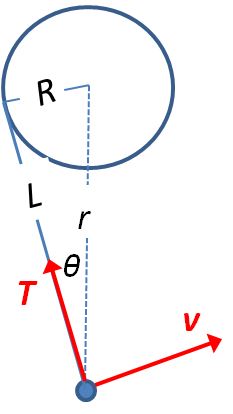
ANSWER:
This is a classic introductory physics
problem. Where you have gone wrong in your analysis is to assume that
the angular momentum is conserved. The condition for angular momentum
conservation is that there be no external torques on the body, in this
case the ball. The only force (ignoring gravity) on the ball is the
tension in the string. Now, since the string does not go through the
axis about which you are computing angular momentum, you can see in the
figure to the right that the tension (labelled F) has a
component which is perpendicular to the line from the center of the
pole to the ball, so it exerts a torque on the ball, so angular
momentum is not conserved. Furthermore, the velocity of the ball
(labelled v) is always
perpendicular to the string and therefore F does no
work; if there are no external forces doing work, then the energy is
conserved so the kinetic energy does not change, so the speed of the
ball actually remains constant in the tetherball problem.
QUESTION:
What is known about time
travel?
ANSWER:
It is possible to travel into the future
using time dilation, a well-known result of special relativity. This is
what is known as the twin paradox (not really a paradox at all).
Basically you travel to a point far away and back at a very large speed
and when you return more time has passed on earth than for you so you
have traveled forward in time. As far as we know, it is not possible to
travel backwards in time. Read more about the twin paradox here.
QUESTION:
If a plane is traveling at
the speeed of light and someone is inside the plane at the back tail
end part and they run to the front of the plane, would they be
traveling faster than the speed of light?
ANSWER:
Well, for starters, it is certainly not
possible to travel with the speed of light because it would take an
infinite amount of energy to get your plane going that fast. But
suppose that went with a speed of about 99.999%, for all intents and
purposes the same as the speed of light for your question. If you ran
to the front of the plane with a speed of say 99% the speed of light,
your speed as seen by somebody on the ground would be about 99.5% the
speed of light. This is fundamental result from the theory of special
relativity—nothing
can go faster than the speed of light and anything with mass must have
a speed less than the speed of light.
QUESTION:
My question is this. Suppose
that in the far future mankind has found the means to travel with the
speed of light. If we manage to send a spaceship 1.000 light years
away, equipped with a extremely powerfull telescope that will be
capable of looking directly to the surface of earth from that distance,
will it be looking earth as it was 1000 years ago or more ( if the
distance is greater )? For instance will it be capable of taking ...
aerial photographs of ancient Rome etc?
ANSWER:
Well, for starters, it is certainly not
possible to travel with the speed of light because it would take an
infinite amount of energy to get your spaceship going that fast. But
suppose that went with a speed of about 99.999%, for all intents and
purposes the same as the speed of light for your question. Then you
would arrive at about the same time as light being emitted from earth
at the time that you left. So if you trained your super telescope back
on earth, you would see things progressing starting from shortly after
you left.
QUESTION:
Is it possible to speak
about a "speed of darkness" or that is only the opposite of the speed
of light since darkness is the absence of travelling photons?
ANSWER:
"Darkness" is not something physical and so
it is rather pointless to talk about its speed. If you have a flash of
light, there is a spherical shell of light expanding out from the
source with the speed of light, so the back side of the flash is the
edge of advancing darkness behind it, so I guess you could say that the
darkness is increasing with the speed of light.
QUESTION:
I don't know why this would
be of any use but, If you mounted two conductive parallel plates of
large magnitude to the top of a lightning rod with the top plate
suspended by an insulator and lightning struck the top plate, would
that be like charging a giant capacitor?
ANSWER:
Sure, assuming that equal and opposite
charge could be acquired from the ground for the lower plate. However,
it would likely not happen since lightening "selects" a path where the
charge can find a route to ground.
QUESTION:
If you set off a nuclear
weapon in a black hole what would happen?
I thought nothing because the particles would not be able to move
around because of the super stong gravatational pull.
ANSWER:
You could not get a nuclear weapon into a
black hole in tact.
QUESTION:
i was once concidering the
effect of propelling an object backward off a moving vehicle with the
exact velocity that you are travelling. From my point of view the
object is moving away from me, but to an observer standing at the side
of the road at the instant i throw the object it merely drops to the
ground. This made me wonder if it is possible for light to behaive in
the similar manner. In this hypothetical situation an object must be
travelling the speed of light. Would the light from the object
travelling in the opposite direction of travel merely stand still in
space becoming "dead light" or would it accelaterate to it's regular
pace. In this situation we would also have to assume that the object is
generating it's own light since light itself would not be able to
reflect off it due to it's speed.
ANSWER:
It seems like I answer this question (in
various forms) at least weekly! There are two problems with your
hypothesis, both violations of the theory of special relativity. First,
no material object may have a speed equal to or greather than the speed
of light; the reason, simply, is that to accelerate it to the speed of
light you would have to supply an infinite amount of energy, obviously
not available. Second, one of the basic postulates of the theory of
theory of special relativity is that the speed of light in a vacuum is
the same for all observers. Thus, even if your object were moving with
99.99% the speed of light (which is possible), an observer at the
roadside would see the light from its back end moving with the speed of
light, not 0.01% the speed of light. The theory of special relativity
is completely verified experimentally and no serious scientist doubts
its correctness.
QUESTION:
what would happen if a small
hole was drilled right through Earth, that is from one side to another
going through the Earth's core, and I so happen to drop an object into
that hole, would the object fall right through, fall towards the middle
and stay there, or result in a ping pong effect? (Given that the
posibillty of creating such a hole is possible, without a catastrophic
event happening)
ANSWER:
This is a classic introductory physics
problem. The object will speed up until it gets to the center and slow
down until it gets to the hole opening at the other side, will then
start speeding up back toward the center, etc. If the earth is
modeled as having uniform mass density (which is only roughly
accurate), the motion of the object will be what we call simple
harmonic motion, that is it will behave exactly as if it were attached
to a giant spring.
QUESTION:
Is it possible to contruct a
machine that repels gravity?
ANSWER:
I don't really know what you mean by "repels
gravity". I suspect you are interested in an "antigravity" machine. The
answer is yes, there are lots of antigravity machines. One is an
airplane which wants to fall to the ground. Another is a tabletop which
keeps a book on it from falling to the ground. I am obviously being a
little facetious here. What would be neat is to have something which is
repelled instead of being attracted by a gravitational field. For this
to happen, there would have to be another kind of mass (just like in
electrostatics we have two kinds of electric charges and so we can have
both attractive and repulsive forces). As far as we know, there is only
one kind of gravitational mass.
QUESTION:
what happens when parallel
rays are incident on a plane mirror?
ANSWER:
The reflected rays are also parallel.
QUESTION:
The other day I was watching
a child play with one of those funfair baloons, filled with (what i
think is) hellium. Often children let go these ballons, and they just
keep on rising and rising...
My question is: how high will such a ballon rise, assuming minimal wind
(i.e. if the ballon rose approx. vertically)?
What if the ballon had hidrogen instead of hellium? Is it different?
ANSWER:
The reason the balloon rises is the same
reason wood floats. When an object is in a fluid (like air or water) it
experiences an upward force (called the buoyant force) equal in
magnitude to the weight of the fluid which it displaces; this is called
Archimedes' principle. So the balloon has two forces on it, its own
weight down and the buoyant force up. If the weight of the air
displaced by the balloon is greater than the weight of the balloon,
there is a net force pushing up which will push the baloon up. This
will be the case if the balloon is filled with helium but not if it is
filled with water, for example. Now, the air in our atmosphere has, as
you probably know, the property that it gets less and less dense as you
go higher and higher; for example, it is quite hard to get enough air
on top of Mt. Everest and airplanes which fly at more that a few
thousand feet must be pressurized. For this reason, the buoyant force
gets smaller and smaller as the balloon rises until, eventually, it is
the same as the balloon's weight and it will stop rising. I have
ignored, in my explanation, the fact that the balloon will get larger
as it goes higher because the pressure of the gas inside stays about
the same while the pressure of the air on the outside gets smaller; I
think the important thing to appreciate is the Archimedes' principle
thing. This is the principle which lets "lighter than air" craft (hot
air balloons, blimps, etc.) fly.
QUESTION:
why can't visible light
waves penetrate most solid walls, yet every frequency below and above
visible light can, such as radio waves, gamma, micro, etc?
ANSWER:
You are incorrect in stating that "every
frequency below and above visible light can" penetrate. Electromagnetic
theory shows that there is a distance called skin depth at which any
electromagnetic wave will decrease to about 1/3 of its amplitude
outside the medium. For conductors the skin depth depends on the
wavelength in such a way that long wavelength waves can penetrate much
farther without significant loss of intensity. At the short wavelength
end of the spectrum (gamma rays, for example) the usual theory breaks
down because we have very energetic single photons interacting with the
atoms in the material and doing such things as losing energy by
ionizing atoms their its paths; here, the more energetic (i.e.
shorter wavelength) the photon, the farther it will go before using up
all its energy.
QUESTION:
I was taught in school that
the speed of light is the speed limit of the Universe. Nothing can go
faster than light. In E=MC2, the speed of light is squared. If nothing
can go faster than C, why does the the equation get square C. Isn't C2
faster than C?
ANSWER:
But, this equation does not mean that
something is going with a speed c2. In fact, going
with a speed c2 does not have any meaning since
speed squared would be measured in, for example, miles2/hour2
which are not the units of a speed. Just because c (3x10⁸
m/s) is the fastest possible speed does not mean that c is the
biggest possible number. There are, for example, many more than 3x10⁸
stars in the universe.
To see questions and answers from longer ago,
link
here.